Animal Kinhood Wild animals Least Concern
12 min read 8 chapters
Liam · American black bear AK · 10 Liam PHOTO ©YP · 2025
Animal Kinhood · Wild animals No. 10 / 19 Episode · Liam
Ursus americanus

Liam.

American black bear

I spend seven months asleep without drinking or eating. My body learns before my head does.
Add it to your Kinhood.Already part of your Kinhood.
Biography · Block 01 of 03 American black bear
Chapters · I–II

The story.

I
CH · 01 / 08

The Smokies

Liam, american black bear, was born in a rural pocket of the Great Smoky Mountains, at that point where North Carolina dissolves into Tennessee and county lines matter less than the direction of the wind. His mother worked at a roadside diner: double shifts, a kitchen of grease and flour, coffee reheated at six in the morning. His father left when Liam was five. One day he was there and the next he wasn't. His mother never spoke badly of him, but she didn't leave the door open either.

What was left was the forest. While his mother covered shifts, Liam took the mountain trails: streams, fallen trunks, summer brambles that smelled of warm earth and fruit burst against the ground. Before he could read fluently, he could already tell edible berries from the ones that weren't. The american black bear has a nasal surface a hundred times greater than the human's, and in Liam that trait works like this: he doesn't need to taste anything to know if it's good. It's enough for him to get close.

The kitchen of his mother's diner was his second home. It smelled of cider vinegar, burnt onion, the old grease in the fryer no one ever cleaned on time. It wasn't a pretty place. It was a place with its own smell, and that mattered to Liam more than he'd have known how to explain at sixteen.

II
CH · 02 / 08

The retired cook

At seventeen, a retired cook in town taught him to ferment. They started with vinegar and sourdough, moved on to kimchi, and ended up in home-brewed beer. The first was undrinkable. The second tasted like vinegar. The third, according to the cook, "tasted like something".

What Liam learned wasn't a recipe. The beer comes out or doesn't come out depending on whether you control the temperature, on whether you taste the malt before you tip it in, on whether you trust what you smell instead of what the label says. The cook didn't explain any of this in words: he let him fail twice and then told him that what was failing wasn't the method but the concentration.

From then on, Liam tastes everything before using it. It's a compulsive act. He chews a berry before putting it in the pot. He smells the bark before deciding if it's worth it. He puts his nose into a sack of fresh hops and closes his eyes for three seconds. If the smell is right, he needs no further analysis.

Voiceline · the character’s canonical quote Liam · American black bear
Hover to pause
I spend seven months asleep without drinking or eating. My body learns before my head does. AK · 10 · Liam I spend seven months asleep without drinking or eating. My body learns before my head does. Voiceline · Ursus americanus I spend seven months asleep without drinking or eating. My body learns before my head does. AK · 10 · Liam I spend seven months asleep without drinking or eating. My body learns before my head does. AK · 10 · Liam I spend seven months asleep without drinking or eating. My body learns before my head does. Voiceline · Ursus americanus I spend seven months asleep without drinking or eating. My body learns before my head does. AK · 10 · Liam
§ 04 · Objects Open editions · everyday
10 pieces · Print on demand

Take Liam home.

Biography · Block 02 of 03 Roots
Chapters · III–IV

The roots.

III
CH · 03 / 08

Asheville

At nineteen he left the Smokies and moved to Asheville. It wasn't ambition — it was that the mountain, for the first time in his life, had become too small for him.

Asheville has ninety-five thousand inhabitants, one of the highest densities of craft breweries per capita in the United States and an artisan scene that isn't alternative out of pose but through the sheer inertia of the land itself: Appalachian textile craft has been there longer than beer. The city sits in the heart of the Blue Ridge Mountains, surrounded by temperate forests that are primary habitat for the american black bear. Real bears come down to urban dumpsters. Liam sees them fairly often. They produce in him a respect he doesn't try to articulate.

West Asheville reminded him of the Smokies: houses with porches, people greeting each other from the sidewalk, workshops turned into studios and breweries where nobody asked you what you did if you didn't want to say. He settled there.

He worked three years as an assistant at Highland Brewing, the oldest brewery in the city. His boss was called Earl. Talked little. Taught him two things: that beer doesn't forgive rushing and that ego doesn't improve the hops. Liam did what he was given — cleaning tanks, moving twenty-five-kilo malt sacks, monitoring temperatures — and watched.

One day he modified a recipe without permission. Added fifteen percent more hops to the IPA because it felt to him like it needed it. Earl tasted it, looked at him, and said: "It's good. But it isn't mine. If you want to make yours, find a place." He didn't fire him. He opened the door. From then on Liam doesn't touch anyone's recipe unless they ask him to.

IV
CH · 04 / 08

The six hours on the road

At twenty-three, a neighbour from the Smokies called to say his mother hadn't opened the diner for three days. Liam drove six hours. Arrived at night. The house smelled closed up. His mother was asleep dressed on the sofa.

He opened the windows. Cooked soup. Took her to the doctor the next day. Chronic respiratory problems: years of industrial kitchen without adequate ventilation, the smoke from the fry-ups of dawn stuck in her lungs until one day you can't climb the stairs.

Four months in the Smokies. Cooking, cleaning, fighting with the rural health system, taking his mother to consultations, watching her refuse to rest. Liam learned something in those months that has nothing to do with beer: that caring for someone is a physical act. You don't say "I'm worried about you". You say "I've brought you soup" or "that tap can be fixed, I'll look at it if you want".

When his mother got well enough to go back to the diner (against Liam's will), he returned to Asheville with a certainty he didn't have before: he wanted to make something of his own. Something he could control from start to finish.

Biography · Block 03 of 03 Craft
Chapters · V–VI–VII–VIII

The present.

V
CH · 05 / 08

The workshop

With savings, a small loan from the local credit union and second-hand equipment, Liam opened his brewery in an old carpenter's workshop in West Asheville. The first year was precarious. Correct beer but no name. The second, a dark porter made with sourwood honey — a tree endemic to the Appalachians — and autumn olive berries he'd foraged himself in Pisgah National Forest won him a local competition and put the brewery on the map.

Pisgah has sixty thousand hectares of forest twenty minutes away by car. Liam knows the trails by heart: Looking Glass Rock, Bent Creek, Pink Beds. He goes to forage ingredients with the same naturalness with which someone else goes to the supermarket. Wild honey, spruce bark, sassafras root, seasonal berries. The American black bear is an opportunistic omnivore that takes seventy or eighty percent of its diet from plants, and Liam has that embedded in his way of understanding cooking: he eats anything, tastes anything, combines without prejudice, and if anything is left over it becomes something else. Food doesn't get thrown out.

The brewery works. You wouldn't mistake it for a design space. The equipment is used and repaired, the ingredients local when possible, the suppliers trusted when not. He has a part-time assistant — a twenty-two-year-old from the neighbourhood, tattooed, quiet — and a stable relationship with a handful of local bars that buy his seasonal beers.

VI
CH · 06 / 08

October and February

Liam's life has two extremes. In autumn he works fourteen hours a day without complaining. It's harvest season, peak production, festivals and a full taproom. The black bear's hyperphagia — that period when a wild bear can consume twenty thousand calories a day before hibernation — translates in Liam into a productive hyperactivity that leaves no room for anything else. Four batches, two seasonal beers, an order for the street festival next door. The workshop smells of hops and sweat. He sleeps six hours. Eats standing up.

In winter the rhythm flips. The taproom empties. The tourists leave. Asheville folds in on itself. And Liam enters his own torpor: he brews less, goes out less, sleeps ten hours if you let him, turns the heating down and sits by the Jotul wood stove he restored himself. He makes dark, heavy beer for the few who come by. Cancels plans. If he's forced to socialise in January or February, he turns irritable, clumsy. Biology turned into character.

The first warm day of March he opens all the workshop windows, takes a chair outside and sits with his face in the sun for five minutes before starting work. It's the only ritual he admits to.

VII
CH · 07 / 08

The porch and the alley

Liam lives alone in a one-storey house with a front porch and a back yard. Wooden floor, windows that open wide, the wood stove in the living room. The kitchen is the centre: open shelves with hand-labelled jars, spices, preserves years old that he doesn't open (forty, fifty jars, each one with date and origin; the act of preserving matters more to him than the act of consuming). He doesn't use synthetic air fresheners. If a space doesn't have a smell of its own, he finds it hostile.

He leaves beers on the neighbour's porch every Friday. An older woman who waters the plants and waves with her hand. He swaps sourdough with the baker on Haywood Road. He passes tools to the carpenter who restored the workshop. And he remembers what each person drank the first time they walked into his taproom. A customer comes back after a year and Liam looks at her: "Last time you had the porter with sourwood honey. Same?"

When someone's having a bad day, Liam shows up with a growler of stout and two glasses. They sit on the porch. Twenty minutes pass without talking. His language works with gestures, not sentences. He cooks, repairs, leaves things without warning. If anyone asks him if he's okay, he answers "yes" before he's processed the question. If they press, he gets uncomfortable.

One September night, closing the taproom late, a real black bear was eating from the organic dumpster in the alley. They looked at each other. Liam didn't move. The bear didn't either. Thirty seconds. Liam said quietly: "Fair enough." And went home. Since then he locks the dumpster with a padlock and leaves a plate of fruit at the end of the alley. Why hasn't he told anyone?

VIII
CH · 08 / 08

What's left to figure out

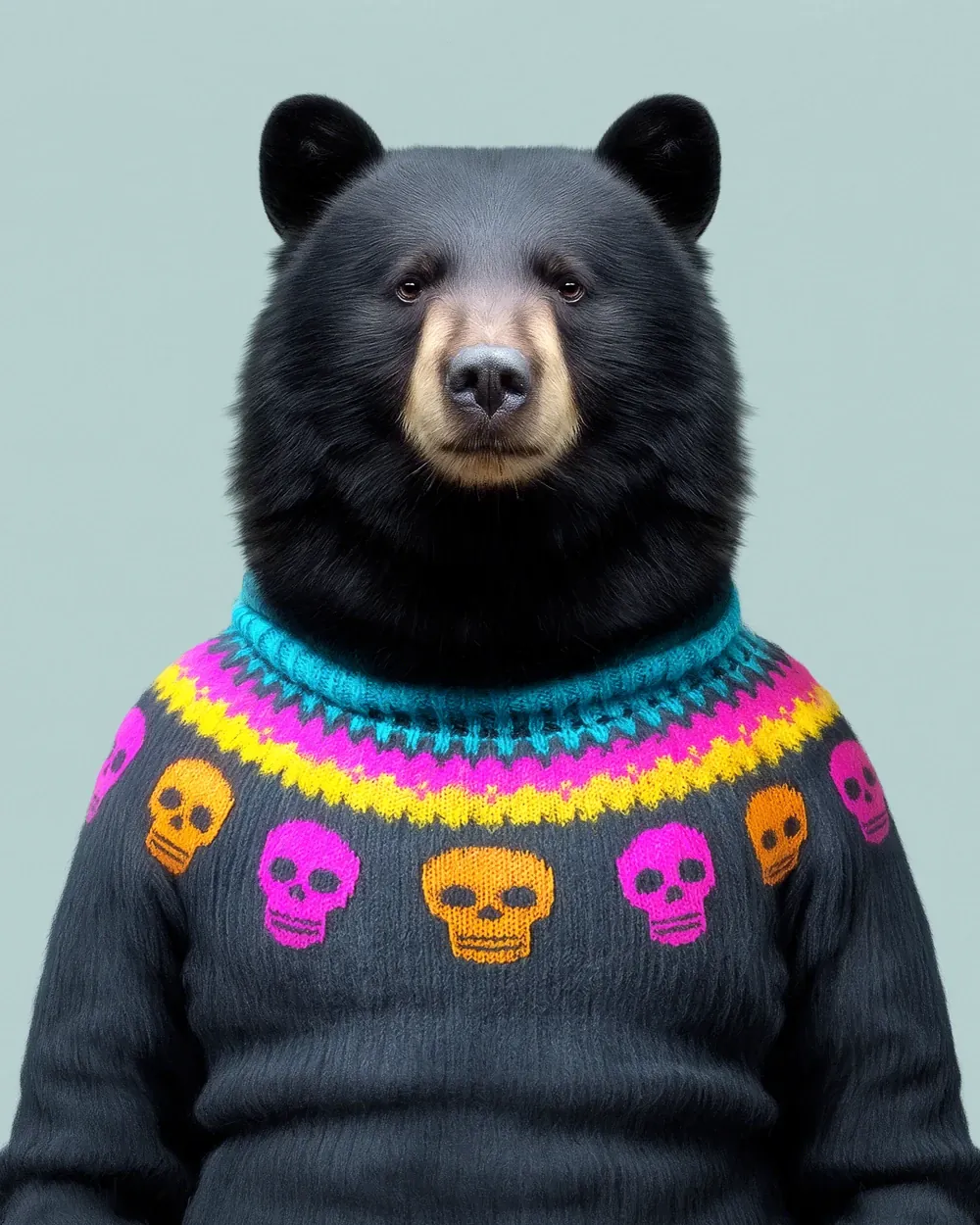
Liam is twenty-eight, twenty-nine. The thick knitted sweater he wears in the portrait — turquoise collar, Fair Isle motifs, skulls in fuchsia and orange on dark grey, handmade, irregular, with that texture that gives away the hands of whoever made it — is the only garment that appears in the photo. It's not known who gave it to him.

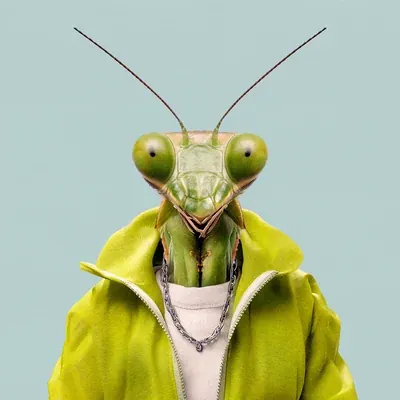
He has friends. He has neighbours. He has customers. He has [Bruno](/animal-kinhood/bruno/), a praying mantis from Marseille whom he met on a craft-fermentation forum and with whom he swaps packets of ingredients and voice notes every two or three weeks. Bruno sent him a field recording from the Marseille market; Liam listens to it while he works. Sometimes he feels Bruno lives more intensely — Marseille, the concerts, the Mediterranean. Bruno thinks the opposite.

What he doesn't have is someone to sit in silence with at the end of the day without it being awkward. Nor certainty that the workshop will keep being his: a certified letter from the owner, a rent review going up, forty percent more. The gentrification of West Asheville has a name and surname and the phone number of a property developer who left a card. Liam folded it and used it to light the stove.

His mother is still working in the Smokies. Liam visits her once a month. Six hours each way. He uses them to think about the things he doesn't know how to say out loud.

He says the brewery's reviews don't bother him, but he reads them every night before bed. He says he's fine alone. But the winter solitude stretches a bit longer every year. And if you asked him what the one object is he'd save in a fire, he'd point to a spiral notebook stained with hops, with every recipe he's made, the failed ones included. He's never rewritten it. He's never lent it.

§ 06 · Connected souls 02 canonical bonds
Animal Kinhood

Connected souls.

§ 07 · Species file Ursus americanus
Ursidae · Carnivora

About the american black bear.

Habitat
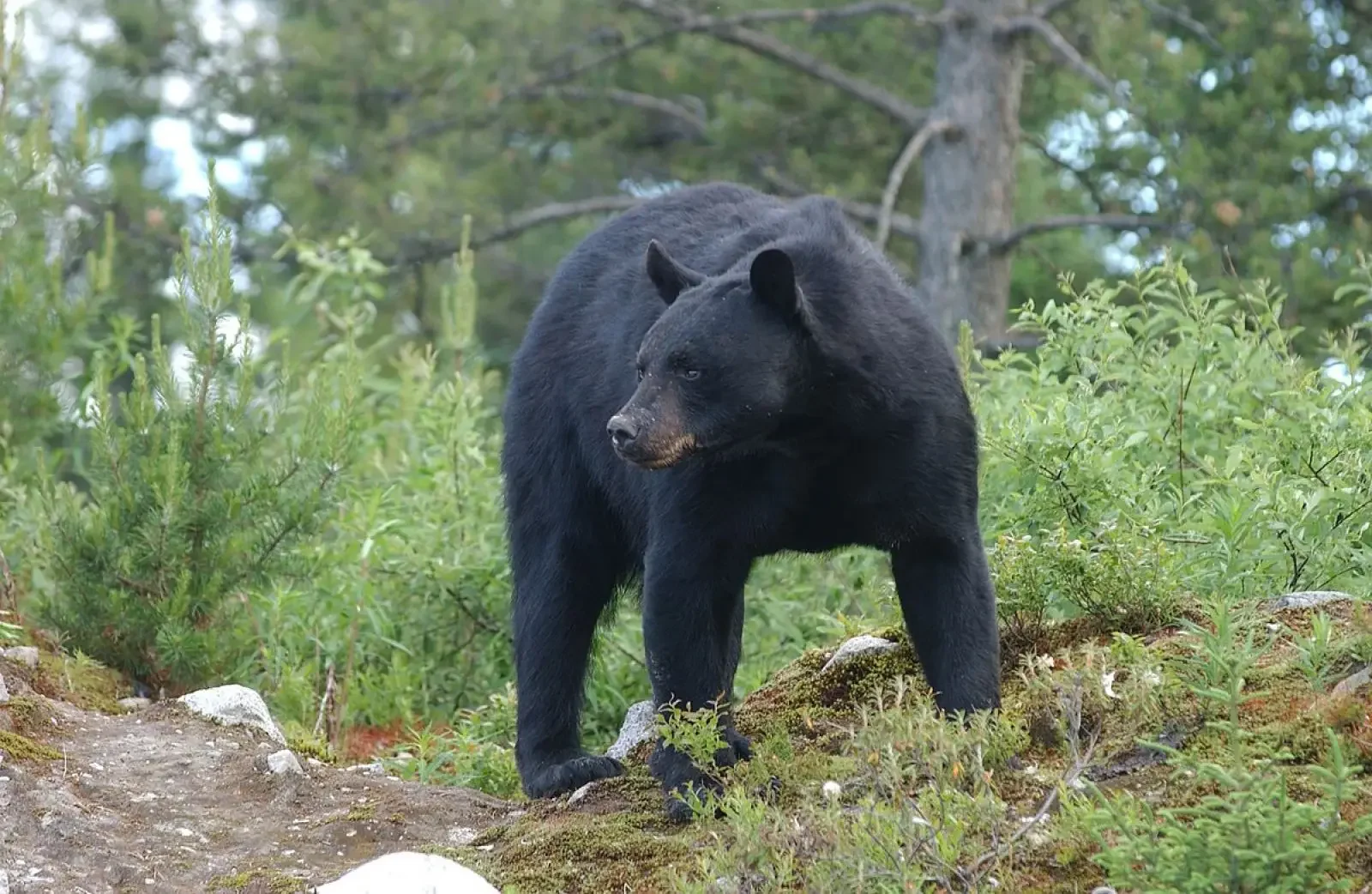
Temperate, boreal and subtropical forests of North America, from Alaska and northern Canada to northern Mexico; especially associated with the southern Appalachians (Blue Ridge, Great Smoky Mountains) and Pisgah National Forest in North Carolina.
Diet
Opportunistic omnivore with 70-85% plant intake (berries, acorns, beech nuts, roots, bark, honey); supplements with insects, larvae, carrion and occasionally fish. In autumn hyperphagia it can eat up to 20,000 kcal daily.
Lifespan
20-25 years in the wild (real average ~10 years due to road and hunting mortality); up to 30 years in captivity.
Weight
60-300 kg in females; 115-270 kg in adult males (males are considerably larger).
Adaptation
Semi-active winter torpor of 3 to 7 months: body temperature drops only from 38 °C to ~31 °C, allowing the bear to wake in the face of threats; females give birth and nurse cubs of barely 300 g during this period without eating or urinating.
Record
The most powerful sense of smell documented in any terrestrial mammal: the nasal mucosa exceeds the human by a factor of about 100 in surface area and can detect odours more than 1.6 km away, according to measurements by the North American Bear Center in Ely, Minnesota.

Main threats

  1. Road collisions: the main non-hunting cause of mortality.
  2. Legal hunting without regulation or with excessive quotas in some states.
  3. Loss and fragmentation of forest habitat from suburban urbanisation.
  4. Human-bear conflict in suburban areas.
  5. Climate change that alters the availability of acorns and berries.
In the early 20th century, unregulated hunting drastically reduced populations; the implementation of controlled hunting seasons from the 1970s-1980s onward and reforestation have allowed the species to recolonise much of its historic range.

Did you know…?

01

Cubs are born during the mother's winter torpor: they weigh barely 300 grams, are blind and hairless, and develop by nursing while she sleeps without having eaten for months. That entire energy — kilos of fat built up in autumn hyperphagia — becomes live cubs without the mother fully waking.

02

The black bear's nasal mucosa exceeds the human by a factor of one hundred in surface area and can detect odours more than 1.6 kilometres away, making it the terrestrial mammal with the most powerful documented sense of smell. A nose like that distinguishes varieties of wild honey, fermentation stages of fruits or human presence days later.

03

Studies published in Animal Cognition show that the American black bear has numerical discrimination comparable to that of great apes: it can visually distinguish between groups of objects of different size to assess which food patch is more abundant.

04

One in ten black bears of the Great Bear Rainforest is born white because of a recessive gene: it is the Kermode subspecies, called moksgm'ol (white bear) in Tsimshian. White bears catch salmon 35% more efficiently than black ones by day.

05

Black bears moved more than 200 kilometres from their original territory have managed to return to it, overcoming barriers like roads or mountains, by orientation mechanisms not yet fully understood.

06

'Black bear' is a misleading name: the species shows colour phases including cinnamon brown, chocolate, blonde, slate blue (glacier phase) and pure white (Kermode phase). In states like Colorado or Montana, more than 50% are actually brown or cinnamon.

§ 08 · Conservation four programs · verified
American black bear

Help protect this species.

Every purchase helps, but a direct donation does more. Four NGOs with specific programs verified for this species.

No. 01 / 04

NABC.

North American Bear Center

The only educational centre specialising in black bears of North America, located in Ely, Minnesota; replaces myths about the black bear's dangerousness with verified scientific data.

Donate to NABC
No. 02 / 04

IBA.

International Association for Bear Research and Management

Professional non-profit society with ~500 members in more than 40 countries; publishes the scientific journal Ursus and organises international conferences on the eight bear species.

Donate to IBA
No. 03 / 04

BearWise.

BearWise Program

Programme backed by state wildlife agencies; works with communities, homeowners and businesses to reduce human-bear conflict through practical education.

Donate to BearWise
No. 04 / 04

ABA.

American Bear Association

Non-profit that manages the Vince Shute Wildlife Sanctuary in Orr, Minnesota, a free-access sanctuary for wild black bears.

Donate to ABA
Animal Kinhood · 19 characters

Nineteen names. Nineteen stories. Nineteen personalities. One same project.

Full catalogue · Drop 01 — Q3 2026 Explore Animal Kinhood