Animal Kinhood Wild animals Least Concern
12 min read 8 chapters
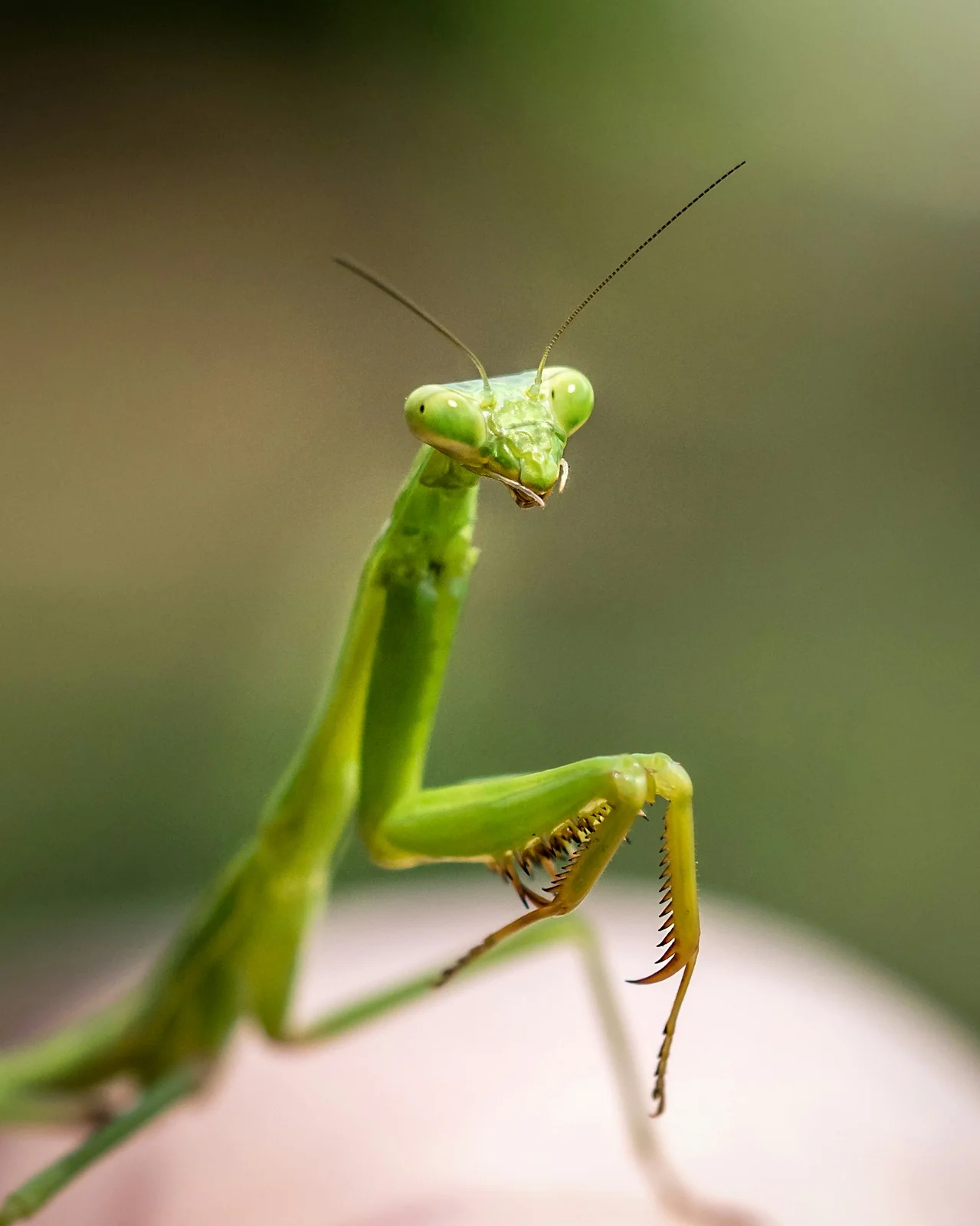
Bruno · Praying mantis AK · 05 Bruno PHOTO ©YP · 2025
Animal Kinhood · Wild animals No. 05 / 19 Episode · Bruno
Mantis religiosa

Bruno.

Praying mantis

Prey doesn't see what's still. My whole technique is not moving before.
Add it to your Kinhood.Already part of your Kinhood.
Biography · Block 01 of 03 Praying mantis
Chapters · I–II

The story.

I
CH · 01 / 08

The neighbour's headphones

To explain how Bruno ended up behind a mixing desk in Marseille you have to go back to an apartment block on the outskirts of Montpellier, to a third-floor flat where a neighbour who'd been a DJ used to live. Bruno was fourteen. He heard music through the ceiling — not the song, but a vibration that came down the pipes and walls as if the whole building were breathing. One day he went up and knocked. The neighbour lent him a pair of Sennheiser HD 25s, the same ones serious DJs use, and Bruno put them on and listened to the same song he'd been hearing through the concrete for weeks.

It was another thing entirely. Not the melody — the space. The distance between the kick drum and the voice. The air inside the mix.

From that day on he stopped listening to songs and started listening to sounds. The neighbour moved away. Bruno never returned the headphones. They hang from a nail next to the door of his flat in Marseille. They don't sound good anymore, but they're still there.

Before that, Bruno was already Bruno. As a kid he was the one who stayed still in the playground watching insects while the others played football. Teachers described him as "very quiet, maybe too much". He wasn't an outcast — he just didn't join in. At eight he discovered that if he stayed absolutely still in his grandmother's garden, lizards would climb onto his feet. Forty minutes without moving (he says an hour, he's probably exaggerating). Understanding that stillness isn't passivity, but a way of letting the world come closer. That was the first important moment.

His father left when he was four. No explanation, no drama. One day he was there and the next he wasn't. His mother, a primary school teacher, didn't talk about it. Bruno didn't ask. There's a void there, and Bruno handles it the way he handles all voids: he doesn't fill it, he doesn't chase it.

II
CH · 02 / 08

Montpellier to Marseille

In secondary school he got mediocre grades in everything except physics and music. Tens in music without studying. Barely scraping passes in everything else. A technology teacher let him use the assembly hall's sound equipment for an end-of-year festival. Bruno spent three weeks putting up cardboard and fabric to control the reverb of a room that normally sounded like a cave. He calibrated the speakers with a borrowed microphone and free software. The festival sounded decent for the first time in the school's history.

No one congratulated him publicly. The teacher told him in private: "You have an ear. Do something with it."

At eighteen, instead of going to university, he took a train to Marseille with a rucksack and the address of a recording studio looking for an assistant. They paid him the minimum to carry equipment, roll up cables and serve coffee. He didn't care. The studio was his school.

In those first months he ate bread and cheese on a bench in the Plaine because he couldn't afford more. In two years he went from roadie to sound assistant. At twenty-one he did his first FOH mix at Le Molotov, a two-hundred-person venue. The band was terrible. The sound was correct. Bruno knew this was his thing: not because of the music or the venue, but because of the problem. Making a space sound the way it should sound.

He moved into a twenty-eight-square-metre studio in Cours Julien with three-and-a-half-metre ceilings — a former sewing workshop converted — and he's still there. The walls are light green. When he sits on the balcony in his lime-green jacket, the neighbours can't tell him apart from the foliage.

Voiceline · the character’s canonical quote Bruno · Praying mantis
Hover to pause
Prey doesn't see what's still. My whole technique is not moving before. AK · 05 · Bruno Prey doesn't see what's still. My whole technique is not moving before. Voiceline · Mantis religiosa Prey doesn't see what's still. My whole technique is not moving before. AK · 05 · Bruno Prey doesn't see what's still. My whole technique is not moving before. AK · 05 · Bruno Prey doesn't see what's still. My whole technique is not moving before. Voiceline · Mantis religiosa Prey doesn't see what's still. My whole technique is not moving before. AK · 05 · Bruno
§ 04 · Objects Open editions · everyday
10 pieces · Print on demand

Take Bruno home.

Biography · Block 02 of 03 Roots
Chapters · III–IV

The roots.

III
CH · 03 / 08

The night in Arles

Until he was twenty-three, Bruno said yes to everything. Any gig, any venue, any band. That's how the intermittent du spectacle system worked — the French regime for performing-arts workers: you accumulate hours, you get paid. If you don't accumulate, you don't get paid.

Then came Arles. Les Suds festival, open-air concert, three thousand people. Bruno was on FOH. Halfway through the headliner's set, a gust of mistral knocked down a side speaker tower. The left-hand sound system ceased to exist. Three thousand people, half without sound. Bruno had two options: stop the concert or reroute all the audio to the intact side in less than two minutes.

He did it. It wasn't perfect — the left side could barely hear — but the concert ended.

Afterwards, the production director told him he'd saved the show. Bruno didn't answer. He went to the car park, sat on the bonnet of a van and spent forty minutes looking at the stars. Was that the first time he understood that his work mattered beyond making things sound good? Maybe.

It was also the first time he spent three days unable to listen to music. Earplugs in even for sleeping. Sensory exhaustion, they call it. Bruno learned that his capacity has limits. Since then he picks. Venues with good baseline acoustics, bands that respect the soundcheck, promoters who pay on time. He got a reputation for being difficult in a sector where technicians say yes to everything. He didn't care.

IV
CH · 04 / 08

The chain and the map

There are two objects in Bruno's life that say more than he ever would. The first is a medium-link chain, matte silver, that he has worn around his neck since he was twenty-four. It was a section of chain from a broken flight case. Marc, a veteran sixty-year-old roadie, gave it to him on his retirement night at L'Affranchi. "So you don't forget where you came from." Bruno put it on and hasn't taken it off.

He never tells the story. When someone asks about the chain, he changes the subject.

The second is a map of Marseille taped to his bathroom wall, marked with red dots. They're his favourite recording spots. Because Bruno, besides mixing concerts, records sounds. He goes out with a Zoom H5 recorder and an omnidirectional microphone, almost always at night, and captures whatever he finds: a skip closing abruptly near the port, the seagulls at three in the morning, a group of young people laughing in Arabic at the end of a Noailles street, the mistral wind against the harbour antennas.

He doesn't publish anything. He's been recording for three years and hasn't shared a single file. He says they're not ready, but they haven't been ready for three years. His favourite is a forty-minute recording of the mistral on the Pharo dyke: wind against boat masts, a tin rolling along the quay. He listens to it when he needs to recalibrate.

Biography · Block 03 of 03 Craft
Chapters · V–VI–VII–VIII

The present.

V
CH · 05 / 08

Cours Julien at eleven in the morning

Bruno's routine is that of someone who works better when the sun goes down. He wakes around eleven. Coffee — the first of three, always black, always in a small cup. He goes out to buy something for lunch at the Noailles market, a fifteen-minute walk: vegetables, fruit, chicken. Always the same stall, an Algerian greengrocer who keeps the big aubergines for him because she knows he cooks tajine. They never exchange more than three sentences.

He comes back, eats little, checks equipment, cleans cables. At five he heads out to the gig if there is one. Soundcheck from six to eight. Quick dinner — kebab, falafel, something from the market he can eat walking. Concert from nine to midnight. Pack-up until one or two. Walks home. Records something if he feels like it. Asleep by three or four.

If he doesn't have a gig, at six in the evening he goes down to the Tunisian bar below his flat. The owner brings him mint tea without asking. They've never formally introduced themselves. Bruno drinks the tea — or a pastis, depending on the day — listens to the conversations around him and leaves. He never stays more than forty minutes.

On Sundays he doesn't work. He stays home, cooks something slow — tajine, ratatouille, something that takes more than an hour of low heat — and reads about acoustics or about insects. His other topic, since childhood.

VI
CH · 06 / 08

Winter

There's one thing Bruno won't admit: that the cold affects him. Below twelve degrees his body slows, he loses concentration, his fingers go clumsy. The heating in his flat is always at twenty-four degrees. In January, with the icy mistral, he arrives at a soundcheck with his hands so cold he can't turn the knobs. He puts them in his pockets for five minutes. Someone offers him gloves. He refuses: he can't feel the frequencies with gloves on.

He waits.

The winter months are his worst. He sleeps more, goes out less, cancels plans. He cooks more — it's his way of inhabiting dead time. In summer he's another person: windows open, Mediterranean festivals (Barcelona, Cádiz, Thessaloniki), long rides along the corniche at eleven at night. The smell of salt rising from the old port, which at that hour smells different than by day.

In his flat there are three stacked flight cases he uses as a coffee table. Inside: cables, adapters, gaffer tape. A glass jar full of guitar picks that musicians have forgotten on his desks over the years. He doesn't collect. He just doesn't throw them out. The mattress is on the floor, in the darkest corner.

VII
CH · 07 / 08

The sound of water against stone

Bruno lives alone. He hasn't had a flatmate since he could afford not to. He's had two relationships — six months one, eight the other — and both ended for the same reason: he can't be with someone all the time. He doesn't say it with drama. He says it the way someone describes the weather. If someone stays over, they sleep on the sofa. The bed is his. The bathroom is his. If someone gets emotionally close too fast, Bruno doesn't confront: he evaporates.

One night, after a concert, a musician told him she liked him. Bruno stood still for three seconds, said "thank you" with complete sincerity and went off to pack cables.

But he isn't entirely alone. There's a stray cat that sleeps in his doorway. Bruno leaves food for her but doesn't touch her. The cat doesn't come close. Coexistence without contact. And there's a retired neighbour on the first floor who waters the courtyard plants at seven in the morning. Bruno hears him every day. They've never spoken. But if one day he doesn't hear the water, he worries.

And there's [Alek](/animal-kinhood/alek/). They met at a music festival in Bilbao. Bruno was recording the harbour before dawn and Alek was on watch on a dock. Alek asked him what he was recording. "The water against the hull of your boat." They kept talking until five in the morning. Since then they send each other voice messages every two or three weeks. Alek sends him audio of the port of Reykjavík — cranes, wind, seagulls. Bruno sends him pieces of concerts or of the mistral. Sometimes Bruno takes days to reply and Alek wonders if he cares.

He does. It's just that replying requires social energy he doesn't always have.

His mother calls once a month from Montpellier. The conversations are identical every time. "Have you been out with anyone?" "No." "Have you done anything fun?" "I recorded the wind against the port." Silence.

VIII
CH · 08 / 08

The empty room

What gives him energy is this: an empty room with good acoustics. The moment just before a concert starts, when everything is calibrated and the audience hasn't come in yet. That silence isn't empty — it's full of possibility. The first coffee of the day. Walking alone along the corniche at night.

What drains him: people who talk without saying anything. Anyone touching his equipment.

When something is wrong, Bruno goes stiller than usual. His head stops turning. His hands drop to his sides.

He does between fifteen and twenty concerts a month in high season, five to eight in winter. Le Molotov, Espace Julien, L'Affranchi, some rotation at MUCEM. In the same week he can mix an Algerian oud trio on Monday, hardcore punk on Wednesday and an industrial techno DJ set on Saturday. If you ask him which he liked most: "The one that sounded best."

There's a young technician who follows him to the gigs. He wants to learn. Bruno lets him stand next to the desk but doesn't explain anything. "Watch and listen." And there's a stage manager at Le Molotov with whom he communicates only with gestures during concerts. Outside work they don't see each other.

Bruno detects things others don't detect. Backstage, he can tell that a guitarist is tuning half a tone flat from ten metres away. He walks over and whispers: "The third string." At a night festival he stops a concert because he's heard a high-voltage cable rubbing against the stage's metal structure through eighty decibels of music. He uses selective earplugs outside work, and wakes up if something changes in the street's nocturnal noise pattern.

There's a sound Bruno can't name. The sound of water against stone. He discovered it in the Calanques one summer day when he went alone — an hour on the bus, a hike down to a cove, sitting on the rocks with the recorder on. It isn't that he likes it. It's that it produces an emotion he has no word for.

That, and the fact that if he had to leave Marseille, he would lose more than he admits.

> **Canonical quote:** If the female has already eaten, the male walks away alive. The cannibalism myth comes from labs without a forest.

§ 06 · Connected souls 01 canonical bonds
Animal Kinhood

Connected souls.

§ 07 · Species file Mantis religiosa
Mantidae · Mantodea

About the praying mantis.

Habitat
Meadows, Mediterranean scrubland, field edges and sunny peri-urban zones from southern Europe to northern Africa and western Asia; successfully introduced to North America since 1899.
Diet
Generalist ambush predator: stays motionless until prey enters range and captures it with its raptorial forelegs in a strike of between 50 and 70 milliseconds.
Lifespan
In the wild, 6-12 months as an adult; eggs in the ootheca overwinter and hatch in spring.
Weight
Between 1.5 and 5 g depending on sex; body length 5 to 7.5 cm. Females are notably larger than males.
Adaptation
Three-dimensional stereoscopic vision unique among insects, confirmed in 2018 by the University of Newcastle; the head rotates 180°, unique among all known insects.
Record
In Liske and Davis's (1987) field study published in Animal Behaviour, sexual cannibalism was recorded in 31% of matings observed in natural conditions in Europe.

Main threats

  1. Massive use of pesticides and insecticides in intensive agriculture.
  2. Loss and fragmentation of open habitats due to urban expansion and industrial agriculture.
  3. Nocturnal light pollution that disrupts male reproductive behaviour.
  4. Climate change and extreme drought events that reduce prey availability.

Did you know…?

01

Sexual cannibalism in the mantis occurs in only 13-31% of wild matings. Old studies were done in labs with hungry females, which inflated the rate. In the field, when the female has eaten well, males escape intact.

02

All vertebrates calculate distances with both eyes, but no other insect does. In 2018, researchers at the University of Newcastle stuck tiny 3D cinema glasses onto live mantises and confirmed that they do see in three dimensions, though they only process moving objects in 3D, not static scenes.

03

The praying mantis is the only known insect capable of turning its head 180 degrees independently of the rest of the body. This mobility lets it track moving prey while staying absolutely still, without giving away its position.

04

The nematomorph Chordodes parasitises mantises and grows inside them for months. When it reaches maturity, it manipulates the host's nervous system and compels it to seek water and throw itself in, completing the parasite's aquatic cycle.

05

The mantis has two large compound eyes plus three simple ocelli between its antennae. It also has a single auditory organ in the centre of the thorax capable of detecting the ultrasounds emitted by bats, its main nocturnal predator.

06

The female lays between 100 and 300 eggs encased in a protein foam that hardens on contact with air. This structure withstands frosts down to -15 °C and heavy rain.

§ 08 · Conservation three programs · verified
Praying mantis

Help protect this species.

Every purchase helps, but a direct donation does more. Three NGOs with specific programs verified for this species.

No. 01 / 03

Buglife.

Buglife — The Invertebrate Conservation Trust

British NGO dedicated exclusively to invertebrate conservation; works on the creation and restoration of pollinator habitats and runs the B-Lines network of habitat corridors.

Donate to Buglife
No. 02 / 03

RE.

Rewilding Europe

European organisation restoring degraded landscapes in eleven areas of the continent; its work in the Mediterranean basin expands the open habitats the mantis needs to reproduce.

Donate to RE
No. 03 / 03

SEO/BirdLife.

SEO/BirdLife — Sociedad Española de Ornitología

Its conservation programmes for grasslands and steppe areas of the Spanish Mediterranean maintain the open ecosystems where the praying mantis reaches its highest densities.

Donate to SEO/BirdLife
Animal Kinhood · 19 characters

Nineteen names. Nineteen stories. Nineteen personalities. One same project.

Full catalogue · Drop 01 — Q3 2026 Explore Animal Kinhood