Animal Kinhood Wild animals Vulnerable
12 min read 9 chapters
Alek · Atlantic puffin AK · 02 Alek PHOTO ©YP · 2025
Animal Kinhood · Wild animals No. 02 / 19 Episode · Alek
Fratercula arctica

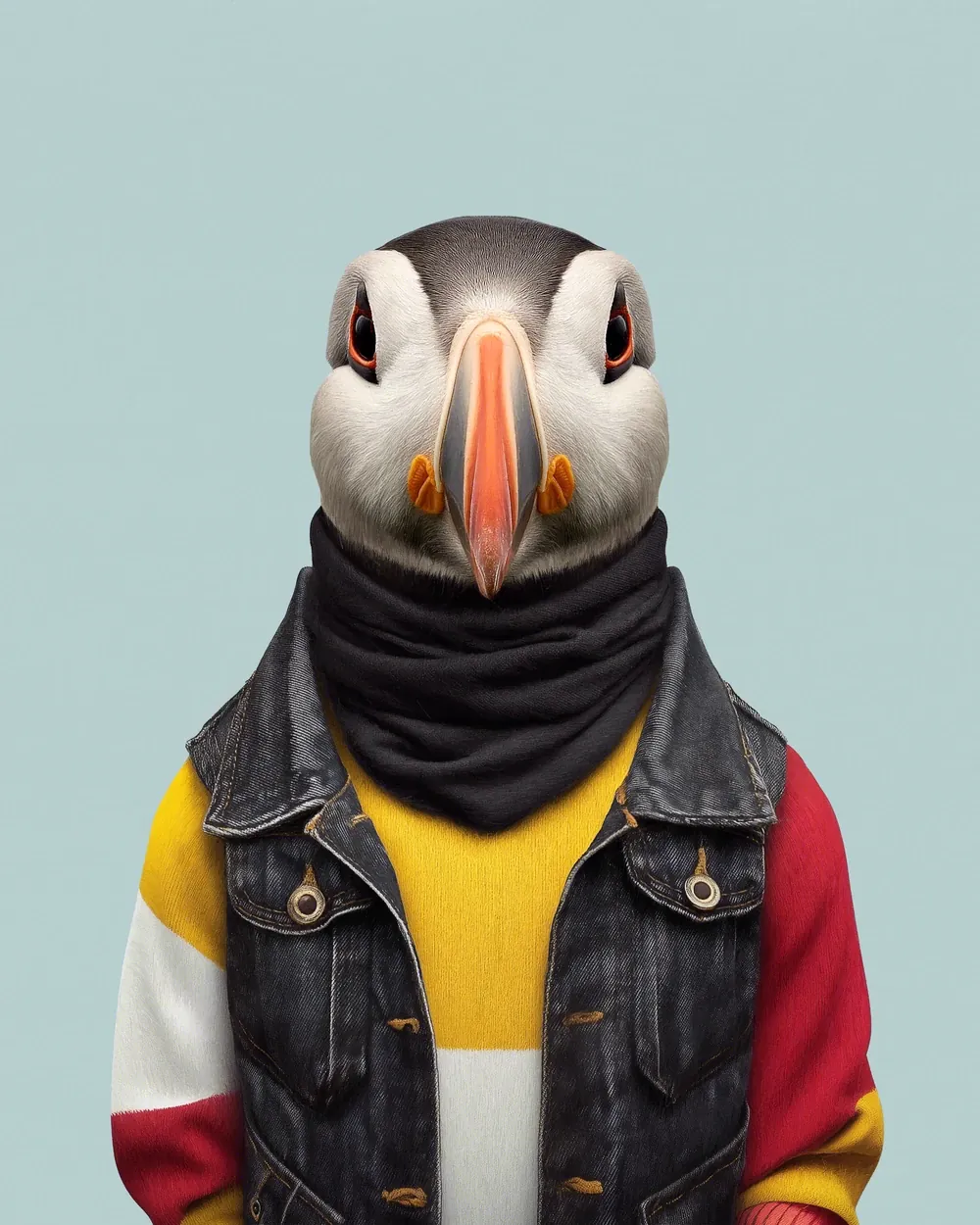
Alek.

Atlantic puffin

The lights of my town send the pufflings off course. A cardboard box fixes it.
Add it to your Kinhood.Already part of your Kinhood.
Biography · Block 01 of 03 Atlantic puffin
Chapters · I–II–III

The story.

I
CH · 01 / 09

The Saturday engine

Alek, atlantic puffin, has had his hands inside a 25-horsepower Yamaha engine since quarter past seven in the morning. It's Saturday. The Grandi workshop doesn't open on Saturdays, but the fisherman who brought the boat in yesterday needs to be out on Monday and the problem is in the electrical system. Alek didn't say he'd come. He came.

The workshop smells of two-stroke oil and cold coffee. Outside, the north wind pushes salt spray through the gap under the quay door. Alek has his black scarf pulled up to his nose, not because of the cold but because when he concentrates he finds the air on his face distracting. It's a gesture his workshop mates know well: scarf up, don't talk to me.

He finds the fault at ten to nine. A stripped cable behind the instrument panel, in a spot no one looks because you have to remove three screws and a bracket to get there. The cable hasn't broken: it has worn through from rubbing against a badly placed washer. Probably been like that for months. Alek strips the end, splices, insulates with vinyl tape and puts the bracket back. He tests the circuit. It works. He writes nothing down.

He takes off the scarf, sits on the stool by the entrance and looks at his right hand. The burn scar is still there, white and irregular, from thumb to wrist. Six years ago, at this same bench, a short-circuit taught him that stripped cables don't warn you.

II
CH · 02 / 09

Heimaey, island of the pufflings

Alek grew up on Heimaey. If you haven't heard of Heimaey, it's an island of four thousand five hundred people off the south coast of Iceland, with a volcano that half-buried it in 1973 and cliffs where eight hundred thousand pairs of Atlantic puffins nest every summer. The largest colony in the world. The puffins are literally on top of the town.

His father fished cod. His mother worked in the care home. His brother, two years older, talked for both of them. Alek collected things from the harbour — bits of rope, broken connectors, bronze nuts — and lined them up on the floor of his room as if they were parts of an engine that didn't exist yet.

In August, like all the kids on the island, he went out at night to do the Puffling Patrol. Puffin chicks leave the burrow for the first time on their own, in the dark, guided by the reflection of the moon on the sea. The town's lights disorient them and they end up in the streets, the gardens, under cars. The children of Heimaey collect them in cardboard boxes, take them to the aquarium to weigh them, and the next day throw them from the cliffs into the water. Slyngja lunda, they call it. Throwing the puffin. It isn't cruelty: it's the only way to give them enough momentum to fly, because from flat ground they can't take off. Their wings are too short.

Alek did it with the same seriousness his father put into tying knots. Without talking much, without celebrating each rescued chick, but without skipping a single August night. At ten years old, his father taught him how to tie mooring knots on the dock. He learned six in one afternoon. Never had to be corrected on a single one.

III
CH · 03 / 09

The eight-thirty ferry

At seventeen he left on the Herjólfur, the ferry that connects Heimaey with the mainland. Thirty-five minutes to Landeyjahöfn. His brother was already in Reykjavík studying something in computing. His father had worked a season out of that port. It wasn't dramatic. But leaving an island of four thousand five hundred people carries a weight that leaving a city doesn't. There's no road back. There's a boat.

He got a job as an assistant in a boat-maintenance workshop in Grandi, the old port of Reykjavík. Grandi was in full transformation: the fish warehouses were turning into galleries and cafés, but the small-scale fishermen still needed someone to fix their engines without overcharging them. The old man's workshop — that's what everyone calls him, though he has a name and is sixty-eight — survived on that.

Alek fitted in. Quick hands, shut mouth, on time. The first month he slept on his brother's sofa. The second he found a semi-basement in Vesturbær, eight minutes on foot from the workshop. One room, kitchen-living room, bathroom. Small windows, low ceiling. He chose it for exactly that reason.

Voiceline · the character’s canonical quote Alek · Atlantic puffin
Hover to pause
The lights of my town send the pufflings off course. A cardboard box fixes it. AK · 02 · Alek The lights of my town send the pufflings off course. A cardboard box fixes it. Voiceline · Fratercula arctica The lights of my town send the pufflings off course. A cardboard box fixes it. AK · 02 · Alek The lights of my town send the pufflings off course. A cardboard box fixes it. AK · 02 · Alek The lights of my town send the pufflings off course. A cardboard box fixes it. Voiceline · Fratercula arctica The lights of my town send the pufflings off course. A cardboard box fixes it. AK · 02 · Alek
§ 04 · Objects Open editions · everyday
10 pieces · Print on demand

Take Alek home.

Biography · Block 02 of 03 Roots
Chapters · IV–V–VI

The roots.

IV
CH · 04 / 09

What a burn teaches you

At nineteen, the short-circuit. A Saturday in January, repairing a boat's electrical system. The arc caught his right hand before he could pull it away. Second-degree, thumb to wrist. He didn't shout. He wrapped his hand with the black scarf he wore around his neck, closed the electrical panel with his left hand and walked to the hospital.

Six weeks unable to work with his right hand. Alek went to the workshop every day. He sat down. He watched. He observed what shortcuts the others took, where they lost time, which tools were in the wrong place, which gestures were unnecessary. When his hand healed, he reorganised the entire workshop without asking anyone. Moved the welding bench, rearranged the tool panels, changed the order of the shelves. No one protested because everything was better.

The old man told him: "I knew if you sat down and watched, this would happen." He raised his wages.

The scar doesn't hurt. He looks at it when he thinks. Sometimes in the middle of a conversation, sometimes alone. It's his internal clock: it reminds him that things break without warning and that what looks like it's working may be rubbing against a stripped cable on the inside.

V
CH · 05 / 09

Grandi in July, Grandi in January

Alek's workshop repairs hulls, outboard engines and electrical systems on small boats and artisanal fishing vessels. It isn't a shipyard. They don't work on large boats. Three people in summer, two in winter. The space smells of petrol, fibreglass resin and the coffee Alek puts on at quarter to seven, before anyone else arrives.

In July, Grandi is another thing. Tourists walk along the dock with ice creams. The art galleries stay open until ten. The sun doesn't set. Alek works nine hours, eats a sandwich on the dock watching the cruise ships manoeuvre in the new harbour, and then goes to the Vesturbæjarlaug pool, five minutes on foot. He doesn't go to swim. He goes to the hot pot. Always the one in the left corner, where he overlaps with a retired electrician who doesn't ask him about work and a woman who works in a bookshop and reads on the edge of the tub. They talk about the weather. The price of lamb. Whether the summer is being long or short. There, in the hot water, Alek talks more than in the whole rest of the day.

In January it's different. The workshop closes at three because there's no light. Alek has four dead hours before he goes to sleep and doesn't know what to do with them. He cooks slow things — lamb stew, plokkfiskur — and listens to the marine VHF frequency even when he isn't on watch. He reads Yamaha and Mercury parts catalogues. He doesn't turn on the television. It isn't that he's sad: it's that he runs on a different regime. Slower, denser, quieter. In March, when the days lengthen and the first boat of the season enters Grandi for a hull check, something switches back on.

VI
CH · 06 / 09

An engine on the living room table

At Alek's place there's an outboard engine dismantled on top of the living room table. Has been there for months. It's a personal project — an old Yamaha he found in a dumpster at the harbour — and he's missing two parts he could order but doesn't. Finishing it would mean he has no excuse to keep it there. And having it there gives him something to do when he doesn't want to think.

The flat is like him: functional, compact, unornamented. Heating at a minimum, kitchen window left ajar even when it's ten below. Blackout curtains. A steel thermos on the countertop that he takes to the workshop every morning. Three pairs of work gloves by the door, of three different thicknesses. A photo of Heimaey taped to the fridge — the only personal image visible.

In the bedroom drawer there's a plastic bag with six rope knots. His father gave them to him last Christmas. He hasn't undone them.

That Christmas, Alek took the ferry to spend three days in Heimaey. His father was sitting in the kitchen at ten in the morning with nothing to do. Retired. Alek recognised the posture: the same one he has when the workshop closes because of a storm. He pulled out the toolbox and told his father the tap was dripping. It wasn't. They spent the morning taking it apart and putting it back together. When Alek left, his father put the bag of knots into his rucksack. Without saying anything. The knots are still there.

Lately his mother sends photos of the flat with short messages. His father forgets things. It isn't serious yet. But the ferry leaves every day. Alek knows.

Biography · Block 03 of 03 Craft
Chapters · VII–VIII–IX

The present.

VII
CH · 07 / 09

[Otto](/animal-kinhood/otto/) and the Norwegian cargo ship

Otto arrived by accident, like everything that matters to Alek. A Norwegian cargo ship docked at Grandi with a broken bow thruster. Alek went down to the quay to take a look. There was a short blonde guy smoking by the loading ramp, staring at the water as if it had something to say to him.

Otto worked at a fish-processing plant in Tromsø. He'd travelled on the cargo ship to accompany a shipment. Alek asked him if he knew anything about engines. Otto said no, but that he wanted to see how it was opened up. He stayed two hours watching without saying anything technically useful. But he made an observation about the sound the shaft made when it turned — something about the frequency of the knocking — that struck Alek as exact. That night they ended up in the same bar on the dock without planning to.

Otto talks more. Quite a bit more. He sends WhatsApp voice messages about the cold in Tromsø, about a seal he saw on the dock, about the plant's refrigeration system that won't leave him alone. Alek listens to them all. Replies to one in every three. They see each other every six or eight months — either Alek goes down on a cargo ship, or Otto comes up when there's something to see in Reykjavík. When they meet, they pick up where they left off. No need to catch up.

They haven't seen each other in eleven months. Otto's last audio said: "Waiting for you here, bastard." Alek smiled. He didn't reply.

VIII
CH · 08 / 09

The offer and the van

The old man of the workshop wants to retire. He's said it twice now: that he'd like Alek to take over the business. The second time he said it while Alek was leaving a coffee on the table, as he does every morning without anyone asking. Alek nodded and kept walking.

He hasn't said no. He hasn't said yes either. Running a workshop is invoices, clients, phone. It's deciding things that aren't screws. Alek can repair any engine you put in front of him, but he doesn't know if he knows how to be a boss. And he doesn't know if he wants to.

There's one thing he does when he can't sleep or when the workshop question takes up too much space. He gets into the van — a 2008 Toyota HiAce with rust on the underside — and drives north on Route 1 to Hvalfjörður, the whale fjord. He always turns around at the same point: a curve where the fjord narrows and the asphalt gets so close to the water it looks like you're going to drive into it. He never reaches the end. He turns back. An hour there and back, with the VHF on and the volume low.

He doesn't know what's at the bottom of Hvalfjörður. Maybe he doesn't want to know. Maybe what he needs is the route, not the destination.

IX
CH · 09 / 09

What you don't see

Alek repairs things. It's what he does best and it's almost all he does. The engines that come to him leave the workshop working. The boats he checks don't give trouble. The Yamaha fisherman, whose same fault he's fixed three times, no longer pays the third time. He leaves fish at the workshop door.

What you don't see is the other stuff. That he arrives before anyone else and has the tools laid out. That he remembers which engine gives trouble to whom. That when a colleague is having a bad day, Alek doesn't ask what's wrong: he leaves the coffee thermos on the bench and keeps working. That in August, if he looks toward the cliffs behind Grandi — smaller than those on Heimaey, no puffins, no chicks to rescue — he stops for a second before going into the workshop.

In Heimaey, puffins' beaks glow under a light that humans can't see. Ultraviolet. They've been communicating for millions of years with a signal no one else detects. Scientists didn't discover it until 2018, by accident, with a torch they'd switched on for another reason.

Alek doesn't know that. But if he did know, he'd probably say "já, já" and carry on with the engine.

§ 06 · Connected souls 01 canonical bonds
Animal Kinhood

Connected souls.

§ 07 · Species file Fratercula arctica
Alcidae · Charadriiformes

About the atlantic puffin.

Habitat
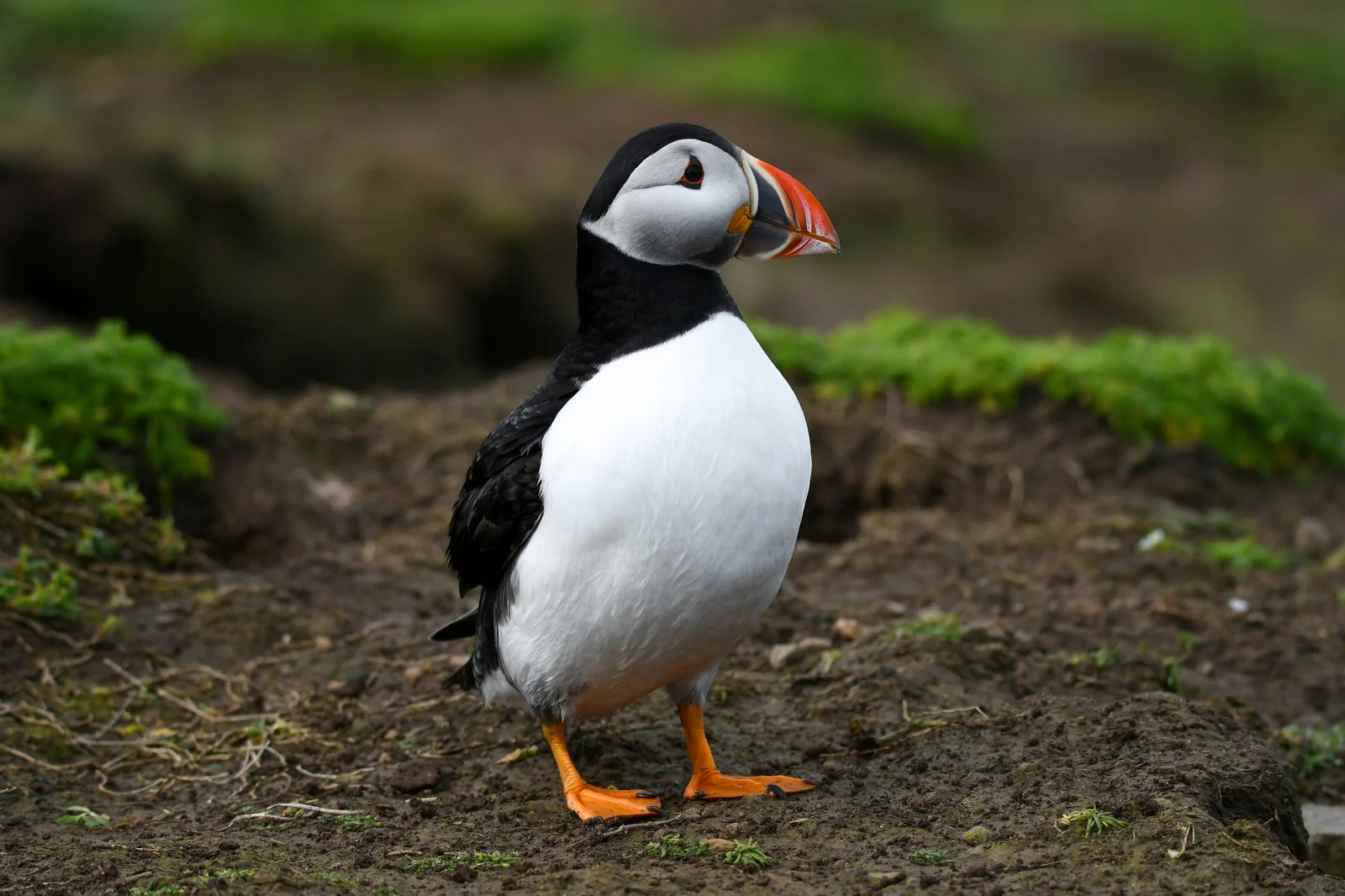
Open North Atlantic sea during the non-breeding months, where it lives as a solitary pelagic far from any coast; in summer, coastal cliffs with diggable soil for breeding, mainly in Iceland (60% of the world population) and in the Vestmannaeyjar archipelago, where the Heimaey colony holds around 830,000 pairs, the largest in the world.
Diet
Piscivore specialised in sandeels (Ammodytes), capelin (Mallotus villosus) and herring (Clupea harengus); hunts in underwater flight, propelling itself with its wings and using its feet as a rudder.
Lifespan
20-25 years in the wild; up to 36 years documented in marked wild individuals.
Weight
310-550 g, with a length of 28-34 cm and a wingspan of 50-60 cm; no marked sexual size dimorphism.
Adaptation
The wings serve a double function — aerial flight and underwater propulsion —, which demands a biomechanical compromise: in the air they must beat up to 400 times per minute, while in the water they reach 60 m depth with great efficiency.
Record
62 sandeels carried simultaneously in the beak, recorded by RSPB researchers at the Skomer colony (Wales); the longest-lived individual known was ringed on Skomer in 1974 and tracked until 2016.

Main threats

  1. Prey scarcity from overfishing and the collapse of sandeel and herring fisheries.
  2. Climate change that pushes fish shoals out of reach of adults during the breeding season.
  3. Accidental capture in longlines and gillnets.
  4. Plastic pollution and oil spills.
Project Puffin restored the species on five islands in the Gulf of Maine between 1973 and the 2000s; since 2021 only a quarter of pufflings survive in those colonies.

Did you know…?

01

Every autumn, the puffin sheds the showy keratinous plates of its beak — those orange and red laminae that make it unmistakable — and emerges with a small grey beak, unrecognisable. The animal hasn't changed species: it has just switched off its courtship signal until the next spring.

02

The yellow ridges on the puffin's beak fluoresce under ultraviolet light, something puffins themselves perceive because their vision reaches into the UV spectrum. Humans need a special torch to see it; they use it as a signal of breeding quality.

03

Once a year, the puffin sheds all its flight feathers simultaneously and becomes unable to fly for up to 77 days. It doesn't land on any cliff: it waits afloat on the open sea, invisible and vulnerable.

04

Puffins keep the same cavity dug into the ground year after year, sometimes for decades, with a fidelity of 85-93%. If one of the two doesn't return, the survivor accepts a new partner in the same hole: the real bond is with the place.

05

The puffling leaves the burrow without its parents' help, always at night, orienting itself toward the light of the sea horizon. In Heimaey, the town's lights disorient thousands of pufflings each August; the children collect them in cardboard boxes — the Puffling Patrol — and throw them from the cliffs at dawn.

06

Up to 62 sandeels have been documented carried simultaneously in a single beak, held in place by recurved palatal denticles and a muscular tongue with spines.

§ 08 · Conservation four programs · verified
Atlantic puffin

Help protect this species.

Every purchase helps, but a direct donation does more. Four NGOs with specific programs verified for this species.

No. 01 / 04

RSPB.

Royal Society for the Protection of Birds

Manages coastal reserves with breeding colonies in Scotland, Wales and England; led the campaign that in 2024 secured the ban on industrial sandeel fishing in Scottish waters and the English North Sea.

Donate to RSPB
No. 02 / 04

ASI.

Audubon Seabird Institute

Has run Project Puffin since 1973, which reintroduced the Atlantic puffin to five Maine islands where it had been wiped out in the 19th century.

Donate to ASI
No. 03 / 04

SG.

The Seabird Group

Scientific organisation founded in 1966 that coordinates the study and conservation of seabirds in the North Atlantic; its colony censuses are the basis for IUCN reports.

Donate to SG
No. 04 / 04

BirdLife.

BirdLife International

Maintains the official Atlantic puffin fact sheet in its DataZone and coordinates population monitoring programmes.

Donate to BirdLife
Animal Kinhood · 19 characters

Nineteen names. Nineteen stories. Nineteen personalities. One same project.

Full catalogue · Drop 01 — Q3 2026 Explore Animal Kinhood