Animal Kinhood Wild animals Vulnerable
12 min read 9 chapters Live · Maasai Mara
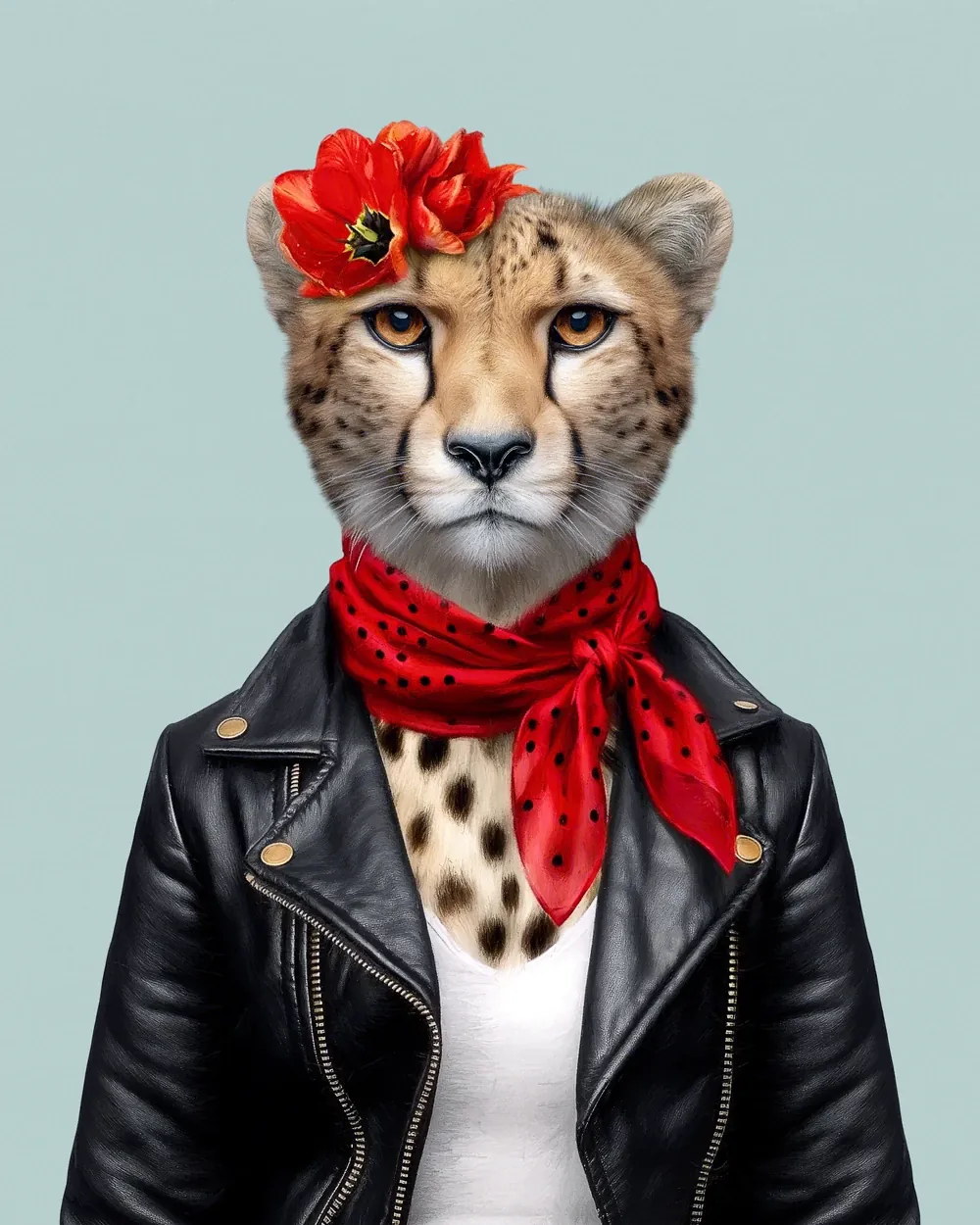
Nayna, Cheetah — Animal Kinhood portrait by Yago Partal AK · 20 S 1°30′ E 35°12′ Nayna Maasai Mara, KE PHOTO ©YP · 2026
Animal Kinhood · Wild animals No. 20 / 25 Episode · Nayna
Acinonyx jubatus

Nayna.

Cheetah

The engine tells the truth before the owner does. I listen to the machine first, then to the excuses.
Add it to your Kinhood.Already part of your Kinhood.
Biography · Block 01 of 03 Cheetah
Chapters · I–II–III

The story.

I
CH · 01 / 09

Blue Gate, Half Past Six

At half past six, Lunga Lunga Street still smells of dew and cold diesel, and Nayna has already opened the workshop's blue gate. She painted it herself one Saturday with a hardware-store brush, and the white sign above it — NAYNA MOTORS — she lettered by hand, so the letters didn't come out quite straight. She doesn't mind. She poured the concrete floor herself, working from a tutorial with a borrowed cement mixer, over three weekends, before she'd even bought a fan. The compressor came first.

There's half an hour, before Mwangi arrives, when the workshop is hers alone: the light comes in low through the door, the metal is cold, and on the bench, in an empty Castrol oil can, sits a bunch of red carnations she brought in that morning. A superb starling slips in through a gap in the roof, perches on the beam, and leaves when it feels like it; Mwangi calls it the Boss. Leaning against the back wall is the daily-use Honda CB125. And behind it, half taken apart, a Yamaha that doesn't belong to anyone yet.

II
CH · 02 / 09

Bursts of Work, Then the Blackout

She starts an engine, listens to it for eight seconds, glances at the exhaust pipe, and names the failing part without opening anything up. "The engine tells the truth before the owner does," she says when a customer starts making excuses or haggling: she listens to the machine first, the excuses after. People joke that a cheetah only knows how to run. She's the silent counter-argument: she doesn't run — she makes things run.

She works in bursts. Two, three, four hours on one engine without lifting her head, without eating, without talking, and then all at once she drops onto the red stool, drinks half a liter of water in one go, and stares into space for five minutes. After an intense week she vanishes for a day or two without warning. Mwangi has learned to read it by now: he knows when she's about to disappear. If she doesn't cool down — water, shade, silence, a walk — her hands start shaking and she refuses to work. Not because she can't. Because she won't risk getting something wrong.

When an engine finally turns over clean, she closes her eyes for a second and makes a low hum from deep in her chest that she doesn't even choose to make. Mwangi named it: Nayna's engine.

Eight to twelve bikes a week, almost all 125cc boda-boda motorcycles. The good months bring three repairs in a row from the same rider; the bad ones, a part stuck for weeks in customs at Mombasa. The workshop covers the rent, the materials, and the food, and not much more. She's not ashamed to live tight.

III
CH · 03 / 09

Eight Thousand Shillings and a *Flashlight*

She bought the CB125 wrecked. Ochieng, who sends her customers without taking a cut, sold it to her for eight thousand shillings — everything she had at the time — a 2008 Honda with a seized engine. She rebuilt it in two months, at night, on the sidewalk, with a flashlight clamped between her teeth because she had neither a table nor a light. The day it started, she heard herself make that hum for the first time.

Before that came three bad months she almost never talks about. She fixed motorcycles on a sidewalk in Eastlands, with no workshop, four wrenches, and a screwdriver; people paid her in cash or in kind: a helmet, half a tank of fuel, a lunch. She didn't eat every day. Every night she wrote down what she'd earned in a squared notebook, column by column, as if keeping count were a way of not going under.

The CB125 gave her two things at once: mobility and a reputation. People started calling her the one who fixes what everyone else has given up for dead. With what she made from the second bike she rebuilt and resold, she bought a secondhand leather jacket in Gikomba — the first thing that was a hundred percent hers. She repaired it herself. She hasn't taken it off since.

Voiceline · the character’s canonical quote Nayna · Cheetah
Hover to pause
The engine tells the truth before the owner does. I listen to the machine first, then to the excuses. AK · 20 · Nayna · Maasai Mara 2025 The engine tells the truth before the owner does. I listen to the machine first, then to the excuses. Voiceline · Acinonyx jubatus The engine tells the truth before the owner does. I listen to the machine first, then to the excuses. AK · 20 · Nayna · Maasai Mara 2025 The engine tells the truth before the owner does. I listen to the machine first, then to the excuses. AK · 20 · Nayna · Maasai Mara 2025 The engine tells the truth before the owner does. I listen to the machine first, then to the excuses. Voiceline · Acinonyx jubatus The engine tells the truth before the owner does. I listen to the machine first, then to the excuses. AK · 20 · Nayna · Maasai Mara 2025
§ 04 · Objects Open editions · everyday
10 pieces · Print on demand

Take Nayna home.

Biography · Block 02 of 03 Roots
Chapters · IV–V–VI

The roots.

IV
CH · 04 / 09

Wanjiku's Chai

At five, she started going to her grandmother Wanjiku's chai stall at Syokimau station after school. The smell of cardamom, boiled milk, road dust. Wanjiku taught her two things, and both stayed with her for life: to tie a scarf around her neck — "for the dust, and so people know you work" — and not to speak unless she had something worth saying. Nayna's "that's that," the one word she uses to close a subject, accept a favor, or cut a haggle short, comes from there.

At eight, she stood for twenty minutes watching a mechanic on the A109 highway strip down a differential. She didn't ask anything. She watched until she understood it. That's still how she learns, and how Mwangi learns beside her: in silence, watching, until the thing opens up on its own from the inside. When people ask her to standardize, to do it "by the book," she loses interest and does it worse. She never does two repairs the same way, even when the problem is identical. Every bike is a specimen with its own history; where others see just another one, she sees something unrepeatable.

V
CH · 05 / 09

The Tools He No Longer Used

Her father was a truck driver and something of a mechanic. At ten, Nayna would sit beside his truck on the A109 and hand him tools before he asked for them; she could tell a diesel from a gasoline engine just by the sound of the start-up. He didn't teach her mechanics. He simply didn't stop her from learning it.

When she was fourteen, a tanker truck ran over her left foot. She didn't lose it, but she could no longer work underneath a chassis. Her mother took on double shifts at the textile factory in Athi River. Money took on a different shape at home. Nayna started carrying the flour sacks at her grandmother's stall before school and fixing neighborhood bicycles for tips, then boda-boda motorcycles — flat tires, chains, brakes — right outside the house, with her father's Gedore wrenches, the ones he could no longer use himself. He watched her from the window. One day he told her: "Learn to do things right, or don't do them at all." It's the longest thing he's ever said to her about the trade. He still sends her money every month.

To her father, who barely speaks anymore, she fixes things without being asked. One afternoon she gave him back the old radio that had stopped working, without telling him what she'd done to it. He switched it on, listened to KBC, and said nothing — but he turned it up louder than he needed to.

VI
CH · 06 / 09

The Key in Kamau's Drawer

At eighteen she finished secondary school, moved to Nairobi, and started at Kamau's workshop in South B. Fourteen months. There she learned motorcycle electronics, injection diagnostics, welding. Kamau was competent and unfair, both at once.

One day he docked three thousand shillings from her pay for a socket wrench that had gone missing. The wrench was in his own drawer; he'd had it the whole time. Nayna finished her shift without saying a word. She didn't come back the next day, or the one after. There was no scene. She just stopped showing up.

That's where her one non-negotiable rule came from: never work for a boss again. It wasn't rebellion. It was a calculation she made, and she chose to pay the price. It cost her the three months on the Eastlands sidewalk, and she still wouldn't consider anything else. She doesn't want to be anyone's boss either, or open a second workshop, or grow the business. Kamau still runs his, eight hundred meters away. When their paths cross, they nod and nothing more. It's a conflict that never got resolved, and it stays that way.

Biography · Block 03 of 03 Craft
Chapters · VII–VIII–IX

The present.

VII
CH · 07 / 09

A Tuesday in August

Wanjiku died on a Tuesday in August, of a heart attack, making the morning chai at her stall. She was seventy-four. Nayna arrived twenty minutes late.

The first thing she did was close the stall. The second was to take the red scarf with black polka dots off her grandmother's neck and tie it around her own. She hasn't taken it off in three years. She washes it, puts it back on, pulls it up over her face when there's dust on the road or when she needs to disappear in the middle of the street. Wanjiku was the most important person in her life, and she never told her in time. That's the truth she can't deny, and she doesn't state it out loud — it shows in the fact that she keeps the scarf and never explains why.

Her grandmother isn't an open wound. She's more like a compass tied around Nayna's neck that goes unnamed. Most days she manages fine: she works, charges what's fair, closes on time. The scarf is faded from so many washes, and that's how she likes it. Her grandmother travels with her without needing to be spoken of.

VIII
CH · 08 / 09

Carnations at Half Past Five

A few months after that August, she passed through Wakulima Market at half past five — it opens at four, and smells of overripe fruit and wet earth, not flowers — and stopped in front of a bucket of red carnations without knowing why. A hundred shillings. She bought them, carried them pressed against the CB125's handlebar, and put them in the oil can on the bench. She went back the next day. Three years on, she still does: two or three times a week. She doesn't throw out the wilted ones until the new ones arrive, so sometimes petals fall between the wrenches and the screws, red on metal.

She's never examined it. If you ask her why she buys flowers, she says "because I like it." If you push further, she goes quiet. On the day there are no flowers, she works worse, and she doesn't explain that either.

There's exactly one thing that overwhelms her, and it lasts as long as a red light: a sudden waft of cardamom where she doesn't expect it — someone cooking nearby, a chai at a stall that isn't the usual one — and her throat closes for half a second. Then she carries on.

IX
CH · 09 / 09

The Tear She Knows How to Mend

The leather jacket is her armor and the first thing that was ever truly hers. It has a tear in the inner lining, at the left side, that's gone unrepaired for two years. She knows how to sew leather; she taught herself. She could fix it in an afternoon. She doesn't fix it. She tells herself it doesn't matter. It matters.

It's the same distance she keeps from everything. She tells herself "I don't need anyone" while five people are holding her up: Mama Amina, who brings her a chai the day she sees her running low and is the first to notice if she's missing; Njoroge, the truck driver, who brings her ugali from his wife; Ochieng; Mwangi; and her father, on the other end of the phone on Sundays. She sends him money and doesn't visit as often as she should. "I'll come soon," she tells him. "I'll come soon" has been running for three months now. She keeps that distance like armor, even if from the outside it reads as coldness.

When she needs to disappear completely, she takes the CB125 south, past Athi River, and turns where the road ends and the grasslands of Kitengela begin. She parks, sits on the ground, and looks out for an hour, two. She doesn't think. She looks. By Monday she's back, with the '85 Yamaha waiting for her half-assembled, catalogued piece by piece, that she has no intention of selling.

> **Canonical quote:** She tied Wanjiku's scarf around her neck the day she died and has never taken it off; she cares for the people she loves by fixing their things, never by saying so.

§ 06 · Connected souls 01 canonical bonds
Animal Kinhood

Connected souls.

§ 07 · Species file Acinonyx jubatus

About the cheetah.

Classification
  1. Animalia
  2. Chordata
  3. MammaliaMammals
  4. Carnivora
  5. Felidae
Acinonyx jubatus (Schreber, 1775)
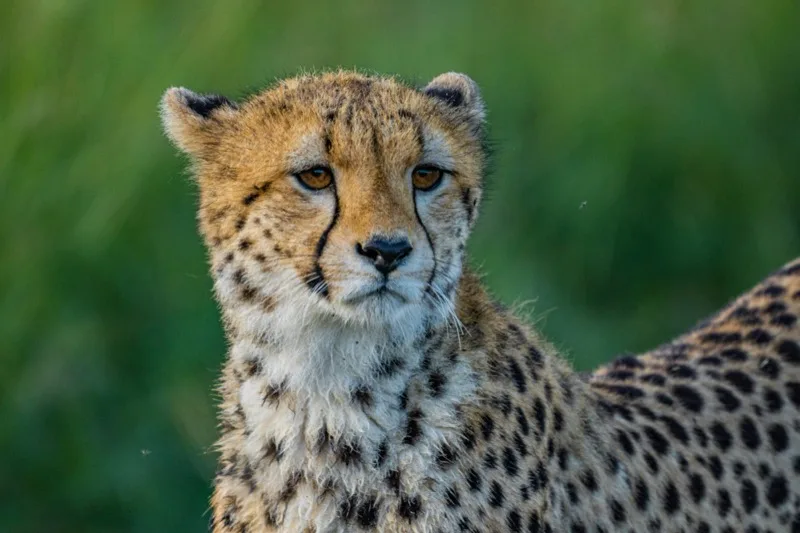
Cheetah (Acinonyx jubatus) in the wild
The real animal · Acinonyx jubatus
Habitat
Open savannas, grasslands and semi-arid scrub of eastern and southern sub-Saharan Africa (Kenya, Tanzania, Namibia, Botswana); also the central plateau of Iran, where the last Asiatic population survives with fewer than 50 individuals.
Diet
A strict carnivore that hunts by daytime high-speed pursuit; its main prey are gazelles (Thomson's and Grant's), impalas and hares. A success rate of 40-58%, the highest among the large African felids.
Lifespan
10-12 years in the wild / up to 17 years in captivity.
Weight
Between 21 and 65 kg; males are slightly larger than females. Athletic, lean build, with a deep chest and a narrow waist.
Adaptation
The spine acts like a compressed spring that lengthens each stride to 7-8 metres and allows speeds of up to 112 km/h; the semi-retractable claws work like athletics spikes. During the chase the body temperature rises to 40.5 °C.
Record
In 2012 the female Sarah, at Cincinnati Zoo, officially recorded 98.2 km/h over a distance of 100 metres, setting the world record for terrestrial speed in mammals.

Conservation status

Global (IUCN)
Vulnerable
Where it lives
The north-east African subspecies was reclassified as Endangered; the Asiatic subspecies remains one of the most threatened in the world.
Population
Approximately 6,500-7,100 mature individuals according to the 2022 assessment; the Asiatic subspecies has fewer than 50 individuals in Iran (Critically Endangered).
View the IUCN Red List page

Main threats

  1. Habitat loss and fragmentation from agricultural and livestock expansion, which has reduced the historical range by more than 91%.
  2. Conflict with livestock farmers: cheetahs that attack herds are hunted down and killed.
  3. Illegal trafficking of cubs as pets to the Persian Gulf (between three and six die for every one that arrives alive).
  4. Low genetic diversity caused by a population bottleneck 10,000 years ago.
  5. High natural infant mortality: 70-90% of cubs die in the first three months.

Did you know…?

01
The 100-metre track

The cheetah covers 100 metres in about 3 seconds: it starts from zero and reaches 100 km/h before any racing car gets past first gear. The sprint lasts between 20 and 60 seconds, but that's enough to win or lose everything.

02
A sniper's eyesight

The cheetah's fovea isn't round as in most mammals, but a continuous horizontal band running across the whole retina. This morphology lets it track a gazelle at full run without moving its eyes from side to side.

03
The tear marks are a sight line

The black lines running down from the tear duct to the corners of the muzzle are not ornament: they absorb direct sunlight and reduce glare, working just like the black paint under the eyes of baseball catchers.

04
The chirp that fooled the naturalists

The cheetah can't roar: its vocal cords aren't built for it. The contact call between mother and cubs is a high, piercing whistle that carries two kilometres. Nineteenth-century European explorers noted it down as an unknown savanna bird.

05
Akbar and the single cheetah

The Mughal emperor Akbar the Great kept around 1,000 cheetahs at his court at once, around 1600. Throughout his reign, only one bred in captivity. Captivity interrupts the cheetah's complex courtship rituals.

06
A bottleneck 10,000 years ago

The whole species passed through a near-total extinction event at the end of the Pleistocene that left the survivors with a genetic diversity so reduced that skin grafts between unrelated individuals produce no immune rejection.

§ 08 · Conservation three programs · verified
Cheetah

Help protect this species.

Every purchase helps, but a direct donation does more. Three NGOs with specific programs verified for this species.

No. 01 / 03

CCF.

Cheetah Conservation Fund

An organisation based in Otjiwarongo (Namibia) and the global reference laboratory for the species; runs coexistence programmes with livestock farmers and leads the most complete field genetic research in the world.

Donate to CCF
No. 02 / 03

Panthera.

Panthera Corporation

Works in five African countries through GPS anti-poaching patrols and safe transit corridors; its wildlife credits programme pays communities for the safe passage of cheetahs.

Donate to Panthera
No. 03 / 03

AWF.

African Wildlife Foundation

Protects the cheetah by reducing conflict with livestock farmers through reinforced bomas and financial support for farmers who suffer losses.

Donate to AWF
Animal Kinhood · 25 characters

Twenty-five names. Twenty-five stories. Twenty-five personalities. One same project.

Full catalogue · Drop 01 — Q3 2026 Explore Animal Kinhood