Animal Kinhood Wild animals Least Concern
12 min read 7 chapters
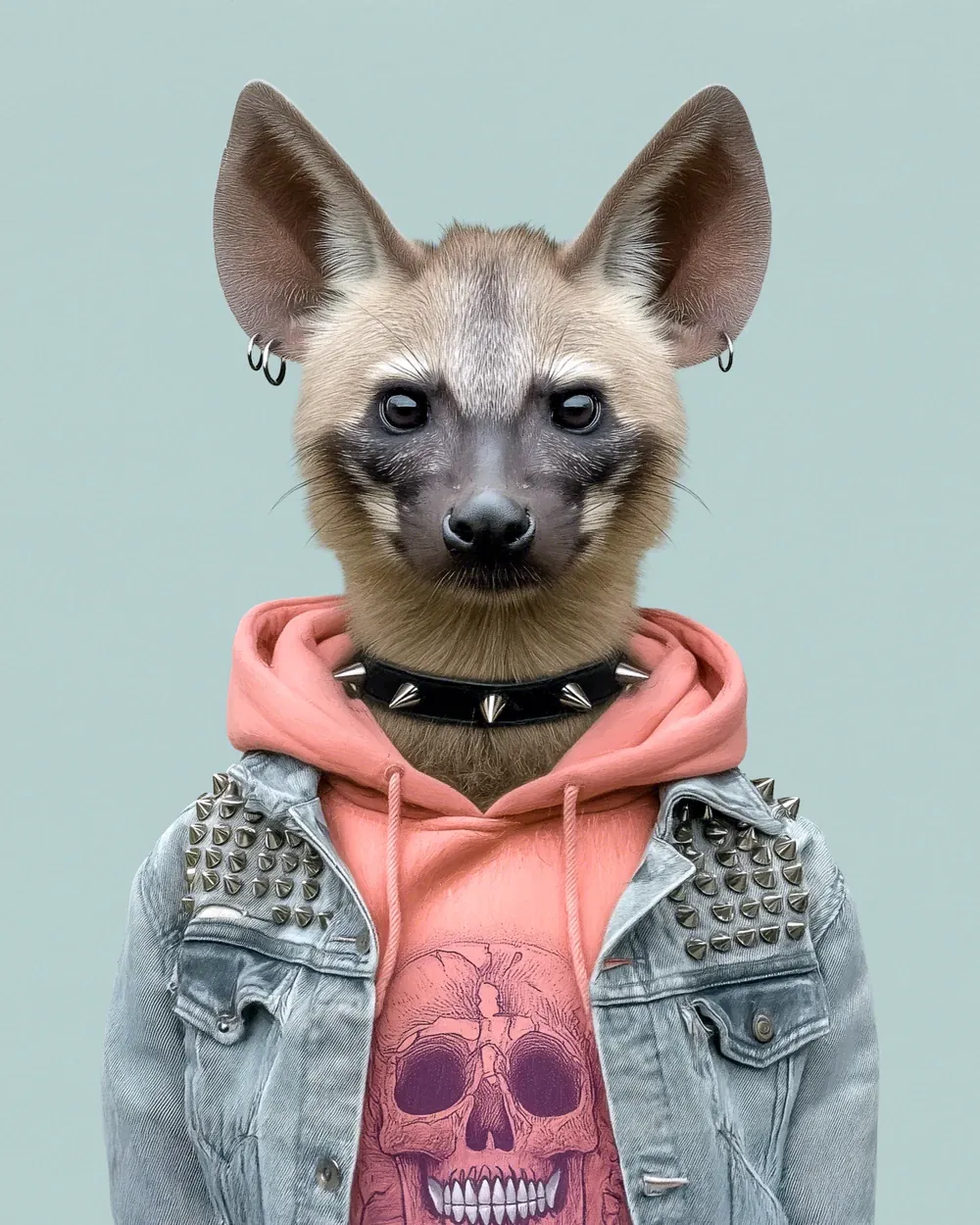
Nala · Aardwolf AK · 13 Nala PHOTO ©YP · 2025
Animal Kinhood · Wild animals No. 13 / 19 Episode · Nala
Proteles cristata

Nala.

Aardwolf

Dotwork teaches you to wait. Dot by dot, without pressing the skin.
Add it to your Kinhood.Already part of your Kinhood.
Biography · Block 01 of 03 Aardwolf
Chapters · I–II

The story.

I
CH · 01 / 07

Limpopo, open country

Nala is an aardwolf who grew up between Polokwane and Mokopane, in the part of Limpopo where the bushveld opens out and the earth is red and flat. Her mother worked at a rural clinic. Her father — she calls him "the one who left", and that's where the sentence ends — disappeared when she was four. She doesn't remember his face. She remembers his boots by the door.

She was raised by her mother and, above all, by her maternal grandmother. Koko Mapula lived in the house next door, sewed for the people of the village, and had the steadiest hands Nala has ever seen. By the age of six she was already sitting her down to thread needles. By eight, Nala was sewing buttons onto the shirts they later sold at the market while Koko finished the hems. It wasn't play: it was work for small hands, and Nala's were the smallest and stillest in the village.

She was a child who made no noise in class. Not for good reasons, not for bad ones. She drew in the margins of her notebooks — no flowers, no faces: lines, patterns, repetitions. A teacher called them "obsessive scribbles". Koko saw them, said "these are my girl's patterns", and bought her a notebook just for that. Nala still has that notebook. It's the first of fourteen.

At night she slept badly. She'd wake at three in the morning and sit at the window to listen. She could tell animals apart by sound: the dry bark of a jackal, the cry of a hyrax, that particular silence that comes before an owl. Her mother told her she had "an old man's ears". Koko told her she had an aardwolf's ears, an animal that also walks at night and hears what others don't. Nala didn't know what an aardwolf was. One night, Koko took her out to the edge of the field with a torch and a lot of patience. Two eyes shining under a bush. A crest of long hair that showed for a second and vanished into a burrow. "See? It looks big. But it's small. And it doesn't bite. It just eats ants." "Termites, Koko." "Ants with helmets."

That line stayed with her.

II
CH · 02 / 07

Polokwane

At twelve they moved. Her mother found work at a bigger clinic in Polokwane and they left the country house. Nala went from listening to hyraxes to listening to traffic. She slept worse, ate worse, stopped drawing for three months. Well, three and a half — she counted them later. It wasn't sadness with a name: it was that the world sounded different and she didn't know where to put herself.

At fourteen, one Saturday at the Polokwane market, she saw a guy tattooing with a homemade machine at a stall between fruit and clearance clothes. The lines were crooked, the hygiene questionable, but the sound of the needle on skin froze her. She stood watching for an hour. The guy told her: "If you want to learn, bring me coffee." She brought him coffee three Saturdays running. On the fourth, he let her practise on a pig skin. The lines were horrible. Her hand didn't shake.

At sixteen, while her classmates went to shopping malls, Nala took the minibus to Johannesburg — four hours of jolting — to do the rounds of the tattoo studios in Braamfontein. She didn't go in to ask for anything. She watched from outside. She watched the machines, the lamps, the way people sat on the table and let themselves be worked on. She got her first piercings on one of those trips: two small hoops in each ear, without telling anyone.

The relationship with her mother was functional but strained. Her mother wanted her to study nursing. Nala wanted to tattoo. "That's not a job." "Koko sewed." "Koko sewed clothes, not people." The argument was never resolved. It turned into a silence the two of them tended with the same precision with which they avoided each other's eyes at dinner.

Voiceline · the character’s canonical quote Nala · Aardwolf
Hover to pause
Dotwork teaches you to wait. Dot by dot, without pressing the skin. AK · 13 · Nala Dotwork teaches you to wait. Dot by dot, without pressing the skin. Voiceline · Proteles cristata Dotwork teaches you to wait. Dot by dot, without pressing the skin. AK · 13 · Nala Dotwork teaches you to wait. Dot by dot, without pressing the skin. AK · 13 · Nala Dotwork teaches you to wait. Dot by dot, without pressing the skin. Voiceline · Proteles cristata Dotwork teaches you to wait. Dot by dot, without pressing the skin. AK · 13 · Nala
§ 04 · Objects Open editions · everyday
10 pieces · Print on demand

Take Nala home.

Biography · Block 02 of 03 Roots
Chapters · III–IV

The roots.

III
CH · 03 / 07

Johannesburg, first attempt

At eighteen, she left. Not to Maboneng — that would come later. First to Hillbrow, which was what she could afford: a flat shared with two girls who worked in retail and slept at normal hours while Nala practised with her tattoo machine at two in the morning, door shut and headphones on. She'd bought the machine with three months' wages as a cashier at a Shoprite. It wasn't a good machine. It was hers.

She found work as an apprentice at a Braamfontein studio. The owner was called Tshepo, had been tattooing for fifteen years, and did African blackwork with a cleanness Nala thought impossible. Tshepo didn't teach with patience. He taught by letting her watch, making her clean, and once a week letting her trace lines on synthetic skins. A whole year before touching human skin. "If you can't wait, you can't tattoo."

Nala could wait.

The day she did her first complete tattoo on a real client — a geometric fern on a forearm, three hours without a break, the needle dotting the skin as if counting — Tshepo said nothing during the session. He watched from the other side of the studio without intervening. When the client left, Nala found a black studded collar on her table. A note: "Don't take it off." There was no speech, no toast, no pat on the back. The leather collar with conical studs was everything. Nala put it on. She hasn't taken it off in six years. She sleeps with it. She removes it to shower and puts it back on before anything else.

IV
CH · 04 / 07

What broke

At twenty-one, Koko Mapula died. Nala took the first minibus to Limpopo. She arrived six hours after the death. She couldn't say goodbye.

She went back to Johannesburg and worked without stopping. Twelve hours a day, six days a week, for four months. Tshepo told her to stop. Nala didn't stop. They argued. It was the fight she couldn't win because Nala doesn't know how to fight — the aardwolf has the weakest jaws in the whole hyena family, and Nala has the weakest confrontation of anyone you know. She doesn't shout, doesn't slam doors. She says one uncomfortable truth in three words and disappears.

She left the Braamfontein studio and spent two months without tattooing, living off her savings in Hillbrow, drawing patterns in notebooks at night. What pulled her out of the pit wasn't a revelation or a cinematic moment. It was a neighbour from the block who asked her to tattoo her newborn daughter's name. "But I don't have a studio." "Do you have hands?" Nala tattooed her in the neighbour's kitchen with sterilised equipment, new gloves and a plastic chair. The letters were perfect. "Amahle", in clean script, across the left forearm. That night Nala slept right through for the first time in months.

Biography · Block 03 of 03 Craft
Chapters · V–VI–VII

The present.

V
CH · 05 / 07

Maboneng

The studio she found in Maboneng was a former tailoring workshop. The coincidence with Koko didn't escape her, but she never says it out loud. She rented it with what she had and fitted it out with what she found: the worktable she bought from a dentist who was closing down, the lamp she rescued from a skip at Arts on Main, the waiting chair came from a Jeppestown barbershop. She refurbished nothing. She adapted what was already there. (The aardwolf doesn't dig burrows either: it takes over the ones others left behind.)

Maboneng means "place of light" in Sesotho. Nala lives at night.

She opens at three in the afternoon. She cleans, prepares, reviews designs. Sessions start at four and the last one begins at ten. She closes between one and two in the morning. Then she walks. She calls it "the round": down Fox Street, across toward Jeppestown, up Bez Valley if the night is clear, back along Main Street. No headphones. She listens to the city the way she used to listen to the Limpopo countryside: jackals then, traffic now, the same background silence that comes before something you can't see.

She specialised in dotwork and blackwork. Thousands of dots, one by one, geometric or botanical patterns that grow out of the skin as if they'd always been there. She doesn't do lettering, doesn't do colour, doesn't do hyperrealistic portraits. "I have one thing I do well. I don't need ten." The precision of her hands has something of the aardwolf's tongue lapping termites from the surface of the ground: no force, no rush, exact repetition. Hundreds of thousands of times.

Sessions last three hours at most. Three, not three and a half. If the client's body says enough, she stops, even with half an hour of work left. "The skin needs to rest. So do you." She never negotiates this. The aardwolf doesn't destroy the termite mound: it harvests it and lets it regenerate. Nala does the same with the people who sit on her table.

VI
CH · 06 / 07

The jacket

The first time you see her, what you see is the jacket. Washed denim, ice blue, covered top to bottom in silver pyramid studs. Each one driven in by hand. Underneath, a pale pink hoodie that shows at the neck and chest. And around her neck, Tshepo's studded collar.

She looks like someone you wouldn't approach without a reason. That's exact. The aardwolf bristles its dorsal crest — a strip of long hair along the spine — when it feels threatened, and manages to look forty percent larger than it is. It doesn't have the bite to back it up, or the mass. It only has the display. Nala is one metre sixty-two, weighs fifty-two kilos, and with the jacket on she projects something people mistake for toughness. Those who know her know the pink hoodie isn't hidden. It shows. Nala lets it show.

If you see her work, the reading changes. The hands that looked defensive turn out to be the same ones that offer you a glass of cold water without your asking, the ones that remember your allergies, the ones that stop the session before you have to ask. The studded collar isn't provocation: it's the most valuable gift she owns, given without words by the person who taught her to wait.

There's a stud missing from the left shoulder of the jacket. She hasn't replaced it. She knows which one it is.

VII
CH · 07 / 07

Fox Street, two in the morning

The owner of the shisa nyama on the Fox Street corner knows her by name. He keeps the same cut for her. If Nala doesn't show up two nights running, he sends her a WhatsApp: "Alive?" "Alive." That's enough for the two of them.

The ceramicist with a studio two doors down lends her tools, and they have rooibos together on Sunday afternoons. They don't talk much. Sometimes not even that.

Nala hasn't spoken to her mother in five months. Not out of a fight: out of inertia. The distance between Johannesburg and Polokwane is four hours by minibus, but the distance between "that's not a job" and the Maboneng studio is measured in something else. One of these days she's going to call her. She says it every week. Every week she opens another notebook, draws another pattern, and the call stays where it was.

The studio rent went up eighteen percent this year. The landlord wants to turn the ground floor into a specialty coffee shop. Nala has a lease until December. After that, she doesn't know. Gentrification in Maboneng advances like the poison farmers use to kill aardwolves believing they're jackals: without noticing what they're really eliminating.

At weekends, sometimes, she drives forty minutes south on the N1 until the Highveld opens out and there are no buildings. Just grass and sky. She walks for half an hour without looking for anything. The aardwolf lives in other animals' burrows within a fixed territory — Nala has changed flats three times in four years, always within the same radius of six blocks around the studio. The flat changes. The territory doesn't.

She goes back to the studio at night. She always goes back to the studio. It's more home than the flat: it has her music, her light, her tools, Koko's sewing needle in a glass jar on the drawing table. She doesn't use it. It's there.

In her wallet she carries a folded note. "Don't take it off." No one has seen it except her. The rooibos goes cold in the cup. Outside, Johannesburg at three in the morning sounds of distant generators and a dog barking in Jeppestown.

§ 06 · Connected souls 01 canonical bonds
Animal Kinhood

Connected souls.

§ 07 · Species file Proteles cristata
Hyaenidae · Carnivora

About the aardwolf.

Habitat
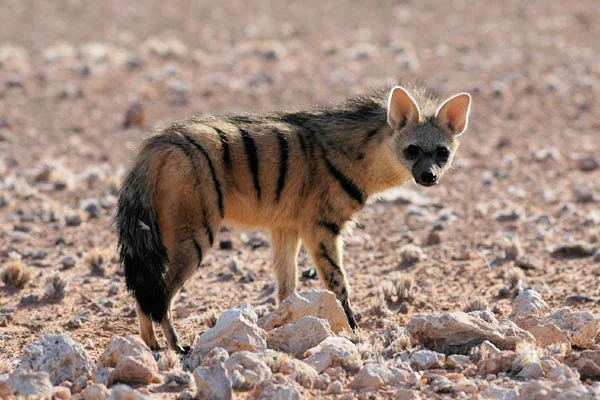
Open savannas, grasslands and semi-arid scrub of eastern and southern Africa, with annual rainfall below 800 mm; in South Africa it occupies the Highveld, the Karoo and the bushveld. It avoids dense forests and extreme deserts.
Diet
A near-exclusive specialised insectivore: more than 95% of its diet is termites of the genus Trinervitermes, which it gathers from the ground with its long, sticky tongue without destroying the mound; it consumes up to 300,000 termites in a single night.
Lifespan
8-10 years in the wild / up to 18 years and 11 months in captivity (a record set at Frankfurt Zoo).
Weight
Between 7 and 10 kg, with a body length of 55-80 cm plus 20-30 cm of tail; the smallest member of the Hyaenidae family, with little visible sexual dimorphism.
Adaptation
A long tongue resistant to the bites of soldier termites, able to lap thousands of insects a minute; alongside it, a dorsal crest of long hair that can bristle and make the animal look between 40% and 70% larger than it really is.
Record
The longest-lived captive individual lived 18 years and 11 months at Frankfurt Zoo, Germany.

Main threats

  1. Deliberate or accidental poisoning through confusion with jackals and hyenas, especially on farms where baits are used for predator control.
  2. Night-time roadkill on secondary roads that cut through savanna and bushveld habitats.
  3. Habitat loss and degradation from agricultural expansion.
  4. Local persecution driven by mistaken livestock folklore that identifies it as a predator of small stock.

Did you know…?

01

The aardwolf eats up to 250,000 termites in a single night without attacking any vertebrate. It is the only member of the Hyaenidae family to have abandoned the carnivorous diet entirely and to have developed jaws so reduced that it cannot chew solid food of any meaningful size.

02

It neither digs up nor ruins the termite mounds: it laps the termites from the surface and moves off before the colony reacts. This sustainable harvesting strategy ensures the mound rebuilds itself and can be exploited again.

03

The erectile dorsal mane can increase its silhouette by between 40% and 70%, turning an 8 kg animal into a convincing visual threat. Its jaws are so weak that it cannot bite with any significant force: the whole defence is bodily theatre.

04

Its striped pattern resembles that of the striped hyena, a species regional predators consider dangerous. The Batesian mimicry hypothesis is unconfirmed, but it would explain how an almost defenceless animal manages to avoid attacks.

05

A single aardwolf controls the populations of Trinervitermes, the termites that destroy pasture for livestock. The farmers who poison them, mistaking them for predators, eliminate their main biological ally against the very pest that does the most damage to their own grasslands.

06

Aardwolf means earth wolf in Afrikaans; the Nama call it |gīb. No culture that has named it has got it right: each one mistook it for a different animal, as still happens today.

§ 08 · Conservation three programs · verified
Aardwolf

Help protect this species.

Every purchase helps, but a direct donation does more. Three NGOs with specific programs verified for this species.

No. 01 / 03

EWT.

Endangered Wildlife Trust

A South African NGO working across nine strategic conservation landscapes in southern and eastern Africa; it runs dedicated programmes monitoring carnivores threatened by human-wildlife conflict and advocates against the use of poisons in agricultural areas.

Donate to EWT
No. 02 / 03

AWF.

African Wildlife Foundation

A Nairobi-based organisation working across sub-Saharan Africa on the protection of open-savanna habitats; its coexistence programmes benefit the aardwolf directly.

Donate to AWF
No. 03 / 03

TPFECF.

Twin Pine Farm & Exotics Conservation Foundation

It launched the first formal captive conservation programme for aardwolves in North America in 2022; in 2025 it achieved the first captive birth in the USA in more than 40 years.

Donate to TPFECF
Animal Kinhood · 19 characters

Nineteen names. Nineteen stories. Nineteen personalities. One same project.

Full catalogue · Drop 01 — Q3 2026 Explore Animal Kinhood