Animal Kinhood Wild animals Vulnerable
12 min read 10 chapters
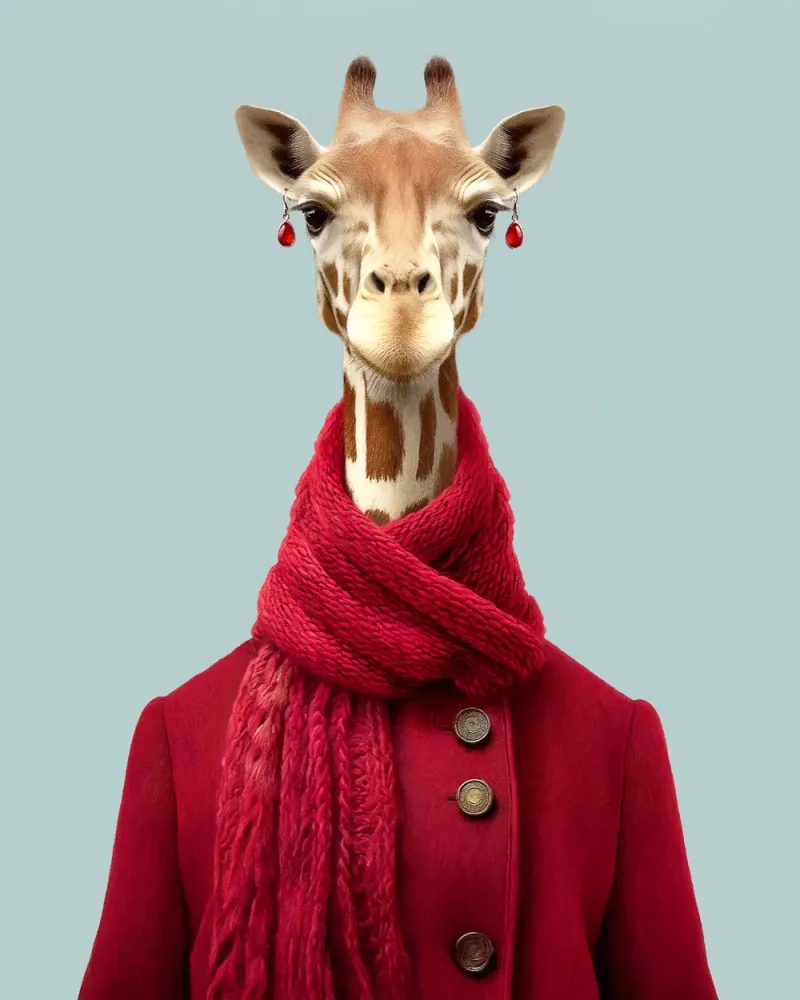
Ayana · Northern giraffe AK · 03 Ayana PHOTO ©YP · 2025
Animal Kinhood · Wild animals No. 03 / 19 Episode · Ayana
Giraffa camelopardalis peralta

Ayana.

Northern giraffe

Memory doesn't live in archives. It lives in the voice of whoever tells it again.
Add it to your Kinhood.Already part of your Kinhood.
Biography · Block 01 of 03 Northern giraffe
Chapters · I–II–III

The story.

I
CH · 01 / 10

The Dosso notebooks

Ayana grew up in Dosso, daughter of a primary school teacher and a post office worker. Zarma family, not strictly Muslim, a large house with a courtyard where her paternal grandmother, an aunt and three cousins also lived. Haoua, her grandmother, told stories every night. Not fairy tales: real stories. The 73 drought. The giraffes that came back to Kouré when she was young. The names of the neighbours who left and those who stayed. Ayana listened without interrupting, and at eleven she started writing them down in Clairefontaine notebooks she still keeps.

When Haoua died, Ayana was twelve. She left her drop earrings with red stones — garnet, maybe artisanal glass from Agadez — which are the only thing Ayana always wears. The notebooks went from hobby to something else. Something that didn't have a name but pulled inwards.

II
CH · 02 / 10

The Kouré question

At sixteen, on a school trip to Kouré, she saw giraffes for the first time. It wasn't a moment of revelation or an epiphany that would be neatly told afterwards. It was more a silent recognition: tall, slow, visible animals eating acacia leaves unhurriedly while the rest of the bus shouted and pointed. The local guide said that in the nineties fewer than fifty remained. Ayana asked a question the guide couldn't answer: "Who counts that? Who keeps it?"

It took her ten years to find the answer.

But first came university — Modern Letters with a specialisation in African Linguistics at the Abdou Moumouni University of Niamey —, a first job classifying sound documents at the Centre Culturel, and fourteen boxes of cassettes in a basement. Cassettes from a Franco-Nigerien project of the eighties, hand-labelled, some undated, sticky with humidity. A cockroach came out of the first box. Ayana spent eight months digitising them alone, at night, with equipment borrowed from the Alliance Française, because the Centre's generator couldn't handle the electrical load by day. She recovered eighty-five hours. Among them, the voice of an old man speaking about the giraffes of Kouré in 1985, when fewer than a hundred remained.

That man was already dead. His voice wasn't.

III
CH · 03 / 10

Alexandria, humidity and the return

At twenty-four she got a scholarship for a master's in Intangible Cultural Heritage Management at Senghor University in Alexandria. Two years out of Niger. Alexandria was humid, loud, dense — everything that shrinks her stomach. She barely slept for the first two months. She desperately sought high ceilings and horizon. She found the terrace of the Bibliotheca Alexandrina and turned it into her refuge.

She learned archive methodology, UNESCO standards, metadata management. She graduated with distinction. She returned to Niamey five kilos lighter and with one conviction: Niger's oral heritage was dying without anyone documenting it rigorously.

At twenty-eight she presented the Kouré project. The idea was specific: gather testimony from the communities that live with the West African giraffes, the story of the species' recovery told by those who lived through it. From forty-nine individuals in 1996 to more than six hundred today. That story existed in people's memory, but in no archive.

Voiceline · the character’s canonical quote Ayana · Northern giraffe
Hover to pause
Memory doesn't live in archives. It lives in the voice of whoever tells it again. AK · 03 · Ayana Memory doesn't live in archives. It lives in the voice of whoever tells it again. Voiceline · Giraffa camelopardalis peralta Memory doesn't live in archives. It lives in the voice of whoever tells it again. AK · 03 · Ayana Memory doesn't live in archives. It lives in the voice of whoever tells it again. AK · 03 · Ayana Memory doesn't live in archives. It lives in the voice of whoever tells it again. Voiceline · Giraffa camelopardalis peralta Memory doesn't live in archives. It lives in the voice of whoever tells it again. AK · 03 · Ayana
§ 04 · Objects Open editions · everyday
10 pieces · Print on demand

Take Ayana home.

Biography · Block 02 of 03 Roots
Chapters · IV–V–VI

The roots.

IV
CH · 04 / 10

Three rounds of tea

The first years were hard. Intermittent funding. Sixty kilometres on moto-taxi along dust roads. Informants who distrusted recorders. Ayana learned one thing: arrive, sit down, drink three rounds of green tea — the obligatory ritual of every visit in the area —, and wait. Sometimes she came back with an hour of recording after a whole day.

Sometimes she came back with nothing.

What changed the project was a woman. Bibata, seventy years old then, matron of one of the Kouré communities. She didn't speak French; she spoke Zarma and Fulfulde. Ayana interviewed her in Zarma. Bibata told the complete story of how the giraffes came back: the drought, the hunting, the agreement between the community and the conservationists, the first calves born under community protection. It was the first time that story had been recorded from the women's perspective. Not the biologists', not the NGOs'. The grandmothers' who saw the giraffes return to the well.

When Ayana presented that recording at a conference in Ouagadougou, the audience sat in silence listening to Bibata's voice describe how a young giraffe drank water from the community well for the first time in years. The silence in the auditorium wasn't politeness.

V
CH · 05 / 10

The red coat

Ayana bought the coat in Ouagadougou, during FESPACO, the pan-African film festival. Crimson red, thick wool, gold buttons, classic cut. In Niamey a coat like that is unusual — most people wear boubou or light clothing. She wears it in the cold season, on early-morning trips in the harmattan, and when she presents her work. The red knitted scarf was a gift from Fatima, a weaver from the Yantala neighbourhood she sees at the Katako market on Saturdays. Haoua's earrings. All red. It isn't accidental, but neither is it a flag. It's a standard.

She has a wardrobe full of bazin and wax fabrics she buys at the market without needing them. She touches them when she needs to think. She doesn't wear them. It's her version of wandering through a bookshop with no intention of buying anything, only with fabrics.

VI
CH · 06 / 10

One hundred and eighty hours

She lives alone in a three-room apartment in the Plateau neighbourhood, third floor. One room is a bedroom, another is an archive — metal shelves, external hard drive, Zoom H5 recorder, notebooks —, and the third is almost empty: an armchair, a low table, fabrics stacked in a corner. She needs to see the horizon from where she works. When the Cultural Centre reorganised the offices and assigned her an interior room without windows, she didn't write anything for three days. On the fourth, without saying a word, she moved her desk to the corridor, next to the stairwell window. No one protested.

She sleeps five or six hours, with fifteen-minute naps that reset her. She works at night often: two in the morning, headphones on, a transcription of a Zarma elder recounting the first time he saw a giraffe. She falls asleep with the pencil in her hand. At quarter past two she wakes, notes down the last three words and carries on.

She eats little and often. Dates, peanuts, fruit, pieces of wagashi cheese. She doesn't have a large dining table. In meetings with French funders she barely touches the main course but eats the whole bread basket. "Merci, je grignote" — thanks, I snack — she once told a development worker who kept insisting on the salad.

She calls her mother Fati in Dosso every two or three days. They speak in Zarma for exactly twenty minutes. Her mother asks if she's eating well. Ayana says yes. A half-lie: she is eating, but standing up.

Biography · Block 03 of 03 Craft
Chapters · VII–VIII–IX–X

The present.

VII
CH · 07 / 10

Thirty hours that don't come back

At thirty-six, a voltage surge during a storm corrupted the hard drive. One hundred and fifty hours of recordings. Ayana didn't shout. She sat still, ten minutes. She called a technician. It took them four days to confirm they could recover eighty percent. The remaining twenty — thirty hours from the early years of the project — was lost.

Real voices of real people. Some already dead.

She set up a double backup system: local disk and a server at the Alliance Française. Never a single point of failure again. But every time she backs up she thinks about the thirty hours missing. Not as grief. As inventory.

VIII
CH · 08 / 10

The archive conflict

Her project colleague, Aminata, twenty-eight, wants to upload the files to an open platform. "If we put it online, we'll reach more people. It's that simple." Ayana listens to her right through, pauses a long pause and answers: "Bibata didn't speak for the internet. She spoke for Kouré." The conflict hasn't been resolved. The funding depends on a French cooperation cycle that ends in eighteen months, and Ayana needs to complete two hundred and fifty hours of archive before it does. She is training three young people from Kouré as community documentarians — the idea is for the community to be able to continue without her — and preparing a bilingual Zarma-French book of the women's stories.

Insecurity in the Sahel complicates travel. Armed groups in the Tillabéri region. Military checkpoints on the road to Kouré. The same dust road as always, but with tension on top.

IX
CH · 09 / 10

Halima and the silences

Her sister Halima, thirty-four, a nurse at the national hospital in Niamey, is the person she lowers her guard with. With Halima she can cry, laugh loudly, complain about the heat and the generator and the funders who don't answer emails. With the rest of the world she keeps a calm that seems natural but costs her. When something is wrong, she touches her earrings, eats less, walks faster than usual. If someone finds her crying on the stairs at two in the morning, she says "poussière" — dust — and carries on.

Moussa, the electrician in the building, asks her nothing. He leaves a glass of bissap at her door without knocking.

Ayana remembers the name of every person she has interviewed. More than three hundred in twelve years. When someone on the team has a personal problem, she shows up with food and sits close without talking. She doesn't ask what's wrong.

X
CH · 10 / 10

"Tungu, nuit"

One night in Kouré, after a recording session, Ayana heard something. A low, sustained sound, as if the earth was breathing. One of the guides told her: "It's the giraffes. They speak at night." Giraffes emit low-frequency vocalisations that can only be heard in complete silence. Ayana recorded the sound. She saved it in a separate folder, without metadata, unclassified. Only the name: "Tungu, nuit." Tungu is giraffe in Zarma. Nuit is night in French.

There is something there that sums up everything she does: capturing what sounds when no one is listening. The oral stories lost in the night, the voices of elders who are no longer there, the community agreements that sustain an entire species and that no one puts in writing. The giraffes of Kouré went from forty-nine to six hundred thanks to the people who live with them. That story is told by the grandmothers by the fire, when the harmattan raises red dust and the morning cold forces you to move closer.

Ayana arrives, sits down, accepts the three rounds of tea and switches on the recorder.

She doesn't define what she does as a mission. The word annoys her. Nor does she call it fieldwork or research. She simply says she records. That someone has to be there for things to exist beyond the moment they're said.

And then she goes home, puts Haoua's earrings in the ceramic bowl next to the bed, and sits in the empty armchair to transcribe what she has listened to.

§ 06 · Connected souls 01 canonical bonds
Animal Kinhood

Connected souls.

§ 07 · Species file Giraffa camelopardalis peralta
Giraffidae · Artiodactyla

About the northern giraffe.

Habitat
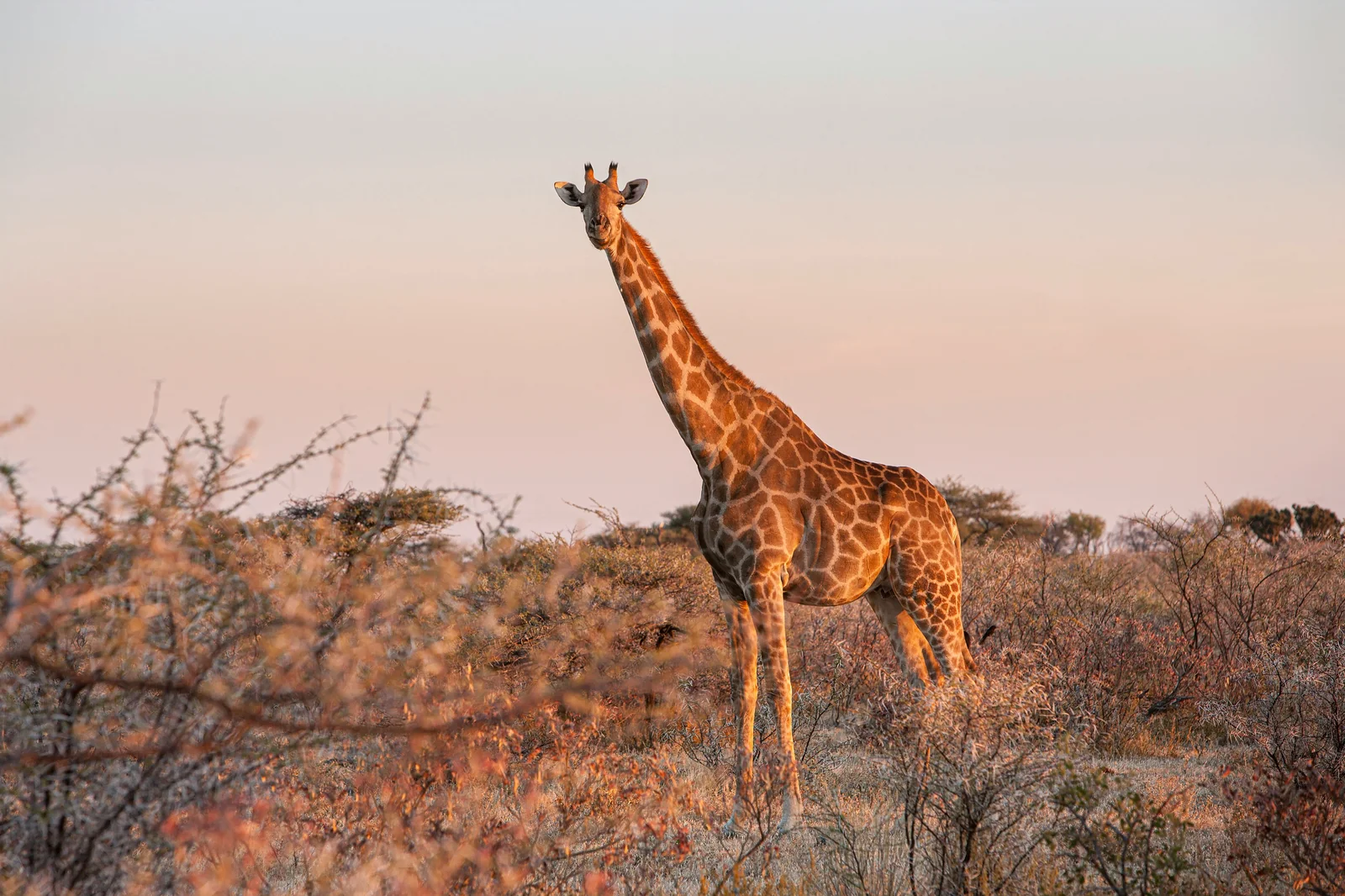
Open savanna and wooded savanna of the Sahel and East Africa: from Niger and Chad to Ethiopia, Uganda and South Sudan. The West African subspecies lives exclusively in the Kouré area (Niger), in savanna with acacias, combretum and balanites, at altitudes of 0 to 2,000 m.
Diet
Browsing herbivore: leaves, shoots, flowers and fruits of trees, mainly acacias. Forages between 16 and 20 hours a day in small continuous amounts using a prehensile tongue up to 45 cm long, pigmented blue-black to protect against UV radiation.
Lifespan
25 years in the wild / up to 28 years in captivity.
Weight
Females weigh between 800 and 1,200 kg, males between 1,100 and 1,900 kg; height ranges from 4.3-4.8 m in females to 4.8-5.5 m in males.
Adaptation
A heart of roughly 11 kg with arterial pressure of up to 280/180 mmHg to push blood up to the brain. A specialised arterial network (rete mirabile) at the base of the skull buffers the sudden pressure changes when the head lowers and rises.
Record
The 2018-2022 translocation in Niger, coordinated by GCF, established the first satellite population of West African giraffe outside Kouré: twelve individuals moved to the Gadabedji Biosphere Reserve.

Main threats

  1. Habitat loss and degradation from agricultural expansion and intensive grazing in the Sahel.
  2. Poaching for bushmeat and traditional medicine.
  3. Genetic fragmentation among isolated populations.
  4. Political instability in the Sahel.
  5. Climate change that alters rainfall cycles and acacia availability.
The West African giraffe is the most documented recovery case: from 49 individuals in the nineties to around 670 in 2025.

Did you know…?

01

A giraffe's heart weighs around 11 kg and generates arterial pressure of 280/180 mmHg to push blood up to the brain, more than two metres above. Without that extraordinary motor, the tallest animal in the world couldn't even stand.

02

Under each coat patch there is a dense system of blood vessels capable of releasing heat to the outside in a controlled way. The spots are, literally, thermal windows: each giraffe carries its own personalised cooling system printed on the skin, and the pattern is as individual as a fingerprint.

03

For decades scientists believed giraffes were mute. In 2015, researchers from the University of Vienna confirmed that they emit a low-frequency humming at night, audible only with sensitive equipment. The most visible animal on the savanna turns out to be one of the most discreet.

04

Post-reproductive females continue to live for years after losing the ability to breed and dedicate that time to caring for and protecting their daughters' calves. The giraffe is one of the few mammals, along with orcas and humans, where the grandmother effect has been documented as a survival factor.

05

The West African giraffe, Ayana's subspecies, was down to just 49 individuals in Niger in the second half of the nineties. Thanks to formal protection by the Nigerien government and active conservation programmes, the population has climbed back to around 670 in 2025.

06

Giraffes sleep between 4.5 and 30 minutes of deep sleep a day, always in blocks of barely 5 minutes, often with the neck curled back to rest the head on the rump. It is one of the shortest sleep patterns of any mammal.

§ 08 · Conservation three programs · verified
Northern giraffe

Help protect this species.

Every purchase helps, but a direct donation does more. Three NGOs with specific programs verified for this species.

No. 01 / 03

GCF.

Giraffe Conservation Foundation

The only NGO in the world dedicated exclusively to the conservation of giraffes in the wild, present in 21 African countries. Coordinated the first translocation of West African giraffes to the Gadabedji Biosphere Reserve (Niger, 2018-2022).

Donate to GCF
No. 02 / 03

AWF.

African Wildlife Foundation

Reference organisation in African wildlife conservation that works directly on the recovery of the West African giraffe's habitat, replanting acacias in the Sahel and training rural communities.

Donate to AWF
No. 03 / 03

GCF-Force.

Global Conservation Force

Deploys anti-trafficking teams and snare-removal patrols in giraffe habitats, collaborates with law-enforcement agencies and funds scientific collaring for population monitoring.

Donate to GCF-Force
Animal Kinhood · 19 characters

Nineteen names. Nineteen stories. Nineteen personalities. One same project.

Full catalogue · Drop 01 — Q3 2026 Explore Animal Kinhood