Quarter past three
Otto wakes at a quarter past three in the morning with no alarm. Every day. He leaves a small apartment in Kvaløya, an island west of Tromsø, crosses the bridge on a bike with studded tires, and arrives at a fish-processing plant where he sorts catches in a cold-storage room at twenty below. The cold suits him. It's not a figure of speech: he works better when the temperature drops and the noise drops too. The arctic fox shows no signs of cold stress down to seventy below. Otto doesn't get that far, but he understands the principle.
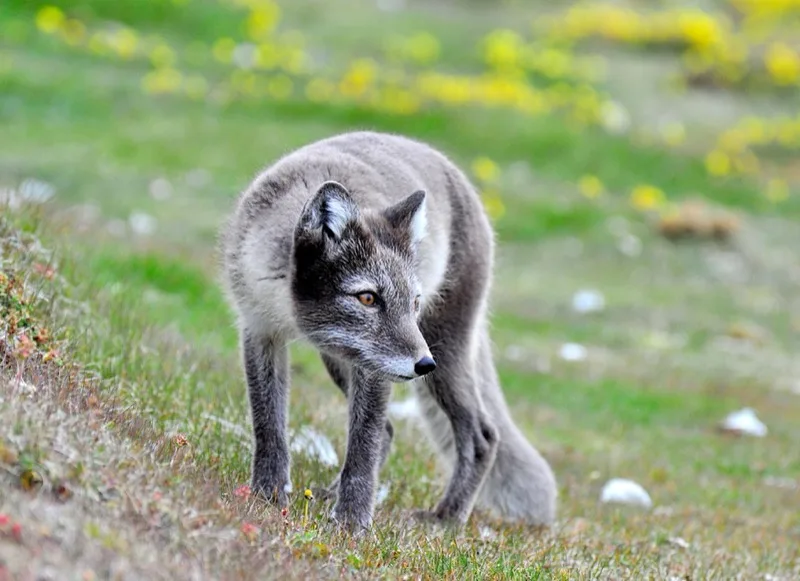
What you see in the portrait is exactly that. A thick knit sweater with vertical navy and mustard-yellow stripes, a wool beanie pulled down over the ears, and amber eyes looking straight ahead, asking for nothing. He doesn't smile. He doesn't threaten. He registers. The look of someone who's been awake since three in the morning and who knows things about his surroundings you haven't noticed yet.
The yellow of the sweater is the only warm accent in the whole image. The rest is navy blue, silver-gray, white. The fur of the face has three tones that blend without a hard transition: dark gray on the forehead, mid-gray on the sides, pure white on the muzzle and chin. There's a symmetry in the composition that's almost perfect but not quite — the head has a minimal tilt, imperceptible if you don't look for it. It humanizes.


