Hang art without drilling - Three realistic ways for rental apartments.
Adhesive strips, shelves and gallery rails: three real ways to hang a poster or print without drilling in a rental apartment. Pros, cons and on which walls each system fails.

Hanging pictures without drilling in a rental apartment is perfectly possible with three systems: removable adhesive fasteners, shelf or furniture support, and gallery rails. All three work, but none will work on every wall. What will work for you depends on the weight of what you want to hang, the type of surface and what your contract says.
I’m going to get straight to the point with each option and, above all, the situations where they fail. Which is what you really need to know before you buy anything.
Before you choose: how much weight you are going to hang
This conditions everything else, and many people ignore it. A poster without a frame (fine-art paper, A3 or A2) weighs between 100 and 300 grams. Almost any adhesive will do. But as soon as you put a frame with glass, you can go to 3-5 kg without realizing it. And that’s where anything goes.
If you are not sure how much your frame weighs, weigh it in your arms and subtract. This is the most reliable and least commonly used method.
Adhesive fasteners: the first option (and its real limits)
Velcro-type removable adhesive strips are the most popular method. They are available in various brands and formats, and the strongest ones on the market hold up to 9 kg using four pairs of extra large strips. The standard models you find in any European hardware store range from 5 to 7 kg.
For a light poster or a poster with a thin frame, they usually work well on smooth, painted walls. You clean the surface with alcohol, stick, wait a while and you’re done. When you leave, you pull the tab down and there’s no trace left. That’s the theory, and on smooth walls it usually works.
How much weight can they really hold? It depends on three things: the surface (smooth, clean and dry), the temperature (heat reduces adhesion) and the preparation. If you don’t clean well or don’t wait for the curing time indicated by the manufacturer, it can fall. There are those who hang without problems for years and there are those who see the painting on the floor after two hours. The difference is almost always in the preparation.
An important nuance: the most well-known manufacturer of these strips recommends not to hang anything on the bed using adhesives. This is sound advice that applies to any brand.
The problem of gotelé (and why no one explains it well)
This is where most guides fall short. If you live in Spain, there’s a good chance your wall has gotelé: that rough texture so common in apartments built between the 1960s and 1990s. And gotelé is the natural enemy of flat adhesives.
Why? Because the strips need contact surface to grip. In medium or thick gotelé, the real contact area is reduced to the peaks of the texture. Result: the adhesive does not hold well and the picture ends up on the floor. Users of products such as IKEA ALFTA confirm this in reviews: on smooth walls it is perfect, on stippled walls it does not stick.
Is there a solution? For smooth stippling, thick double-sided foam-type strips can better adapt to the irregularity. For medium or thick stippling, an adhesive assembly paste (putty type) molds to the lumps and holds better, but it has a problem: it is not removable without leaving some marks. And if the paint of the stippled is old or badly adhered, when pulling the adhesive you can take pieces of paint with you.
In thick gotelé, the cleanest option is not to hang on the wall. Support.
Resting on shelf or furniture: the zero-risk option
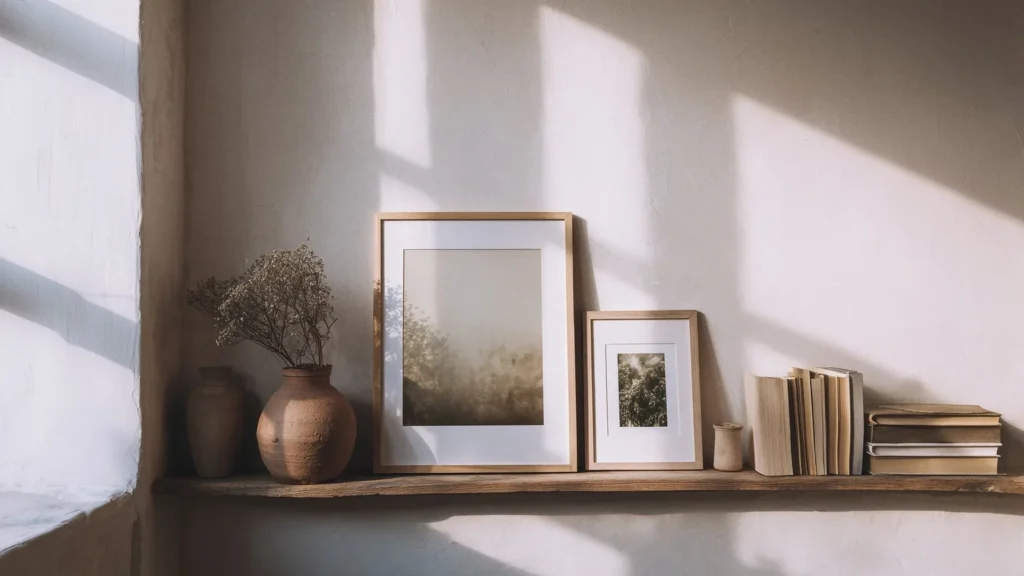
This is not a patch or a fix. It is a legitimate way of displaying art that works especially well with medium and large formats. You rest the framed painting or print on a narrow shelf (there are specific ones for paintings, about 5-10 cm deep), on a sideboard, on a chest of drawers or directly on the floor against the wall.
The aesthetic result can be very good. A large format resting on the floor, with some free space around it, looks deliberate and contemporary. It doesn’t look like a nail is missing: it looks like the piece is there because you want it to be there.
What about stability? For pieces supported on furniture, the frame is supported by its own weight and by the slight inclination against the wall. You don’t need anything else if the piece is not too heavy or in a passageway where someone can push it. For pieces on the floor, the same: choose a wall without traffic.
The best thing about this method: it works on any wall. Gotelé, tile, brick, whatever. You don’t touch anything.
Gallery rails: the museum option (with a catch)
Gallery rails are the system used by museums and professional galleries. A horizontal bar at the top of the wall, from which cables with adjustable hooks hang. You can move the work to any position without making a single new hole. It is flexible, elegant and can withstand very high weights: professional models support from 20 to more than 70 kg per meter of rail.
The catch: installing the rail itself does require screws. A few at the top of the wall, virtually invisible, but screws nonetheless. In a rental apartment, that means asking the landlord’s permission. Some accept it without a problem (especially if you commit to leaving it installed, because it adds value). Others don’t.
Is it worth it if you move often? It depends. If you move every one or two years, it is probably not worth the investment or the negotiation with the landlord. If you have been in the same place for a long time and plan to stay, it may be the best long-term solution. You install it once and never worry about it again.
There are adhesive versions of rails, but their load capacity is much lower and I have not found reliable technical data from the manufacturer on how much they hold per meter. For light parts they may work. For something heavy, better not to risk it.
And you hang them easy?
The «easy hang» hooks (those plastic ones with steel prongs that stick in with a tap) are useful and practical, but they are not strictly «no holes». They leave one or two micro-holes. If your contract expressly forbids any drilling, this can be a problem when returning the flooring. If your contract says nothing or your landlord is reasonable, they are a quick and reliable option that supports between 1 and 6 kg depending on the model.
Will the adhesive strips damage the paint when removed?
Not on smooth walls with paint in good condition. They are removed by pulling the tab slowly downwards and leave no residue. On walls with old paint, poorly adhered or on stippled paint, they can take paint with them when they peel off. If in doubt, do a test in a hidden area before hanging anything visible.
Can I use adhesives on tiles?
Yes, and in fact tiles usually give better results than painted walls because the surface is smooth, hard and non-porous. Just be sure to clean well with alcohol before gluing.
What system do museums use to hang artwork?
Picture rails with steel or nylon cables and adjustable hooks. The principle is simple: a fixed bar at the top and everything else slides and adjusts without touching the wall. It is the most versatile system available, but requires installation.
In a nutshell
For a poster or light film on a smooth wall: removable adhesive strips. For stippled or when you don’t want to touch the wall at all: support on shelf or furniture. For a long-term professional system with the owner’s permission: gallery rail. What is not worth it is to buy adhesives blindly without knowing what wall you have or how much weight you are going to hang.
If you are looking for prints or posters for your wall, in our store you can see the available formats. And if you want to better understand what materials we use, the section on materials and quality explains it without technicalities.