Animal Kinhood Wild animals Endangered
12 min read 9 chapters Live · Darjeeling
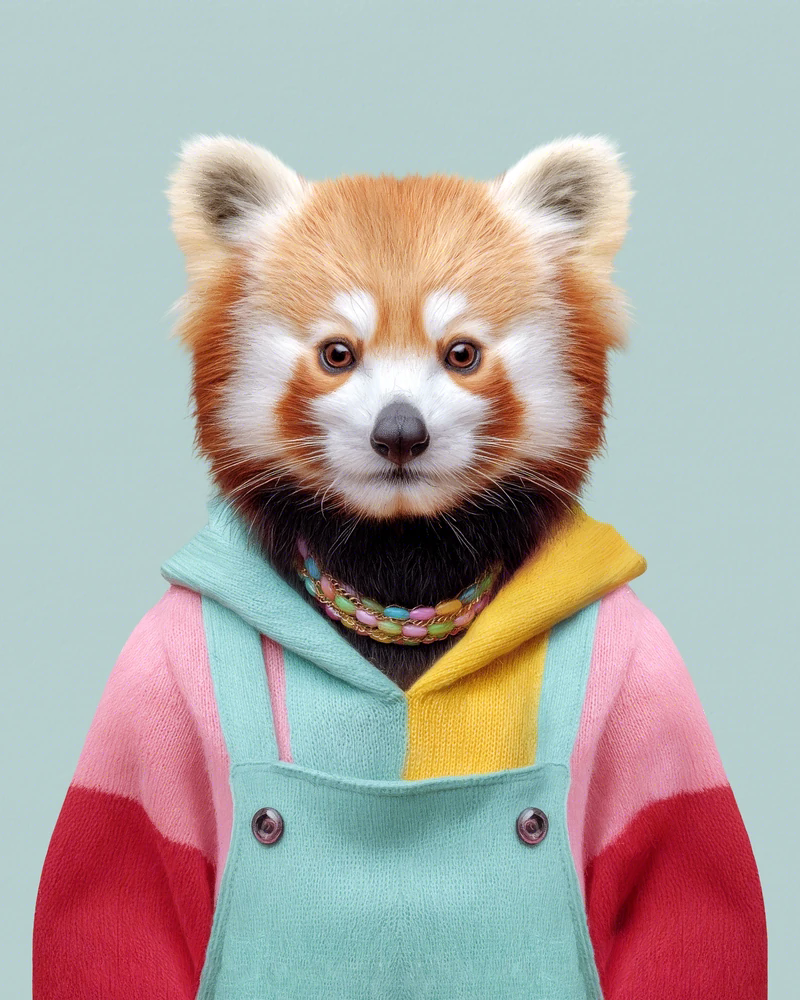
Front-facing, realistic portrait of a young red panda, with reddish-brown fur, a white face with markings and white-fringed ears, big dark eyes, wearing a turquoise knit dungaree with two buttons over a pink-and-red block-pattern sweater, a yellow hood peeking out at the neck and a beaded necklace in bright colors with a fine gold chain, against a plain gray-green background. This is Dolma, a character from Yago Partal's Animal Kinhood series. AK · 02 N 27°02′ E 88°16′ Dolma Darjeeling, IN PHOTO ©YP · 2026
Animal Kinhood · Wild animals No. 02 / 23 Episode · Dolma
Ailurus fulgens

Dolma.

Red panda

I climb up high and watch in silence. I know my own by their tails, and I don't rest easy until I know not one of them is missing.
Add it to your Kinhood.Already part of your Kinhood.
Biography · Block 01 of 03 Red panda
Chapters · I–II–III

The forest from above.

I
CH · 01 / 09

Before doing anything, watch

It's still dark when Dolma is already up in the big cedar, wrapped in a blanket that reaches her nose, watching the mist start to lift off the forest. She isn't waiting for anything in particular. She's waiting to see: who's moving below, which branch broke overnight, where something passed in the dark. From up high the world falls into order for her. Down below, she says, you can't see a thing.

She's twelve and lives in the hills of Darjeeling, in the Himalayas, where the cloud forest meets the tea gardens and the villages spread across the slope without ever crowding together. Her house is one of them, up above the tea, with a patch of bamboo out back and a tree she climbs the way someone else walks into their own bedroom. The whole village passes below it every morning and no one looks up. She does look down, and she sees what the rest of them miss.

She isn't a shy girl, even if she seems it. It's that she's learned almost everything works out better if you watch first. She comes down slowly, once she's seen the whole of it, and then she acts. Never the other way around.

II
CH · 02 / 09

The dawn round

Her father, Nima, is a Forest Guardian: one of the neighbors who patrol the community slope, count the wild red pandas, and scare off the ones who come up with snares. He was the one who first carried her up high, at five years old, so she could watch the mist come out, and the one who taught her to read tracks, trails, and tails before she read letters. Dolma learned both at once, but tracks come easier to her.

Now she goes with him as a volunteer on the dawn round, which is when the forest stirs. They go in silence, her a step behind, climbing to the high points to watch. She can tell a track left overnight from one left the evening before by how wet with dew it is; she knows which bamboo was chewed fresh and which dried up on its own; she reads in a snapped branch who passed and in what hurry. Nima no longer asks her what she's seen: he's grown used to the fact that, if Dolma bends a branch on the trail, it's because something happened, and that she's almost never wrong.

Her mother, Yangchen, picks tea in season and sells momos at the morning market; her grandmother, Ama Lhamu, weaves and keeps the house. Between the three of them they raised her with care and let her loose early, which is how her people raise their children: an only child, independent ahead of her age, walking the mountain alone at an age when others don't cross the village. No one keeps watch for her on the way back. They trust that she knows how to come down.

III
CH · 03 / 09

I don't come down right away

"I don't come down right away. First I watch." She says it whenever someone asks her to act now, to come down, to do something. Half a child's stubbornness, half a law of her own. Moving before she's seen properly gives her an almost physical unease; she'd rather stay up too long, look twice, three times, than come down early and get it wrong.

It's the same with everything. With a little one from school who gets lost: first she climbs the fir to spot the house, and only then does she come down to walk him home. With an odd trail: first she works out who might have left it, and then she gives the warning. Once, a neighbor's lamb tumbled down a ravine and everyone went running and shouting down the slope; Dolma climbed onto the tin roof, saw from up there where it had gotten caught and how to reach it, and said it in a single sentence. They brought it down right where she pointed. No one thanked her for climbing onto the roof instead of running, but the lamb came back.

The village takes her for slow and she doesn't argue; she knows it isn't slowness, it's that watching is her place, the spot from which no one slips past her. The rest of it — the noise, the rush, the people who shout before they've seen — she could do without.

Voiceline · the character’s canonical quote Dolma · Red panda
Hover to pause
I climb up high and watch in silence. I know my own by their tails, and I don't rest easy until I know not one of them is missing. AK · 02 · Dolma · Darjeeling 2025 I climb up high and watch in silence. I know my own by their tails, and I don't rest easy until I know not one of them is missing. Voiceline · Ailurus fulgens I climb up high and watch in silence. I know my own by their tails, and I don't rest easy until I know not one of them is missing. AK · 02 · Dolma · Darjeeling 2025 I climb up high and watch in silence. I know my own by their tails, and I don't rest easy until I know not one of them is missing. AK · 02 · Dolma · Darjeeling 2025 I climb up high and watch in silence. I know my own by their tails, and I don't rest easy until I know not one of them is missing. Voiceline · Ailurus fulgens I climb up high and watch in silence. I know my own by their tails, and I don't rest easy until I know not one of them is missing. AK · 02 · Dolma · Darjeeling 2025
§ 04 · Objects Open editions · everyday
10 pieces · Print on demand

Take Dolma home.

Biography · Block 02 of 03 Roots
Chapters · IV–V–VI

The notebook of tails.

IV
CH · 04 / 09

The winter the bamboo flowered

There was a winter when the bamboo flowered all at once — it does that every so many years — and then died off entirely, and the mountain went without food for a long stretch. The red pandas of the forest had a hard time of it; some came down, others didn't make it. Dolma was nine, and for the first time she understood that her own could vanish without her finding out in time.

That was when the notebook began. Without telling anyone, not even her father, she set about drawing every wild red panda she knew by the rings on its tail, which are different on each one, as unique as a fingerprint. Beside each she noted whether she'd seen it or only its trail, and the date, and on which slope. Every season she goes over her slopes and checks: this one's still here, this one too, this one she hasn't seen yet this moon. She counts twice, three times, before closing the notebook; skipping someone by accident gives her a small dread. She keeps the notebook in a hollow of the tree by her house and shows it to no one. If she shows it, she says, it spoils.

V
CH · 05 / 09

I know my own by their tails

"My own," she calls them. They aren't pets or friends: they're three or four wild red pandas she watches over from a distance, without going near, each in its own patch of forest. Her kind live like that, solitary and spread out, each family on its own slope, never rubbing shoulders, knowing one another by signs. Dolma doesn't look for a pack and doesn't miss one. It's enough for her to know her own are still there.

She knows them by their tails, long and ringed, almost as long as their bodies, the same tail they wrap around themselves like a blanket against the cold, just as Dolma wraps hers. She may not see their faces: if she sees the tail, she knows who it is. She also knows that in spring they climb up for the tender shoots and in winter they drop down to the most sheltered ground, so she shifts which slopes she watches with the season, following them without their knowing.

She has good hands for the notebook — she draws fine, ties knots, grips branches that get away from others — and she doesn't know that comes from her own kind too. At dusk, when the mist rises and the forest settles below her, she makes her own short round across everyone's slopes, notebook in hand, and doesn't head home until she can write, for each of them, "this one's still here." That second — confirming that the one she feared losing is still there — she wouldn't trade for anything.

VI
CH · 06 / 09

The page she folded aside

One of her own, a young red panda she'd noted down as "the one with three pale rings on its tail," stopped showing up one season. A dog come up from the village, they said: loose dogs chase the cubs and bring disease, and they're among the things that do the most harm in the hills. Dolma didn't cry in front of anyone. She tore that page out of the notebook and kept it folded aside, neither with the ones still there nor thrown away.

She doesn't cross it out. The one who no longer shows up she doesn't strike through: she folds him away, and every so often she passes by his slope just in case, though she knows he won't be there. Since then she watches more, and differently: she starts the round on the slopes of the smallest ones, the easiest to lose, before those of her usual own. It's the closest thing she has to a prayer, though she wouldn't call it that or know how to say one.

Biography · Block 03 of 03 Craft
Chapters · VII–VIII–IX

Warning without shouting.

VII
CH · 07 / 09

Three branches on the trail

"I don't shout. I warn." Her kind make almost no sound — red pandas have barely any voice, a huff, a low twitter — and neither does Dolma. When something goes wrong she doesn't raise the alarm: she bends three branches on the trail, the signal her father taught her, and waits still for the round to come and read them.

That was how, one early morning, she saw from her branch a man setting snares where he shouldn't, before anyone else did. She didn't shout, didn't give herself away, didn't come down to face him: she'd have put herself in danger and scared him off. She stayed still, memorized which way he went, came down without a sound once the man had moved off, bent her three branches at the fork in the trail, and waited for the round. The Forest Guardians followed the branches and caught him with the snares on him. She didn't tell anyone it had been her; she went red when her father guessed it from the way the branch was bent, which he already knows by now. In the forest, Dolma thinks, the one who shouts is the one who hasn't seen anything yet. The one who has seen gives a quiet warning and lets things sort themselves out without it showing that it was him.

VIII
CH · 08 / 09

At noon she's no use; at dusk you go looking for her

There's an hour when Dolma is no use at all, and it's noon. When the sun beats down and the forest goes still, her eyes shut wherever she is: on a branch, on the tin roof, on the school bench. She curls into the blanket her grandmother wove from the mountain goats' wool — very long, for the dawn rounds when it's still dark — and dozes off despite herself. The schoolteacher isn't thrilled about it. Her grandmother is fine with it: she keeps the dusk free for her, because she knows that's when her granddaughter comes alive.

Because at dusk, when the mist rises, Dolma wakes fully and heads out. It's the hour she sees best, in the half-light, and the hour the forest stirs. The blanket is the first thing she grabs on her way out and the last she lets go of. Her grandmother says the girl sees with her ears and her hands, not just her eyes. Could be.

IX
CH · 09 / 09

What she watches over from up high

The one who watches over everyone and notes everyone down won't let herself be watched or show her notebook to a soul. It isn't mistrust — she warns, she cares, she joins the round every morning — it's that being watched leaves her out in the open, and watching is her safe place. Beneath the notebook, the climbing, the counting by tails, there's a fear she wouldn't know how to name: that one of her own vanishes without her seeing it in time, and that she finds out when there's nothing left to be done.

Her forest is breaking into pieces — the tea, the roads, the slopes being cleared — and the families end up farther and farther apart, unable to cross from one to another. Her father and the other Forest Guardians plant bamboo, close off the ways in for dogs, count what's left; it's slow work, neighbors' work, not heroes' work. Dolma can't stitch it back together. All she can do is climb up high every dawn and every dusk, count the ones still there, bend a branch when it's needed, and keep the notebook with its page folded aside.

She'd like, one day, for her father to let her do a stretch of the round on her own, without following behind; for them to trust her eyes completely. And she'd like, deeper down and without knowing how to put it, to trust herself that not everything depends on her seeing it. But she can't yet. So she climbs, wraps herself in the blanket, and watches. First, always, she watches.

§ 07 · Species file Ailurus fulgens

About the red panda.

Classification
  1. Animalia
  2. Chordata
  3. MammaliaMammals
  4. Carnivora
  5. Ailuridae
Ailurus fulgens
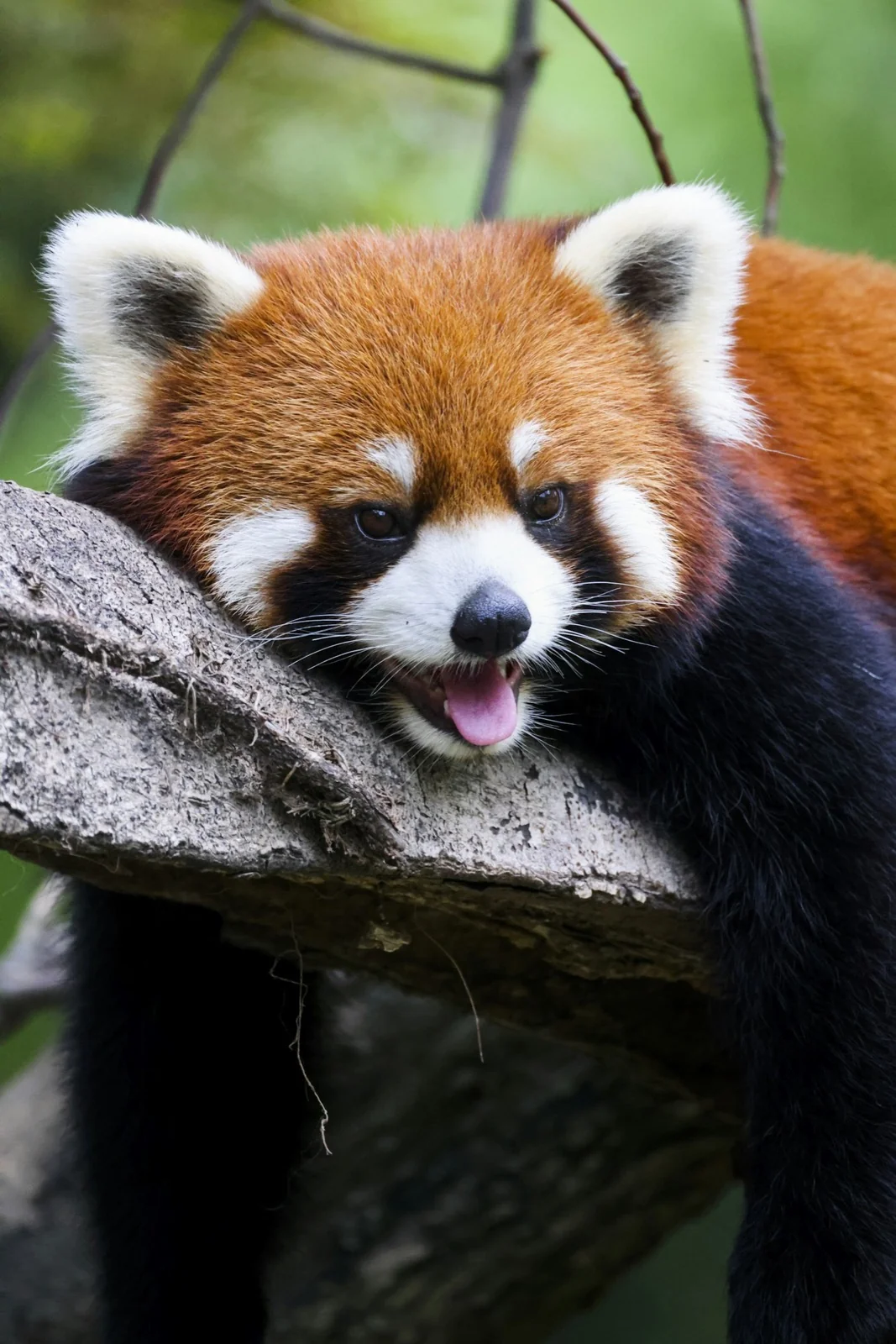
Red panda (Ailurus fulgens) in the wild
The real animal · Ailurus fulgens Foto: Xiangkun ZHU / Unsplash
Habitat
Temperate montane cloud forest with a bamboo understory, between 2,200 and 4,800 m, in the eastern Himalayas and southwestern China
Diet
Mostly bamboo (leaves and shoots), rounded out with fruit, acorns, eggs, and insects; though a carnivoran, it is almost entirely a leaf-eater
Lifespan
about 8-10 years in the wild; up to 14-16 in captivity
Weight
3-6 kg · 50-64 cm body plus a ringed tail of 28-59 cm
Adaptation
A “false thumb” (an enlarged wrist bone) to grip bamboo, a thick tail it wraps around itself like a blanket against the cold, and furred soles for the ice
Record
It is the “original panda”: the name panda was given to it in 1825, half a century before the giant panda, and it is the only living member of its family, the ailurids

Conservation status

Global (IUCN)
Endangered
Where it lives
In China, a decline of around 40% over the past fifty years is estimated; in Nepal, India, Bhutan, and Myanmar, populations survive in patches of montane forest that are ever farther apart.
Population
Fewer than 10,000 mature individuals are estimated worldwide, on a declining trend and scattered across increasingly isolated forest patches; fragmentation makes reliable censuses very hard.

Main threats

  1. Loss and fragmentation of montane forest through expanding crops (cardamom, potato, tea), logging, and livestock grazing on the slopes of the eastern Himalayas.
  2. Free-roaming or feral village dogs, which prey on cubs and transmit canine distemper, lethal to the species.
  3. Poaching and illegal trade in pelts and in live animals for the pet market.
Protected community forest monitored by Red Panda Network's Forest Guardians, habitat corridors funded with Rainforest Trust, and WWF's work in the transboundary Kangchenjunga landscape.

Did you know…?

01
The original panda

The word “panda” was coined for it in 1825, half a century before the “giant panda” existed. Today it lends its silhouette to the mascot of the Firefox browser, the “fire fox.”

02
A thumb that isn't a finger

To hold bamboo it has a “false thumb”: an enlarged wrist bone that acts as a sixth digit. The giant panda has the same trick, invented separately: two unrelated animals that hit on the same solution.

03
The tail that's a blanket

Its thick, ringed tail, almost as long as its body, isn't just for balance in the branches: it wraps itself in it like a blanket to sleep in the mountain cold.

04
A carnivore that barely eats meat

It belongs to the order of carnivores, yet it spends twelve or thirteen hours a day chewing bamboo, of which it digests very little. It has even lost the gene that let it taste meat.

05
It climbs down headfirst

Its ankles rotate almost fully, so it can come down a tree headfirst, claws dug in: something almost no other carnivore can do.

06
One species or two?

For years it was debated whether the Himalayan and the Chinese red panda were two separate species. A recent genomic study found they interbreed, and concluded they are a single species with two forms.

Frequently asked questions

Why is Dolma so colorful and bundled up in her portrait?
Because she's a young red panda from the hills of Darjeeling, in the Himalayas, where the dawn is cold. She wears a knit dungaree, a color-block sweater, and a hood, and in the story she wraps herself in a long blanket-scarf her grandmother wove for her, like her species' blanket-tail.
Is the red panda endangered?
Yes. The IUCN lists it as Endangered: fewer than 10,000 adults remain and falling. Its montane forest is splitting into ever more isolated patches, and it is hit by village dogs and poaching.
Where does Dolma live?
In the hills of Darjeeling, near Singalila National Park, in the eastern Himalayas of India. She's a junior volunteer with the Forest Guardians and spends her days high up in the cloud forest, keeping watch.
§ 08 · Conservation three programs · verified
Red panda

Help protect this species.

Every purchase helps, but a direct donation does more. Three NGOs with specific programs verified for this species.

No. 01 / 03

RPN.

Red Panda Network

A Kathmandu-based nonprofit devoted exclusively to the red panda: it manages community forest and trains the Forest Guardians, local people who patrol and monitor the species.

Donate to RPN
No. 02 / 03

Rainforest Trust.

Rainforest Trust

An international land-purchase and habitat-protection nonprofit that, together with Red Panda Network, funds protected forest corridors for the red panda in Nepal's eastern Himalayas.

Donate to Rainforest Trust
No. 03 / 03

WWF.

WWF (World Wide Fund for Nature)

Through its Nepal program it works in the transboundary Kangchenjunga landscape, one of the last continuous refuges of the red panda, with camera traps and forest-corridor restoration.

Donate to WWF
Animal Kinhood · 23 characters

Twenty-three names. Twenty-three stories. Twenty-three personalities. One same project.

Full catalogue · Drop 01 — Q3 2026 Explore Animal Kinhood