Animal Kinhood Wild animals Endangered
12 min read 6 chapters
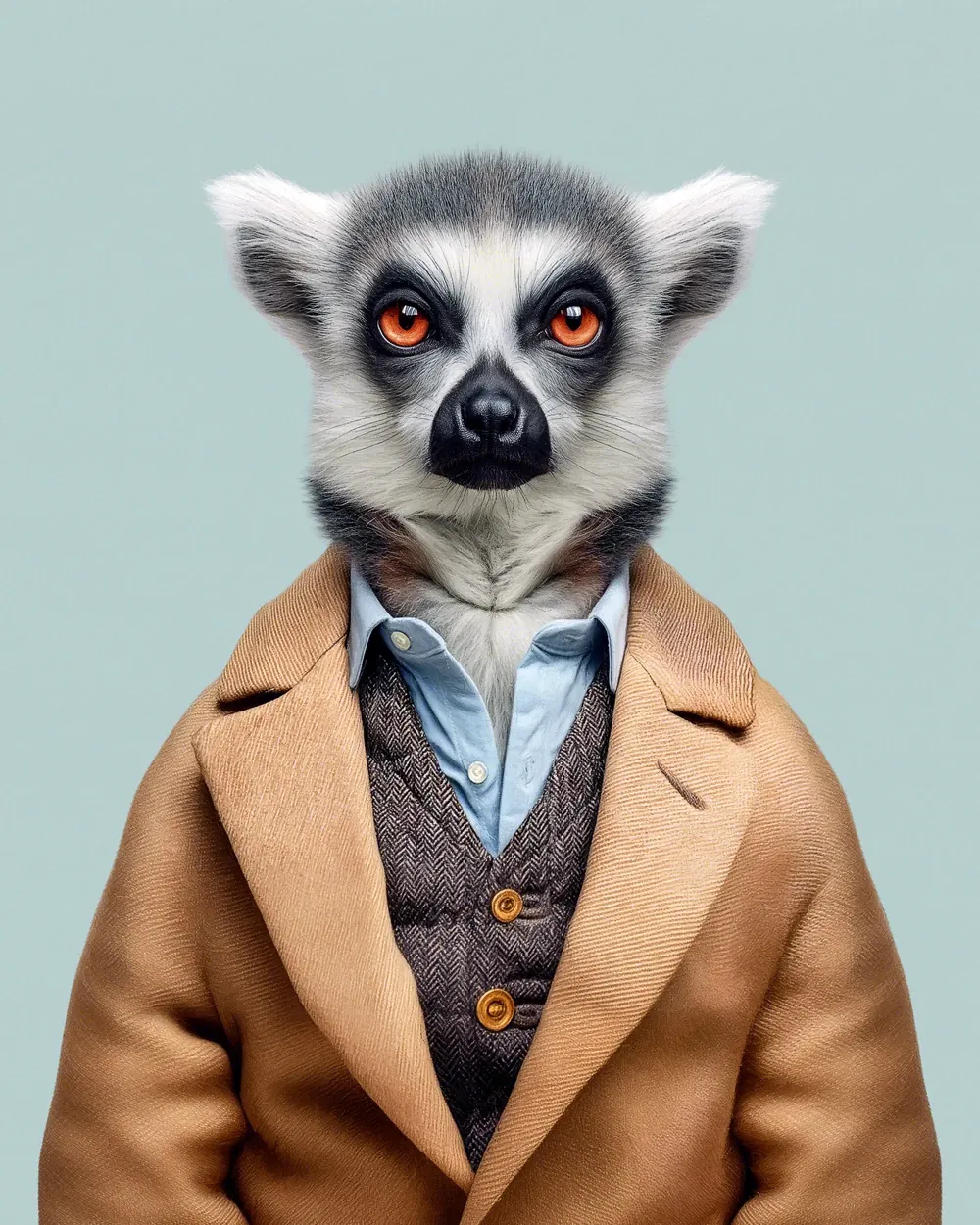
Wesley · Ring-tailed lemur AK · 17 Wesley PHOTO ©YP · 2025
Animal Kinhood · Wild animals No. 17 / 19 Episode · Wesley
Lemur catta

Wesley.

Ring-tailed lemur

Boundaries are measured with a paper tape. A raised voice doesn't move maps.
Add it to your Kinhood.Already part of your Kinhood.
Biography · Block 01 of 03 Ring-tailed lemur
Chapters · I–II

The story.

I
CH · 01 / 06

Paper tape, maps and a goat-hair brush

On Wesley's desk there's a tray with two words written in marker: "In" and "Out". If something arrives at his office — a written submission, a complaint, a cadastral map, an appeal —, it has a place. If something leaves, it does too. The system isn't decoration. It's what lets him keep his head clear for what comes next: angry people, boundaries that shift, agreements that break before the ink is dry.

Wesley works as a community mediation officer. In practice that means that when two families have spent months arguing over where the line between their plots runs — a line that according to one "was always here" and according to the other "got moved when they fixed the road" —, Wesley is the one who unrolls the cadastral map on the courtyard table and says: "The line is here. Do you want us to measure it?" Without raising his voice. Without taking sides. With the data in front of them and a pen ready to write down whatever they agree.

The conflicts that reach his desk aren't the stuff of films. They're conflicts of proximity: who has access to the irrigation channel, who reaches the watering trough first on Tuesdays, whose right of way runs through the back plot, why the neighbour's charcoal smoke comes in every afternoon through the window of the other man's office. In Ambalavao, a town of thirty thousand where subsistence plots start a hundred metres from the market and the granite hills of the Réserve d'Anja rise six kilometres to the south, those conflicts aren't settled in courts. They're settled with someone who listens to both sides, writes down what they say, puts it on paper and gets them to sign.

Wesley is that someone. And his oldest tool is not a civil code or a decree: it's a goat-hair brush given to him by an older archivist on the verge of retirement. "To clean without breaking," he told him. Wesley uses it every morning to dust the documents he takes out of the boxes. He carries it to the office the way others carry a lighter or a keyring. It isn't superstition — it's the only thing they gave him at the mairie without his having to earn it.

II
CH · 02 / 06

What the sun teaches and what the smell hides

Wesley grew up in southern Madagascar, in a setting where the swing between dawn and midday can be twenty degrees. He learned early that the sun isn't scenery: it's the energy that moves the day. As a child, the group organised itself around who warmed up first, who kept watch, who waited their turn. The structure wasn't up for debate. The females were in charge. The males who knew how to wait lasted longer than the ones who pushed.

That logic stayed with him. At the mairie, the deputy mayor has the last word on the files. Wesley doesn't compete for leadership. He competes for clarity. If the deputy tells him to change the format of the minutes, he changes it. If anyone asked him why, he'd say she has more information and more context, and that arguing over a format isn't the battle worth his energy.

What does cost him is smell. Wesley has a sensitivity he can't control: if someone burns incense in the mediation room, he needs to leave. If a neighbour lights charcoal in the building's courtyard without warning and the smoke seeps in through the archive window, Wesley loses concentration for half an hour. He isn't exaggerating. He doesn't choose it. The body reacts before the head — his eyes water, the air runs short, his hands look for something to hold.

He's learned to manage it: unscented soap, mild coffee, windows open whenever he can. When he walks into a closed room, the first thing he does is smell. If it smells neutral, he breathes long. If it smells of something persistent, he opens a window and waits. People sometimes think it's a ritual of authority. It's survival.

Voiceline · the character’s canonical quote Wesley · Ring-tailed lemur
Hover to pause
Boundaries are measured with a paper tape. A raised voice doesn't move maps. AK · 17 · Wesley Boundaries are measured with a paper tape. A raised voice doesn't move maps. Voiceline · Lemur catta Boundaries are measured with a paper tape. A raised voice doesn't move maps. AK · 17 · Wesley Boundaries are measured with a paper tape. A raised voice doesn't move maps. AK · 17 · Wesley Boundaries are measured with a paper tape. A raised voice doesn't move maps. Voiceline · Lemur catta Boundaries are measured with a paper tape. A raised voice doesn't move maps. AK · 17 · Wesley
§ 04 · Objects Open editions · everyday
10 pieces · Print on demand

Take Wesley home.

Biography · Block 02 of 03 Roots
Chapters · III–IV

The roots.

III
CH · 03 / 06

Ambalavao from the inside: market, hills and the reserve in the distance

Wesley likes to walk familiar routes. In a town where the smells change from street to street — silk workshop, cooking smoke, soap from the washing place, generator diesel —, repeating a route is a way of controlling variables. There are streets where the sun comes in two minutes earlier. There are others where the wind drops from the hills and the air clears. Wesley picks those without telling anyone.

At the morning market he buys quickly. Fruit, bread, something savoury. If there's mango, mango. If not, banana. The same vendor as always knows what he wants and sets it aside without making him hold a conversation. Wesley pays the exact amount and leaves. He has plenty of time to reach the mairie, but he'd rather arrive with margin than arrive just on time.

Ambalavao is on the RN7, the road that connects Antananarivo with the south. The tourists drive straight through or stop a night before carrying on towards Isalo or Toliara. Few stay. Wesley doesn't work for the tourists — he works for those who stay. The families who live among the granite hills and the terraced rice paddies. The herders who take their zebu to areas that sometimes overlap with the reserve's boundaries. Those who need someone to translate for them what a map they never asked for says.

The Réserve Communautaire d'Anja is six kilometres to the south. It's one of the densest ring-tailed lemur colonies in the country, managed by the Betsileo community. From the mairie, Wesley sees the conflicts the reserve generates around it: herders who lose access to grazing land, plots that shrink when the protected perimeter is widened, families that depend on ecotourism and families that depend on the land. Wesley doesn't mediate between the reserve and the people — it isn't his jurisdiction —, but he mediates among those who live around it, which is where agreements break and are remade each season.

IV
CH · 04 / 06

The paper that holds up and the paper that crushes

There's one file Wesley keeps apart, in a box separate from the rest. It isn't a special case or an important secret. It's a file where he made a drafting error that delayed an agreement by three weeks. In that time, one of the parties lost access to the irrigation channel during the dry season. Nothing serious happened — they sorted it out afterwards —, but Wesley learned something he doesn't forget: paper can be a tool of justice or a tool of abuse, depending on who handles it and how it's written.

Ever since, he writes with care. He chooses the words of the minutes as if each one carried legal weight, because it does. He doesn't humiliate. He doesn't point fingers. He doesn't put "the claimant alleges without evidence" when he can put "the claimant declares the following". The difference is small in the sentence and enormous at the mediation table.

His way of resolving things works like this: when the tone rises — and it rises often, because land and water are the two things no one wants to lose —, Wesley lowers his gaze to the file. "One moment." He notes something down. He looks up again. "What exact time did it happen?" The specific question cuts the volume. Not always, but enough for the meeting to continue.

Biography · Block 03 of 03 Craft
Chapters · V–VI

The present.

V
CH · 05 / 06

Short messages and alliances from afar

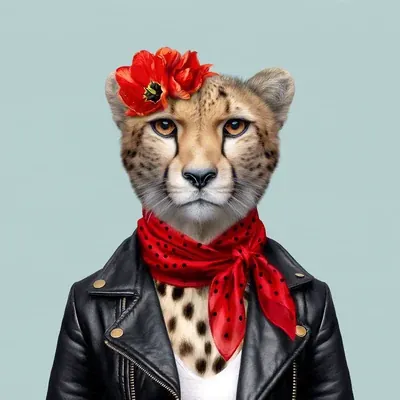
With Nayna, the cheetah who works in security protocol at a municipal complex in Nairobi, Wesley understands each other without needing to explain much. They met through a pilot inter-community mediation project that an NGO ran across three countries. The only thing left of the project was the relationship: short messages, shared checklists, specific favours. Nayna once sent him three words in the middle of an endless meeting: "Get out of there." Wesley stood up, went out to the courtyard, breathed and came back. He wouldn't have done it without that nudge. Now, when he feels he's running out of air in a closed meeting, he remembers the message as if it were an emergency instruction.

What Nayna taught him is to leave in time. What Wesley taught her is to leave evidence without turning it into a threat: that well-written minutes protect both parties, not just one.

There's also an affinity with Jeong, the Amur leopard who works in environmental monitoring in the far east of Russia. They recognise each other in the same thing: few words, checklists, procedures that aren't debated when the environment turns unpredictable. They write rarely, but when they do, the message fits in a single line.

VI
CH · 06 / 06

What Wesley wants to change (and what frightens him)

Wesley doesn't dream of a revolution. He dreams of a protocol. He wants the mairie of Ambalavao to adopt a standard system of community mediation that includes water access, grazing turns and noise as formal categories. One set of minutes per case. The parties signing. Someone following up. It wouldn't change the world — it would change daily life in a town where everyday conflicts are settled by shouting or not settled at all.

What frightens him is the opposite: that pressure from those with more land turns mediation into a farce. That they ask him to sign things he hasn't verified. That the paper stops protecting and starts covering up. If that happened, Wesley would become what he fears most: an official who humiliates with bureaucracy. A man who imposes a sanction because he no longer has the energy to mediate.

But that hasn't happened. For now, every morning he arrives at the mairie, opens the windows, looks for the sun, dusts the documents with the goat-hair brush and puts the "In / Out" tray in its place. Outside, Ambalavao wakes with the market and the smoke from the kitchens. The granite hills to the south can be seen from the courtyard if you lean out. Wesley doesn't lean out much. It's enough for him to know they're there. > **Canonical quote:** The document speaks first. Me afterwards, only if needed. In Ambalavao I learned that a well-drawn cadastral map settles what ten shouts can't.

§ 06 · Connected souls 02 canonical bonds
Animal Kinhood

Connected souls.

§ 07 · Species file Lemur catta
Lemuridae · Primates

About the ring-tailed lemur.

Habitat
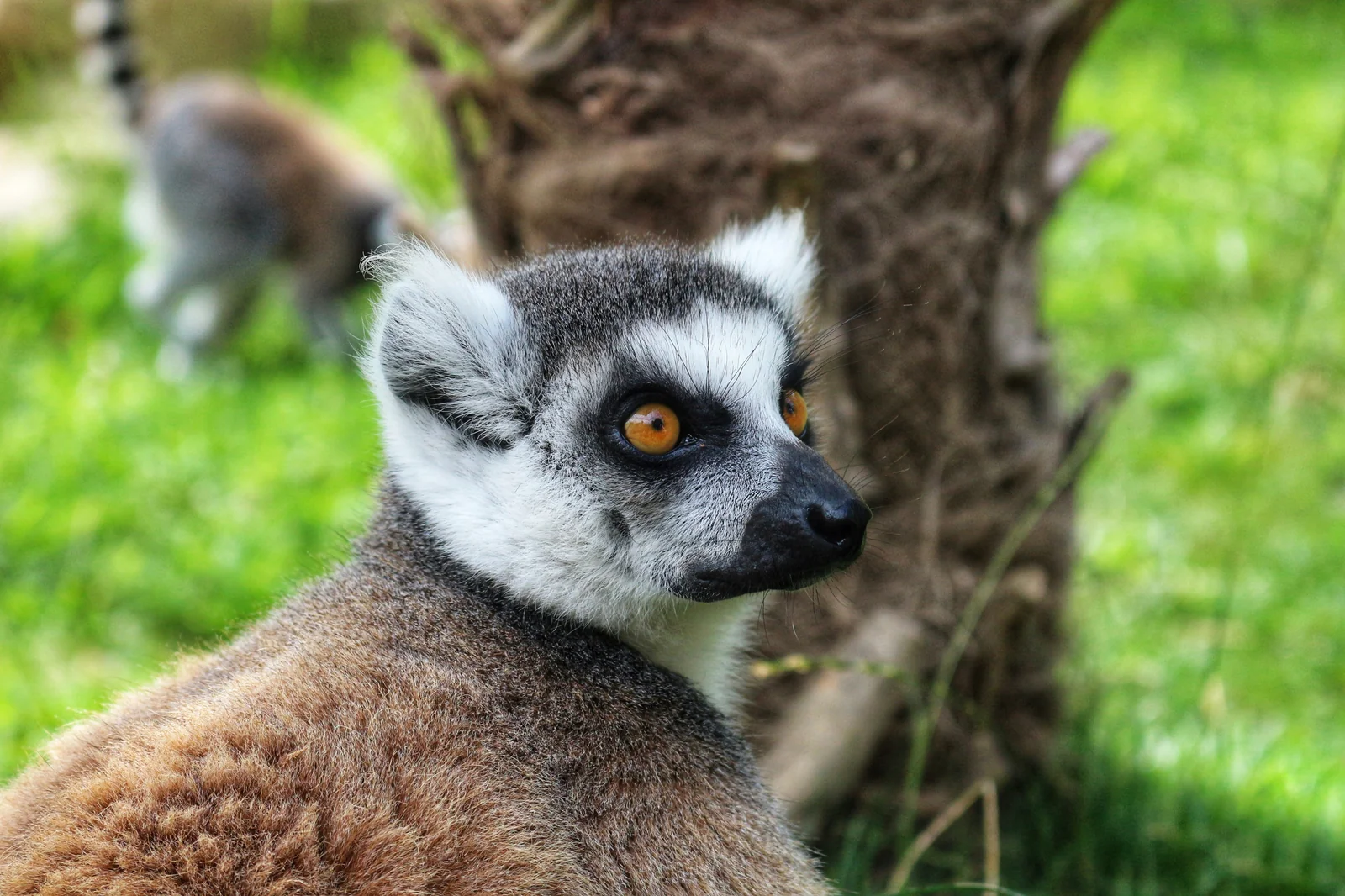
Endemic to southern and south-western Madagascar; inhabits spiny forests, gallery forests, dry scrub and deciduous woodland. Its range runs from Tolagnaro in the south-east to Morondava on the west coast, with inland populations in Ambalavao and the Réserve d'Anja.
Diet
Opportunistic omnivore with a marked preference for the fruit and leaves of the tamarind. Supplemented with flowers, bark, sap, decomposing wood, insects and invertebrates; it also eats mineral-rich soils. It is a key seed disperser.
Lifespan
16-19 years in the wild / more than 20 years in captivity.
Weight
Between 2.2 and 3.5 kg, with a body length of 39-46 cm plus a 56-62 cm tail. There is no appreciable sexual dimorphism.
Adaptation
Thermoregulation through morning group sunbathing in a bipedal posture —back upright, belly exposed, palms open— which lets them reach operating temperature after nights that in Andringitra can drop below -7 °C. It is also the most terrestrial of all living lemurs.
Record
The Réserve Communautaire d'Anja (Ambalavao, Haute Matsiatra) holds one of the highest documented wild population densities for the species, with more than 400 individuals in fewer than 400 hectares of community forest.

Main threats

  1. Accelerating deforestation in southern Madagascar through agricultural expansion, charcoal production and fires.
  2. Subsistence hunting and bushmeat consumption in rural communities with limited access to alternative animal protein.
  3. Illegal capture for the pet trade, driven by the species' charismatic appearance.
  4. Climate change: southern and south-western Madagascar will lose more than 60% of its climatically suitable habitat before 2080.

Did you know…?

01

In ring-tailed lemur groups, any female —even a newly independent juvenile— dominates any adult male. The matriarchy is absolute: females control access to food, choose mates and lead the group's movements.

02

Stink fights between males are not only an exchange of pheromones: they combine secretions from two different glands with symbiotic bacterial communities that shape the chemical message. Research in 2022 showed that the microbial composition varies with the breeding season.

03

Every female in Madagascar comes into oestrus within a window of roughly two weeks a year. This extreme synchrony generates intense, concentrated reproductive competition, and explains the heightened territorial behaviour of the males.

04

The ring-tailed lemur has the proportionally smallest prefrontal cortex of any primate, yet in social cognition tests it scores on a par with monkeys whose brains are three to five times larger.

05

The Latin term lemures referred in ancient Rome to the spectres of the unburied dead. Linnaeus adopted the name in 1758 for these primates for their large, bright eyes and their silent movements.

§ 08 · Conservation three programs · verified
Ring-tailed lemur

Help protect this species.

Every purchase helps, but a direct donation does more. Three NGOs with specific programs verified for this species.

No. 01 / 03

LCF.

Lemur Conservation Foundation

Runs the Lemur Reserve in Myakka City (Florida), with free-ranging lemur colonies, and funds reforestation and environmental education projects in Madagascar.

Donate to LCF
No. 02 / 03

DLC.

Duke Lemur Center

A world reference centre for the study, care and conservation of lemurs since 1966; home to the largest lemur colony outside Madagascar.

Donate to DLC
No. 03 / 03

LCN.

Lemur Conservation Network

A US network bringing together more than 60 organisations active in Madagascar; funds direct conservation projects and supports local communities.

Donate to LCN
Animal Kinhood · 19 characters

Nineteen names. Nineteen stories. Nineteen personalities. One same project.

Full catalogue · Drop 01 — Q3 2026 Explore Animal Kinhood