Matte print vs framed poster: choose without guessing.
Practical guide to choosing between matte print (unframed) and framed poster based on light, children or pets, room style and maintenance. Includes quick decision tree.

Matte print vs framed poster: if you want to hang it today and forget about it, framed poster is the short route. If you prefer to choose a frame to your liking (or already have one), matte printing without a frame gives you more freedom. In brightly lit rooms, glare control is king; with children or pets, protection is usually king. This guide is part of The Backroom.
Quick decision tree (light, children/pets, style)
I simplify it like this: decide with three questions and then adjust with a nuance.
- Light (windows, spotlights, reflections)
-
Too much direct light or spotlights that hit from the front → prioritizes mate and avoid shiny surfaces. If you choose framing, take care of the placement (angle and height) so that the front does not return the window to you.
-
Soft/indirect light → you can choose for presence and maintenance without worrying so much about reflections.
- Children/pets (footprints, bumps, curiosity)
-
There are small hands or snouts nearby → the framing wins by front protection. The risk is displaced: the front (acrylic) can be scratched if you clean it badly, but the paper remains safe.
-
No risk → decide by style and budget.
- Style of room (and how “finished” you want it to look)
-
Minimalist / clean / “I want it to look finished”.” → framing.
-
Eclectic / changing / “I want to choose the frame”.” → matte without frame and frame it your way (now or later).
Final nuance (almost always decisive): If you are going to put it in a narrow hallway, a children’s room or a place where it rubs when you walk by, framing usually gives less everyday problems.
What is each format (and what changes on the wall)?
Although they look similar on screen, they are two different experiences when hung:
-
Matte print / matte poster (without frame): is the matte paper sheet. It is the most flexible option: you can frame it with a frame you already have, use clamps, rest it on a shelf or mount it later when you decide the final style.
-
Framed poster: is the sheet already mounted in a “ready-to-hang” frame, with front protection and hardware.
Question: What exactly arrives if I order “framed poster”? Response: It arrives assembled and ready to hang. In the case of this tent, the front is Acrylite (light acrylic) and the frame is made of wood (on the page of Materials and quality details what it includes and why it is described as a “practical framework”).
Question: Can I buy the matte print now and frame it later? Response: Yes, that’s actually the beauty of the frameless format: you buy the image and give yourself leeway to decide on passe-partout, frame color, or even change the frame over time.
Feeling and presence: why one looks “more finished” (and when it doesn’t matter)
A frame does two very specific things: notes the image and makes it an object. Therefore, a framed poster often feels more like a “final piece” even though the print is the same.
Frameless matte printing, on the other hand, can play in two leagues:
-
Provisional (honest) league: clothespins, washi tape, poster rail, a shelf… works well if you like to move things around or if the space is in transition.
-
Ultimate league (your way): you frame it. The advantage here is that you choose the level of finish: thin frame, solid frame, passe-partout, anti-reflective glass, etc.
Question: Does it look “cheap” if it is frameless? Response: It remains without a frame. If your mental reference is “painting”, you will usually miss it. If your reference is “print/print” (or you like the more editorial look), it can be perfect. If in doubt, framing is usually the safe bet for the living room or entryway.
Light and reflections: what changes the daily experience the most
If there is one factor that turns an “okay” purchase into “it bugs me every day,” this is it.
-
Matte (without frame): matte paper reduces reflections and tends to fare better with windows and sidelight. However, continuous direct light is not a good idea for almost any paper: it can accelerate wear over time. As a simple rule: avoid continuous direct sunlight and high humidity, especially if the film is unprotected from the front.
-
Framed: front protection (acrylic or glass) adds a surface that can reflect. This is not always a problem: it is often fixed with placement (not in front of the window, or with a slight change of angle).
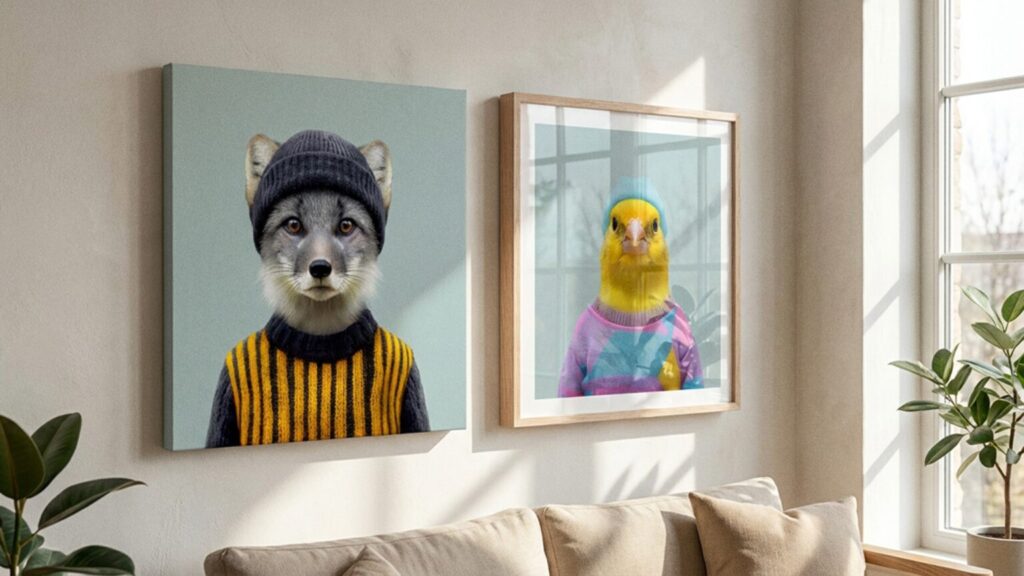
In practice:
-
If the wall receives strong frontal light several hours a day, I would prioritize matte without frame (or custom framed with anti-glare front if you want a frame).
-
If the light is lateral or indirect, framing usually works without too much thought.
Question: I have a window in front of me, will I regret the framing? Response: Only if the placement is fixed and forces you to see it always with reflection. Before deciding, do a simple test: stand at the point from which you will see it most (sofa, bed, table) and look at the wall at different times. If the window “appears” in the exact spot, the frameless matte is more appreciated.
Maintenance and care: dusting, rubbing and cleaning without scares
This is where the difference in the real house is most noticeable.
Framing: less dust on the paper, more care on the front side
The advantage is clear: the paper is not touched, does not stain and does not accumulate direct dust. The disadvantage: the front side must be cleaned thoroughly.
Question: How do I clean the front (acrylic) of a framed poster? Response: With clean microfiber and a cleaner suitable for acrylic. Avoid abrasive products and especially cleaners with ammonia. If grease or fingerprints are present, dry dust first and then wipe gently.
Frameless: more vulnerable, but also simpler

An unframed print suffers more from day-to-day life: rubbing, touched corners, dust, humidity. This does not mean “delicate” in the dramatic sense; it means that it should be treated like paper: handle it by the edges and avoid liquids. If it arrives rolled, it may come with some “memory” from the roll; it is usually sufficient to let it rest stretched out on a clean surface before framing. In prints, the packaging may be a tube or reinforced flat pack, depending on the case.
Typical use cases: when to choose each one without regrets
If you want a rule of thumb (without romanticism), here goes:
Choose framed poster yes…
-
You want hang it when opening the box.
-
It bothers you to see the wall “half-finished” (supported sheet, tape, etc.).
-
There is children/pets and you want a physical barrier between the paper and the world.
-
It is for give away and you don’t want the other person to have to look for a frame.
Choose matte printing without frame yes…
-
You already have frames at home or you feel like choosing them calmly.
-
You like to change location or frame from time to time.
-
The wall receives a lot of frontal light and you prefer to minimize reflections.
-
You want to start with a more contained purchase and then decide on the finish.
Question: What if I want “gallery level”? Response: So the real decision is not “unframed vs. framed”, but “practical framing vs. custom framing”. Custom framing allows you to choose passe-partout, anti-glare or UV protected front, and better control how the piece ages.
For your convenience, in Materials and quality is the technical detail of the paper and framing, and in Frequently Asked Questions are the typical doubts (including what “practical framework” means). For the logistical part (deadlines, packaging, incidents), you have Shipping and return policy. To view available formats and sizes, the most direct entry is Store and collections.