Animal Kinhood Wild animals Critically Endangered
12 min read 9 chapters Live · Nuoro
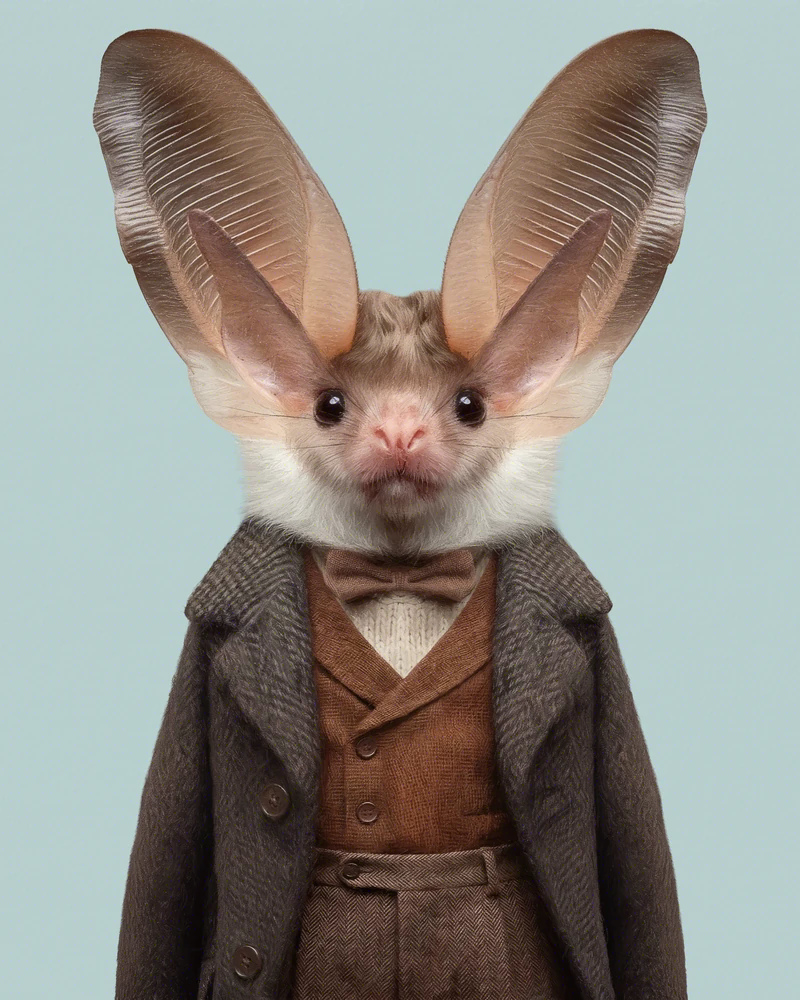
Realistic frontal portrait of a long-eared bat with very long ears, dressed in a bow tie, a brown herringbone vest, a cream knit sweater and a greyish-brown tweed coat, against a plain celadon-green background; slender muzzle, gazing straight ahead. This is Gavino, a character from the Animal Kinhood series by Yago Partal. AK · 01 N 40°19′ E 9°20′ Gavino Nuoro, IT PHOTO ©YP · 2026
Animal Kinhood · Wild animals No. 01 / 24 Episode · Gavino
Plecotus sardus

Gavino.

Sardinian long-eared bat

A stopped watch isn't dead. Most of the time it's just lost its pulse for a moment.
Add it to your Kinhood.Already part of your Kinhood.
Biography · Block 01 of 03 Sardinian long-eared bat
Chapters · I–II–III

The one who opens at night.

I
CH · 01 / 09

A watch isn't looked at

Gavino opens the workshop when the rest of Nuoro is closing up. A rented ground-floor space in Séuna, the old quarter of the city, with a shutter that creaks and a little bell on the door that only rings in the small hours. He works with his bow tie and herringbone vest on even when he isn't expecting anyone, because for him sitting down at the bench is sitting down to something serious. A neighbor comes in with a wristwatch that stops and starts, stops and starts, and he can't work out why. Gavino doesn't open it. He holds it up to his ear, tilts his head, closes his eyes. Half a second. The escape wheel, he says, and he still hasn't touched a screw. A watch isn't looked at, it's listened to. He lets it fall the way you'd say good morning. The neighbor laughs, disbelieving, until Gavino takes the back off the movement and there it is, the escape wheel, exactly where he said. He charges little for that. The old folks of the neighborhood, who bring him watches not worth the repair just to have someone to talk to at dusk, often he charges nothing at all. He gives them conversation and hands the watch back ticking. That's enough for him.

II
CH · 02 / 09

The lamp turned down low

Bright light tires him. He works with the desk lamp turned down almost all the way, a small circle of light on the green felt and the rest in shadow, and that's how he's at ease. He crosses the workshop in the dark without bumping into anything: he reads the room by how it sounds — the hum of the transformer, the drip of the tap at the back, the half-lowered shutter. People coming in for the first time are surprised he doesn't switch on the fluorescent light. He shrugs. With all that light I can't tell what's what, he says, and offers nothing more. When the workshop fills with noise or with people, he turns up the collar of his tweed coat and dims a little inward until he can get back to the quiet. In winter it changes completely. There comes a stretch, in the depth of the cold, when he moves more slowly and talks with his words dragging, sleeps a great deal, and the workshop barely opens. He calls it the season. He doesn't know why it happens to him; he puts it down to his age and to the cold that rises from the stone of the house. When the good weather returns his strength comes back on its own, and he doesn't question that either.

III
CH · 03 / 09

One less window lit

Nuoro empties out without a sound. The young go down to Cagliari or cross to the mainland because there's no work here, and each winter Séuna has one fewer window lit and one fewer workbench open. His own kind, the Sardinian long-eared bats, were always few: families from the inland caves, from the mountains of Oliena and Dorgali, up toward the Gennargentu — a whole people you could cover in a single weekend. Now they're fewer still. The summers of wildfire, worse every year, climb the mountains and scatter whole families when the slope above the breeding caves goes up in flames. Gavino almost never talks about this. He carries it inside, in the silent list of whose watch he fixed last year and who hasn't come back. He repairs the movement, sets it to the right time, and moves on to the next. If someone at the bar turns tragic about the people dying out, he cuts them off with a tired ajò — enough, now — and changes the subject. To his mind, lamenting out loud fixes nothing, and he's a man for fixing things or for keeping quiet. Mostly for keeping quiet.

Voiceline · the character’s canonical quote Gavino · Sardinian long-eared bat
Hover to pause
A stopped watch isn't dead. Most of the time it's just lost its pulse for a moment. AK · 01 · Gavino · Nuoro 2025 A stopped watch isn't dead. Most of the time it's just lost its pulse for a moment. Voiceline · Plecotus sardus A stopped watch isn't dead. Most of the time it's just lost its pulse for a moment. AK · 01 · Gavino · Nuoro 2025 A stopped watch isn't dead. Most of the time it's just lost its pulse for a moment. AK · 01 · Gavino · Nuoro 2025 A stopped watch isn't dead. Most of the time it's just lost its pulse for a moment. Voiceline · Plecotus sardus A stopped watch isn't dead. Most of the time it's just lost its pulse for a moment. AK · 01 · Gavino · Nuoro 2025
§ 04 · Objects Open editions · everyday
10 pieces · Print on demand

Take Gavino home.

Biography · Block 02 of 03 Roots
Chapters · IV–V–VI

The Satta ear.

IV
CH · 04 / 09

The names of the caves

As a boy, his grandmother Lughia would take him to the mouths of the Supramonte caves and tell him, in the dark, the old name of each gallery. She wasn't teaching him geography. She was teaching him to know a place by the sound of its dripping, to stay still and listen before taking a step. Hush — the place tells you where you are, the old woman would repeat; in the neighborhood they called her Tzia Lughia. Gavino was six or seven and didn't understand the lesson, but it lodged in his body. His mother, Grazia, wove on a low-warp loom that took up half the house — blankets and tapestries of the kind they make in the Barbagia — and as a child he fell asleep to the clack of the shuttle going back and forth. That sound of small, repeated work has kept him company all his life. All of Séuna sounded like that back then, he says: looms, the bells of the flocks, the parish bell striking the hours. Now it sounds like fewer things. Grazia is still alive, old now, looked after by Rosaria, the sister who stayed; the other brother, Predu, left for Cagliari as a young man and hardly ever comes back.

V
CH · 05 / 09

The bronzes of Mamoiada

His ear comes from his father. Bachisio tuned by ear the bronze campanacci of the Mamuthones, the masked figures of Mamoiada, right next to Nuoro — those heavy bells that ring out like carnival through the village streets. He took the boy along and taught him to tell when a bronze is dead and when it sings. The first time Gavino understood that an ear like that could earn a living was in a workshop full of bronze bells, helping his father temper them. From there to watches was a short step. He started as an apprentice with the old watchmaker on via Majore, who could no longer see up close and let him stay because the boy heard things in the movements that he himself had stopped hearing. At nineteen he fixed his first watch by ear, without fully opening it, just saying where it was faltering; the master didn't believe him until he took off the back and found the boy was right. When Bachisio died, Gavino inherited the bench and a bronze tuning fork his father had used to bring the bells into tune. He still uses it to tune the balance of the watches. It's the only thing of his own he kept.

VI
CH · 06 / 09

Cloth woven by hand

He met Bonaria at the Redentore festival, selling handwoven cloth at a stall, among the colorful costumes and the crowd. A Sardinian long-eared bat his own age, one of his own kind — something almost impossible to find in a place so small, where everyone has known everyone since childhood and partners are scarce. She weaves a pibiones, the raised wool patterns built up point by point, and he, who spends his life with loupe and tweezers, recognizes his own patience in hers. It took him three years to dare say more than two sentences in a row to her. They married without speeches, with the crisp flatbread pan carasau and house wine, in her parents' garden. Twenty-five years on they still almost never happen to be awake at the same time: she weaves by day, the shuttle clacking on the other side of the ceiling, and he goes down to the workshop when she switches off the loom. They cross paths at dawn and at dusk, in the kitchen, fifteen minutes and a coffee. The marriage lives there, in those two crossings of the day. Your mother's cloth and my watches make the same sound, have you noticed? he said to his daughter once. Clack, tick. Clack, tick. The whole house sounds like small work. He never raises his voice to Bonaria, not even as a joke. He knows how lucky he was to find her, and he doesn't take her for granted for a single day.

Biography · Block 03 of 03 Craft
Chapters · VII–VIII–IX

The watches no one collects.

VII
CH · 07 / 09

The drawer at the back

There's a drawer, at the back of the workshop, that Gavino never opens in front of anyone. Inside are the watches their owners never came back to collect. A customer leaves a movement to be fixed and dies before coming for it; Gavino finishes it anyway, cleans it, sets it to time and keeps it there, in case they come. They don't come. In a town growing old, the drawer has slowly filled with the watches of people who are no longer here. Every night, the last thing he does before heading up to bed is take them out one by one and wind them so they won't stop. He doesn't sell them. He doesn't return them to the families, who don't even know they're there. He can't bear to hear a watch stop when it can still run. The oldest in the drawer is a silver pocket watch belonging to a shepherd from Orgosolo who left it for a cleaning and never came back down from the mountains; Gavino has already replaced its broken hairspring twice to keep it beating. Bonaria caught him one night, coming down for water, winding them in the dark with his ear pressed to one of the movements. She didn't ask whose they were. She left his coffee ready and went back up. Since that night the drawer has been a quiet pact between the two of them, the kind that holds without being named. She hears him at three, some nights, and lets him be.

VIII
CH · 08 / 09

The bus to Cagliari

Mariangela, his daughter, is the only child they had. As a baby she fell asleep to a mobile her father built out of old watch wheels, so she'd learn to drift off to a tick instead of a lullaby. She left for Cagliari to study and look for work, like almost everyone her age in the Barbagia, because there's no future here for a young woman of her kind. Before she got on the bus, Gavino opened up her wristwatch, replaced a worn gasket and told her a bellu a bellu, slowly, slowly, which is what he says when he can't find the bigger words. Now Mariangela calls on Sundays. He grumbles that she doesn't need to call to know her father is still breathing, and then he waits by the phone from mid-afternoon on, watching the wall clock as if it might run the hour forward. When she hangs up he stays a while in the chair, not yet going down to the bench. In the Barbagia new cradles are few, and one that leaves for the city weighs twice as much. But that he doesn't say. He goes down, switches on the lamp, and gets to work.

IX
CH · 09 / 09

A bellu a bellu

He was asked to restore the stopped clock in the tower of a parish church in the neighborhood, and one night, after months of tiny parts and old grease, he set it going. The next morning the bells struck the right hour for the first time in years, and for a while Gavino's quiet trade sounded out for the whole town at once. The pride didn't last long; it embarrasses him. If anyone calls him the last watchmaker in the Barbagia, he laughs and changes the subject, like someone dodging a compliment a size too big; he sees himself as a fellow who fixes watches at night, and that's all. But at three in the morning, when Séuna sleeps and he winds the drawer at the back with his father's tuning fork sitting on the bench, he knows one thing without saying it to himself: as long as one watch keeps running on his street, the place hasn't stopped for good. He switches off the lamp. He climbs the stairs slowly toward the coffee Bonaria will leave him in the morning. And tomorrow again, a bellu a bellu, he'll open when the rest close up.

> **Canonical quote:** Every night, before heading up to bed, Gavino winds the watches their owners will never come back to collect, so that none of them stops.

§ 07 · Species file Plecotus sardus

About the sardinian long-eared bat.

Classification
  1. Animalia
  2. Chordata
  3. MammaliaMammals
  4. Chiroptera
  5. Vespertilionidae
Plecotus sardus
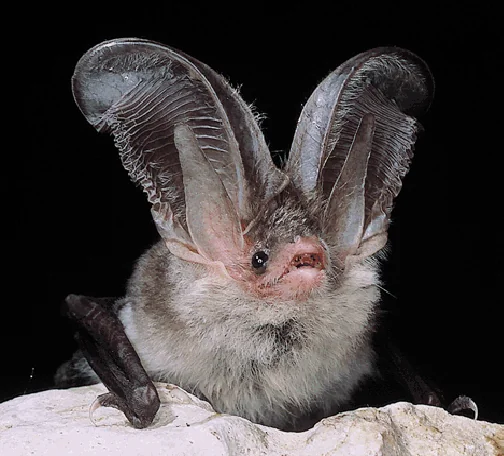
Sardinian long-eared bat (Plecotus sardus) in the wild
The real animal · Plecotus sardus Foto: Mauro Mucedda / Wikimedia Commons (CC BY 3.0)
Habitat
Endemic exclusively to Sardinia; Mediterranean forests of holm oak and cork oak on limestone terrain, with refuges in inland caves (Supramonte, Gennargentu).
Diet
Insectivorous, mostly moths, hunted in slow flight using low-intensity echolocation and passive listening for the sound of the prey itself (gleaning).
Lifespan
No published longevity data specific to the species.
Weight
Up to 9 g; head-and-body length of about 45 mm.
Adaptation
Huge ears, up to 4.5 cm long (almost as long as the body), with the longest tragus in the genus Plecotus (18-19.8 mm), for extremely fine hearing.
Record
The only endemic terrestrial mammal of Sardinia to have survived since humans first arrived on the island, about 8,500 years ago; the rest of Sardinia's endemic mammals went extinct.

Conservation status

Global (IUCN)
Critically Endangered
Where it lives
Sardinia is the entirety of its global range: global and regional status coincide.
Population
From about 950 to about 340 individuals in two decades (−63%).

Main threats

  1. climate change and wildfires in breeding areas
  2. human disturbance of the caves where it shelters
  3. competition with feral pigeons for roosting sites
  4. loss of forest habitat (conifer plantations, pastureland, urbanization)
No documented recovery; the trend remains one of decline, though recent research has located new refuges.

Did you know…?

01
A recently described species

It's one of the most recently described mammal species in Europe, identified barely two decades ago.

02
Ears almost as long as its body

Its ears reach 4.5 cm, and it has the longest tragus — the inner flap of the ear — of the entire genus Plecotus.

03
The last surviving endemic

It's the only mammal endemic to Sardinia that has remained alive since the first settlers arrived, about 8,500 years ago.

04
A hunter that listens

It hunts moths in slow flight, detecting the tiny sound of its prey rather than calling out echoes.

05
The whole species in a handful of caves

The entire known population breeds in just three or four caves in inland Sardinia.

06
A name that is its island

The epithet 'sardus' refers directly to Sardinia, the only place in the world where it lives.

Frequently asked questions

Why is it called the Sardinian long-eared bat?
For its huge ears, almost as long as its body, and because it's endemic to Sardinia (sardus = of Sardinia).
Where does it live?
Only in Sardinia, in the inland Mediterranean forests of holm oak and cork oak, sheltering in caves.
What does it eat?
Insects, mostly moths, which it hunts at night in slow flight by listening for the sound of its prey.
Is it endangered?
Yes: it's listed as Critically Endangered. Its population has fallen from about 950 to about 340 individuals in two decades (−63%).
§ 08 · Conservation three programs · verified
Sardinian long-eared bat

Help protect this species.

Every purchase helps, but a direct donation does more. Three NGOs with specific programs verified for this species.

No. 01 / 03

Centro Pipistrelli Sardegna.

Centro per lo studio e la protezione dei pipistrelli in Sardegna

Sardinian group dedicated to studying and protecting the island's bats, led by the team of Mauro Mucedda, co-discoverer of the species.

Donate to Centro Pipistrelli Sardegna
No. 02 / 03

BatLife Europe.

BatLife Europe

European network of organizations dedicated to the conservation of bats and their habitats.

Donate to BatLife Europe
Animal Kinhood · 24 characters

Twenty-four names. Twenty-four stories. Twenty-four personalities. One same project.

Full catalogue · Drop 01 — Q3 2026 Explore Animal Kinhood