Animal Kinhood Wild animals Least Concern
12 min read 9 chapters Live · Gante
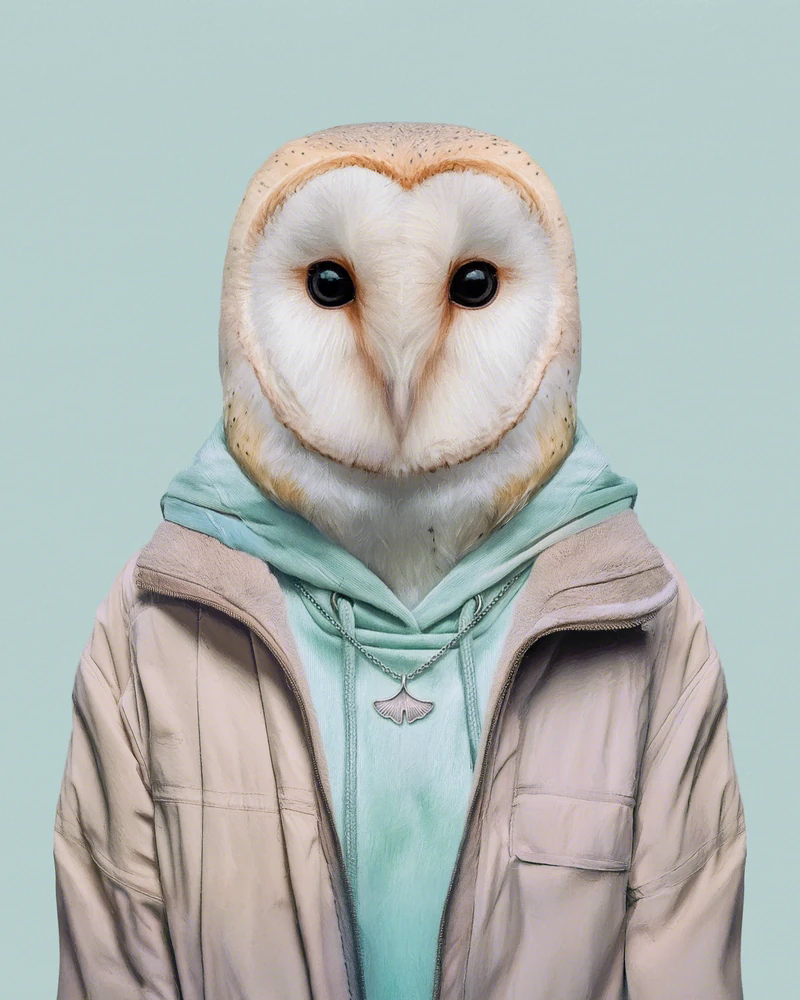
Realistic frontal portrait of a barn owl with a white heart-shaped facial disc and apricot edges, dark eyes; it wears a high-collared beige anorak and, underneath, a mint-green hooded sweatshirt, against a flat background. This is Isabella, a character from Yago Partal's Animal Kinhood series. AK · 01 N 51°03′ E 3°43′ Isabella Gante, BE PHOTO ©YP · 2026
Animal Kinhood · Wild animals No. 01 / 28 Episode · Isabella
Tyto alba

Isabella.

Barn Owl

I can hear it, but I can't name it yet.
Add it to your Kinhood.Already part of your Kinhood.
Biography · Block 01 of 03 Barn Owl
Chapters · I–II–III

First, she listens.

I
CH · 01 / 09

A peak at three thousand two hundred hertz

She closes her eyes in front of the monitors and listens to the whole take. Then she listens to it again. Only then does she speak. "At three thousand two hundred hertz there's a peak. If you push it like that, on good headphones it's going to grate." The client can't hear it; nobody notices that, he tells her. She shrugs. "I do." She points to the exact spot in the mix without looking at the screen and waits for him to check it.

Isabella masters sound at night in Ghent, and she works by ear. With her eyes closed she pinpoints an electrical buzz, the vibration of a fridge, the point where a voice grazes the edge. That's how she decides: by what she hears. When something sounds wrong, she doesn't paper over it. "Don't push it to cover it up. Bring it down and fix it." Silence, for her, is a material, not a gap to fill; she lets a take breathe before she touches it.

Outside the studio she can't stop locating a sound either. In a café she turns her head for a second toward a wrapper three tables away, and comes back. "Sorry. You were saying?" She puts it down to having a fine ear, which is her trade, and thinks no more of it.

Before she gives an opinion she lets out a word. "Wait." One more second to tune in on the inside. Then she decides, and she doesn't go back on it.

II
CH · 02 / 09

The third step

She was eight when she went down the stairs at three in the morning after a sound she couldn't name. It was the gas boiler firing up, but she learned that later. She sat on the third step to wait, without fear, until she understood what it was. Her mother found her there and didn't scold her: she sat down beside her and explained the noise. Isabella asked her to teach her more. "I listen," she said, as if that explained everything.

At KASK, studying audio technology, she found out her ear wasn't like everyone else's. What to her was an obvious buzz, for her classmates didn't exist. While the others called a recording clean, she'd hear the fluorescent light in the hallway, the hard drive of a computer two rooms away, the air passing through a vent. An acoustics professor told her she perceived high frequencies above average. It didn't come free. Certain sirens and engines genuinely hurt her; she covers her ears, closes her eyes, and for a moment she's nowhere recognizable.

Her ear is both her tool and her weak point. She uses it twelve hours a day and protects it the rest.

III
CH · 03 / 09

You sound different today

She started as an assistant at Klokhuis, a studio in Patershol, with Willem. He gave her the rule that still orders her from within: "Don't fix what you don't understand. First listen. Then listen again. Then decide." Isabella doesn't recite it; she wears it. She doesn't argue what she decides either: when emotion gets the better of her, she answers with an undeniable fact; if they push her, she goes quiet; if they insist, she stands up and leaves.

Her way of being with people runs through the ear. She doesn't ask how you are. She listens to how you sound and works it out. For whoever arrives at the studio she adjusts the room temperature before they come in, leaves a glass of water by the booth without being asked, remembers something they said three months ago and mentions it at just the right moment. Instead of "how are you?", she says: "You sound different today." At three in the morning, without taking her eyes off the screen, she opens a jar of almonds and pushes it across the table. "Want some?" If the other person says no, she closes the jar and keeps mixing.

Voiceline · the character’s canonical quote Isabella · Barn Owl
Hover to pause
I can hear it, but I can't name it yet. AK · 01 · Isabella · Gante 2025 I can hear it, but I can't name it yet. Voiceline · Tyto alba I can hear it, but I can't name it yet. AK · 01 · Isabella · Gante 2025 I can hear it, but I can't name it yet. AK · 01 · Isabella · Gante 2025 I can hear it, but I can't name it yet. Voiceline · Tyto alba I can hear it, but I can't name it yet. AK · 01 · Isabella · Gante 2025
§ 04 · Objects Open editions · everyday
10 pieces · Print on demand

Take Isabella home.

Biography · Block 02 of 03 Roots
Chapters · IV–V–VI

Six to six.

IV
CH · 04 / 09

Nachtwerk, by the canal

She set up her studio in Muide, a reconverted industrial neighborhood north of Ghent, beside the canal. She called it Nachtwerk: night work. Two rooms, soundproofing done with a local carpenter and recycled materials. The first night she closed the soundproofed door, sat down and listened for twenty minutes to the silence of the empty room without switching anything on. It was hers. Not Willem's, not anyone's.

Nachtwerk exists because of a commission. A documentary maker from Brussels found three of her tracks on a sound-design forum and asked her for the soundtrack of a documentary about the Scheldt wetlands; with that she paid the deposit on the place. It was the first time field recordings put food on her table.

She opens from six in the evening to six in the morning. Alarm at half past four, blackout curtains, first coffee with nuts, and twelve minutes by bike to Muide, crossing the Graslei and the Coupure. She doesn't measure the hours with a clock: the Belfry carillon strikes the quarters, and she's had them built in since she came to the city. Sessions until two, her own work until half past five, and a walk along the canals to listen to Ghent wake up before she goes to sleep.

The first thirty seconds after she closes the door, when the world goes out and all that's left is what she controls, are her twenty minutes of that first day, compressed.

V
CH · 05 / 09

Which tile creaks

The attic is in an old brick building, third floor with no elevator, near Sint-Baafsplein, with a skylight she opens at night. Isabella knows every crack, which tile creaks, which window lets a draft through, where the moon falls at two in the morning. It has taken her years to build that reference. Losing it wouldn't be a move.

She chose the place for how it sounds. She'd turned down a modern low-ceilinged flat before because you could hear the neighbor chewing. Inside she moves barefoot, opens and closes the doors without a sound; more than one visitor has looked up and she was no longer there: she comes and goes without anyone noticing.

The building is going to be renovated and the rent is going up. That's what keeps her awake by day. A Brussels production company offers her a permanent contract, with office hours. She knows she ought to take it. She can't. "Flexible how? —You can come in at ten. —At night? —…In the morning. —Then it's not flexible for me. No. But thanks."

She doesn't travel if she can help it. When she's forced to, she takes her own pillow and her walnuts, and breathes for the first time in fourteen hours when she steps off the train in Ghent. If someone invites her to Brussels, she answers that they should send her the audio.

VI
CH · 06 / 09

The box of hard drives

When Klokhuis closed —the economy, a breakup, Willem's move to Amsterdam—, Isabella spent six months without a studio. Every night she'd take her bike out to the Waasland polders, plant her microphones in the reed beds and wait for hours. She recorded water, insects, distant trains, wind, owls hunting, which she heard before she saw them. She gathered more than four hundred hours. She released nothing. She didn't mind: she was still listening. In autumn and winter, with the long nights, she recorded more and better; in spring, when day breaks early, she felt hemmed in without quite knowing why, and put it down to winter suiting her.

Those four hundred hours are now in a wooden box, on unlabeled hard drives, and it gives her vertigo to look at it. She knows there's a project inside —an album, an installation, something— and she can't find the shape; she still doesn't know what she wants it to mean. She's embarrassed that someone might discover she has them and has no plan for them.

On Klokhuis's last day she recorded the silence of the empty studio, four minutes and thirty-three seconds. She hasn't played it for anyone. She wrote to Willem once to thank him and got no reply; the message is still in her sent folder, and she doesn't delete it.

Biography · Block 03 of 03 Craft
Chapters · VII–VIII–IX

The few she returns to.

VII
CH · 07 / 09

The ginkgo pendant

At fifteen, her mother gave her a pendant shaped like a ginkgo leaf, a thin silver chain, matte metal. "The things that survive make no noise doing it," she told her. What her mother survived in order to say that line, Isabella has never told. She wears it always. When she listens to a difficult mix she holds it between her fingers without realizing; if someone points it out, she lets go. When she sleeps she leaves it in a little dish beside the bed.

Her mother restores antique furniture on the outskirts of Bruges. She was the one who taught her, that night on the stairs, that listening is a legitimate act and not an oddity. They talk every two weeks, at night, fifteen minutes exactly; her mother got used to her schedule.

Her father is an HVAC technician. He doesn't understand her trade. Every Christmas he asks whether she wouldn't rather have a real job, and she changes the subject. There's no fight. There's a conversation they've gone years without having.

VIII
CH · 08 / 09

Wind from Kvaløya, bells of the Belfry

Otto wrote to her through a field-recording forum, asking what microphone she used for some tracks of the Waasland reed beds. She answered with a question about the Arctic wind. The conversation hasn't stopped since. Voice messages, never text, because they both prefer to hear the other. At three in the morning, the session over, she opens a message from him: forty-seven seconds of wind on Kvaløya. She listens to it twice on the monitors. The next day she sends him fourteen seconds of rain on a zinc roof, without a word. Two loners two thousand one hundred kilometers apart who talk by audio, and neither one suggests meeting.

They both keep recordings they don't know the use of; the difference is that Otto isn't weighed down by it and she is.

The ones who matter are four or five, not a clan. Nayna, an internet acquaintance she trades engine sounds with. Maarten, the downstairs neighbor, retired and widowed, who leaves parcels at her door while she sleeps; she brings him bags up from the market. They understand each other without talking. The baker at the Groentenmarkt saves her a spelt loaf every Saturday without being asked.

IX
CH · 09 / 09

The bell-tower people

Her kind are called "the bell-tower people": a scattered folk, house by house, who nest high and alone. Isabella half-likes the term. What stings is another label, the wise-and-mysterious one, the silent people who know everything. They aren't wise, they're attentive, and the oracle reputation covers up what she really does, which is listen and decide.

Living apart doesn't hurt her: it's the normal thing where she comes from, nobody expects daily company. She prefers three short conversations to one long dinner. But she needs people, in stretches, and doesn't know how to ask for them. She tells herself three things that don't hold up: that she needs no one for this, that the four hundred hours are a hobby and not a project, that the attic doesn't matter to her that much. Her best work comes out when someone's in the room, even if they don't speak. When a night ends she finds it hard to leave; she lingers a moment at the door, opens her mouth, says nothing and goes.

She closes the soundproofed door at six in the morning, climbs up to the attic while Ghent starts to sound, and leaves the pendant in the little dish before she sleeps.

§ 07 · Species file Tyto alba

About the barn owl.

Classification
  1. Animalia
  2. Chordata
  3. AvesBirds
  4. Strigiformes
  5. Tytonidae
Tyto alba
Habitat
Open country with low vegetation for hunting —grassland, marshes, woodland edges, farmland, and the fringes of towns—, from sea level to over 2,000 m; it nests in tree hollows, rock ledges and, very characteristically, in barns, church towers, and lofts
Diet
A predator of small mammals (voles, mice, rats, shrews), which make up around 95% of its catches; it hunts in low flight or from a perch, locating prey almost entirely by ear
Lifespan
barely 1-4 years on average in the wild, owing to high first-winter mortality; ringed birds pass 15 years and in captivity it can reach 20
Weight
250-550 g · 33-39 cm body plus an 80-95 cm wingspan
Adaptation
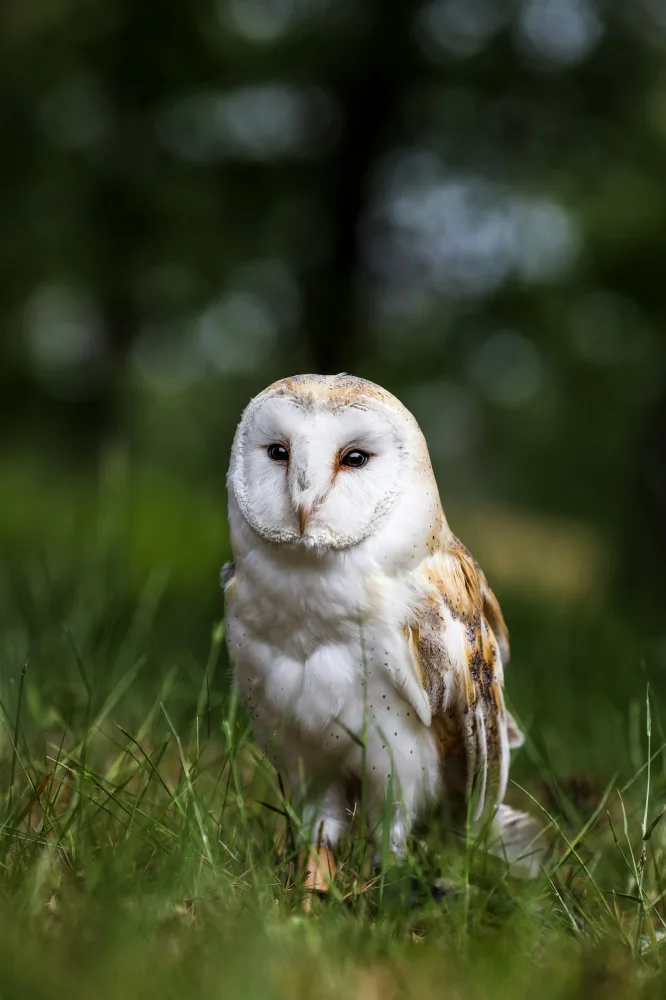
Near-silent flight —the serrated leading edge of its primaries breaks up turbulence and a velvety wing surface soaks up the rush of air— and a heart-shaped facial disc that funnels sound toward asymmetric ears to triangulate prey in total darkness
Record
In Roger Payne's experiments (1971), barn owls in the dark located mice by sound alone with an error of one or two degrees: the finest sound localization ever recorded in a non-echolocating vertebrate

Conservation status

Global (IUCN)
Least Concern
Where it lives
Not threatened globally, but the European population shows a documented downward trend; the Netherlands, Germany, and the United Kingdom suffered marked declines from the mid-twentieth century that prompted large-scale nest-box schemes.
Population
Estimated at between 4 and 10 million mature individuals worldwide (IUCN); in Europe, between 164,000 and 356,000 mature individuals.

Main threats

  1. Loss of grassland, hedgerows, and field margins to agricultural intensification, which shrinks its hunting habitat and prey availability.
  2. Secondary poisoning by second-generation anticoagulant rodenticides, built up in the rodents of its diet.
  3. Collisions with vehicles on rural roads, one of the main causes of mortality given its habit of hunting low over the verges.
  4. Loss of traditional nesting sites (old barns, hollows in mature trees) to agricultural modernization and the felling of old trees.
In the United Kingdom, about half of the current breeding population occupies artificial nest boxes; the Raptor Nest Box Project alone has helped fledge some 2,500 chicks since 2008, proof that the species responds well to active management combined with protection of its hunting habitat.

Did you know…?

01
Hunting guided by sound alone

It hunts in total darkness guided by hearing alone. Its heart-shaped facial disc works like a parabolic dish that steers sound toward its asymmetric ears, able to pinpoint a mouse under the grass to within about two degrees.

02
A flight that makes no sound

The leading edge of its feathers carries a microscopic comb-like fringe that breaks up turbulence, and a velvety surface soaks up the rest of the noise. It flies so quietly that it can keep hearing its prey as it swoops—something almost no other bird can manage, drowned out by the sound of its own flight.

03
The most widespread land bird on the planet

Save for the polar regions, the great deserts, and some islands, the barn owl lives on every inhabited continent. It is one of the land birds with the widest natural range in the world.

04
Staggered clutches that bet on abundance

It lays between 4 and 12 eggs two or three days apart, so the chicks hatch in stages and at very different sizes in the same nest. In years with many rodents it breeds two or three times; in lean years it may not breed at all: its fertility tracks the cycles of its prey.

05
A farm ally worth 3,000 rodents a year

A pair with its brood can take more than 3,000 rodents in a year, which makes it a form of biological pest control. The cross-border project “Barn Owls instead of Pesticides” sets up nest boxes on farms in Israel, Jordan, and the West Bank to replace rodenticides with owls.

06
Its scientific name describes its face, not its size

“Tyto” comes from the Greek for “owl” and “alba” from the Latin for “white,” after the pale plumage of its belly and facial disc. Its common name, by contrast, points in many languages to where it nests: barns in English, bell towers in French, towers in Portuguese.

Frequently asked questions

Why does Isabella work at night?
Because she is a barn owl, a nocturnal bird: her species hunts and moves by night, guided by hearing. Isabella lives it as a craft—she masters and records sound between six in the evening and six in the morning in her Ghent studio—not as an oddity.
Why is her face heart-shaped?
The facial disc acts like a parabolic dish that funnels sound toward her ears, set asymmetrically in the skull. It is what lets her locate prey—or, in Isabella's case, a nuance in a mix—by ear alone.
Is the barn owl endangered?
Not globally, where it is listed as Least Concern. But its European populations have been in documented decline for decades from the loss of farmland habitat, rodenticides, and road deaths, and are sustained in part by nest-box schemes.
§ 08 · Conservation four programs · verified
Barn Owl

Help protect this species.

Every purchase helps, but a direct donation does more. Four NGOs with specific programs verified for this species.

No. 01 / 04

GWCT.

Game and Wildlife Conservation Trust

A British applied-research organization that studies how barn owls use farmland habitats and runs the “Owl Box Initiative,” active on more than 100 farms and 40,000 hectares of south-west England, installing nest boxes and advising on strips of tall grass for their prey.

Donate to GWCT
No. 02 / 04

Hawk and Owl Trust.

The Hawk and Owl Trust

A British charity devoted to birds of prey by day and night; it manages the Sculthorpe Moor and Shapwick Moor reserves with hunting habitat for the barn owl and runs the “Adopt a Box” program, which funds and monitors nest boxes with live cameras.

Donate to Hawk and Owl Trust
No. 03 / 04

Hawk Conservancy Trust.

Hawk Conservancy Trust — Raptor Nest Box Project

Since 2008, this British project has installed more than 1,600 nest boxes for birds of prey across some 4,600 km² of southern England, over 900 of them specifically for barn owls, with close to 2,500 chicks fledged since then.

Donate to Hawk Conservancy Trust
No. 04 / 04

The Peregrine Fund.

The Peregrine Fund

An international raptor-conservation organization that funds field research, captive breeding, and the training of biologists in dozens of countries, aiming to halt the decline of more than half the world's birds of prey.

Donate to The Peregrine Fund
Animal Kinhood · 28 characters

Twenty-eight names. Twenty-eight stories. Twenty-eight personalities. One same project.

Full catalogue · Drop 01 — Q3 2026 Explore Animal Kinhood