Animal Kinhood Wild animals Critically Endangered
12 min read 9 chapters Live · Bukit Lawang
Frontal, realistic portrait of a Sumatran orangutan infant, with rust-red fur and a grey, alert face with big dark eyes, dressed in denim overalls over an orange-and-white striped shirt, against a plain greyish-green background. This is Togar, a character from Yago Partal's Animal Kinhood series. AK · 02 N 3°33′ E 98°08′ Togar Bukit Lawang, ID PHOTO ©YP · 2026
Animal Kinhood · Wild animals No. 02 / 28 Episode · Togar
Pongo abelii

Togar.

Sumatran orangutan

Add it to your Kinhood.Already part of your Kinhood.
Biography · Block 01 of 03 Sumatran orangutan
Chapters · I–II–III

Up high, holding on.

I
CH · 01 / 09

The first canopy

The first thing Togar remembers isn't a face: it's the forest seen from above, moving. His mother carried him clinging to her hair, crossing the canopy branch by branch, and he, hanging from her, watched the green slide past below. Even now, up high still feels to him like the good place, and down below a little less his own.

He lives in the canopy of the Leuser Ecosystem, in the north of Sumatra, beside Bukit Lawang, where the forest ends and the cleared land begins. He's a Sumatran orangutan infant: reddish fur, grey face, six years old, and a childhood ahead of him that will last years. Up high, among the tall trees that bear fruit almost all year round, he wants for nothing as long as his mother is near.

He doesn't come down to the ground if he can help it. His arms are enormously long and his feet grip like hands, so he hangs, swings and holds on to any branch with an ease that seems perfectly ordinary to him. His whole life fits up at that height: the tree where he slept last night, the one that will be loaded with figs next week, the branch he watches from.

II
CH · 02 / 09

Just the two of them

Togar's family is tiny: his mother, Tiur, and him. The orangutan is the most solitary of the great apes; each adult lives in its own patch of forest, without crowding together. The only close bond, the longest there is in the animal kingdom after that of people, is the one between a mother and her infant, and Togar's entire world is made of it.

His father doesn't live with them. The big males each go their own way, off on their own, and they don't raise young. Togar knows him only by hearsay — or rather by ear: he's that long, deep sound that arrives at dawn, from far, far away, from the next valley over. A big flanged male letting the world know he's there. Nothing more.

Nearby, on her own branch, is grandmother Rumondang, Tiur's mother, an older female whose canopy overlaps with theirs. They cross paths now and then and she leaves him the best ripe fruit, the kind she's already had a chance to taste. She keeps the old names of the forest's trees. When she calls him, she just says "Tog." Those are Togar's presences: two, and a voice at daybreak.

III
CH · 03 / 09

The people of the canopy

His own people call themselves, without making a fuss of it, the people of the forest, or the ones up in the canopy. It isn't poetry: it's what they are, the ones who live up high, in the trees. In the northern lands, the people down below have always had the custom of leaving them in peace, of not touching them, because they look too much like them: the hands, the face, the infant clinging to its mother. That old respect is the solid ground the people stand on.

What breaks things is what's new. The forest shrinks at its edges and splits from within: the canopy is felled for plantations, and what's left is cut into pieces by tracks carved out by machines. Each season there's less unbroken canopy to cross and more scattered patches, further and further apart. A family left without its trees has nowhere to go.

Grandmother Rumondang tells of a whole hillside that one year woke up cut through by a new clearing: the families on one side never crossed over to those on the other again. Togar still doesn't fully understand that story. He hears it as the evening falls, when it's not yet time to make the nest, and he goes quiet.

Voiceline · the character’s canonical quote Togar · Sumatran orangutan
Hover to pause
AK · 02 · Togar · Bukit Lawang 2025 Voiceline · Pongo abelii AK · 02 · Togar · Bukit Lawang 2025 AK · 02 · Togar · Bukit Lawang 2025 Voiceline · Pongo abelii AK · 02 · Togar · Bukit Lawang 2025
§ 04 · Objects Open editions · everyday
10 pieces · Print on demand

Take Togar home.

Biography · Block 02 of 03 Roots
Chapters · IV–V–VI

Not yet, but one day.

IV
CH · 04 / 09

What's this one called?

At four, Togar invented a game no one taught him: pointing at each fruit so his mother would tell him its name. The fig. The durian. The mangosteen. The one that stings and can't be eaten. The one you have to open with a stick. Twenty times a morning, the same question — and what's this one called? — until it lodges inside him.

It's not just the name. With each fruit he stores away in his head where the tree stands and in which moon it bears, just as his mother does — she moves through the forest without ever getting lost, as if she carried a map no one else can see. Togar is beginning to fill in that map. He already knows a few trees by heart: the fig tree, the durian tree, the old trunk where there's sometimes honey.

He learns by watching. It's his people's way: an infant spends years glued to its mother and gets everything from copying her, from asking and from paying attention. For Togar, learning isn't a chore; it's his way of being with her. Each thing he gets a little better at is a while longer at her side, on the same branch.

V
CH · 05 / 09

The nest that falls apart

Every evening, before sleep, an orangutan builds itself a fresh nest by bending branches in the canopy. His mother does it in a moment, with her hands, almost without looking. Since he was two, Togar has been attempting the same thing beside hers, stick by stick, just the way he sees her bend them. And almost always it comes apart under him.

The first time he nearly fell. He grabbed hold, laughed, and tried again the next day. Since then he makes a nest every evening, and almost all of them collapse, and almost all of them he tries again. He doesn't call it failure. His is the stubborn determination of an infant who wants to do it himself: he shows off the half-made nest — "look, I made one" — and adds, without any drama, "it fell apart, but almost."

Infants start practicing the nest at six months and don't master it until they're five. Togar is right in the middle of that. His line, the one he repeats when something won't come out right, is always the same: I can't do it yet, but one day I will. He says it about the nest, about the little stick, about everything. And he means it, absolutely.

VI
CH · 06 / 09

His little stick

One day, at five, he watched his mother slip a stick into the fruit that stings — the one guarded by little hairs that dig in — to get the seeds out without hurting herself, and into an old trunk to reach the honey and the insects. Togar looked for his own stick, tried it, couldn't do it, tried it again. And he kept it.

He doesn't let go of it even to sleep. It's his tool, pretend and real at the same time: with it he imitates his mother, with it he practices, and he carries it everywhere. He still pulls out more hairs than seeds, but it's his, and it's the clearest proof that he's learning the trade of being grown up before he's able to be.

That stick is no ordinary toy. Using sticks to get at honey or open a fruit doesn't come built in: it's a technique that's learned, that mothers pass to their infants, and that each valley of the forest does a little its own way, like a custom. Togar is receiving it from Tiur, gesture by gesture, without knowing that one day he'll pass it on to another infant in another canopy.

Biography · Block 03 of 03 Craft
Chapters · VII–VIII–IX

The voice to come.

VII
CH · 07 / 09

He doesn't want to sleep alone

Underneath all of Togar's joy there's a fear, and it isn't of death: it's being left alone in the canopy before he knows how to manage. It's a very specific fear, the fear of an infant of a people whose childhood lasts years and years. If his mother isn't there, who teaches him the nest? How does he know which fruit to eat? That's why he holds on tight, why the "one day I will" always comes with a "not yet."

One morning, in the next canopy over, neither the mother nor the little one Togar used to pull faces at from tree to tree were there anymore. The grown-ups spoke very quietly about some who come up to take the infants away. Togar didn't understand it. He only noticed they were gone, and that night he burrowed deeper into his mother's nest and wouldn't let go of her. He didn't make his practice nest that day.

Since then, some nights he asks to be told again which one is the honey tree, until he falls asleep. And sometimes, without meaning to, he asks in a low voice: you're not going to go away, are you?

VIII
CH · 08 / 09

The call of the big one far away

The first time Togar heard the long call, he was four and it frightened him. It was before dawn, above the forest: a deep sound he'd never heard, coming from far, far away. He clung to his mother. She didn't move. She told him it was a big flanged male, from the next valley over, and that that's what the males do when they grow up.

It's the voice that carries farthest in the whole forest. The call of an adult male can be heard from nearly a kilometer and a half away: no other Asian great ape's voice travels so far. Togar tried to imitate it right there and out came a tiny little squeak. Since then, when he hears it at dawn, he goes very still, listening to what he will become.

Because that's his horizon. One day he'll have that voice, and wide flanges on the sides of his face, and his own patch of forest to roam alone. Some males take years for the flanges to come in, and until then they live a different way. Togar has a very long way to go. For now he practices the squeak, and it doesn't come out right, and he tries again.

IX
CH · 09 / 09

The fruit season

There's a time of year when the forest fills with fruit all at once. The trees bear all together, and then there's hardly any need to travel to eat. His mother takes him from canopy to canopy the whole day long, both of them stuffed with figs and durian, bellies full, ripe fruit within arm's reach. These are Togar's best days.

He learned, without being told, that such abundance doesn't last. That behind it come the lean seasons, when you have to know the trees by heart and travel farther to find food. That's why he asks so much, why he stores every tree in his head: for when the forest won't give it all so easily.

But that's for later. Right now it's the good season. Togar eats, leans against his mother for a while when the sun beats down, and at dusk builds his practice nest beside hers. Almost always it falls apart. As it gets dark he climbs into his mother's, holds on, and asks her for the story of the honey tree. Tomorrow he'll try the nest again. One day it will hold him all night long.

<!-- PRM-025: naturalness pass applied (3rd-person voice, concrete detail, no preaching or piled-up flourishes) -->

> [!info]- Conexiones > YP Studio

§ 07 · Species file Pongo abelii

About the sumatran orangutan.

Classification
  1. Animalia
  2. Chordata
  3. MammaliaMammals
  4. Primates
  5. Hominidae
Pongo abelii
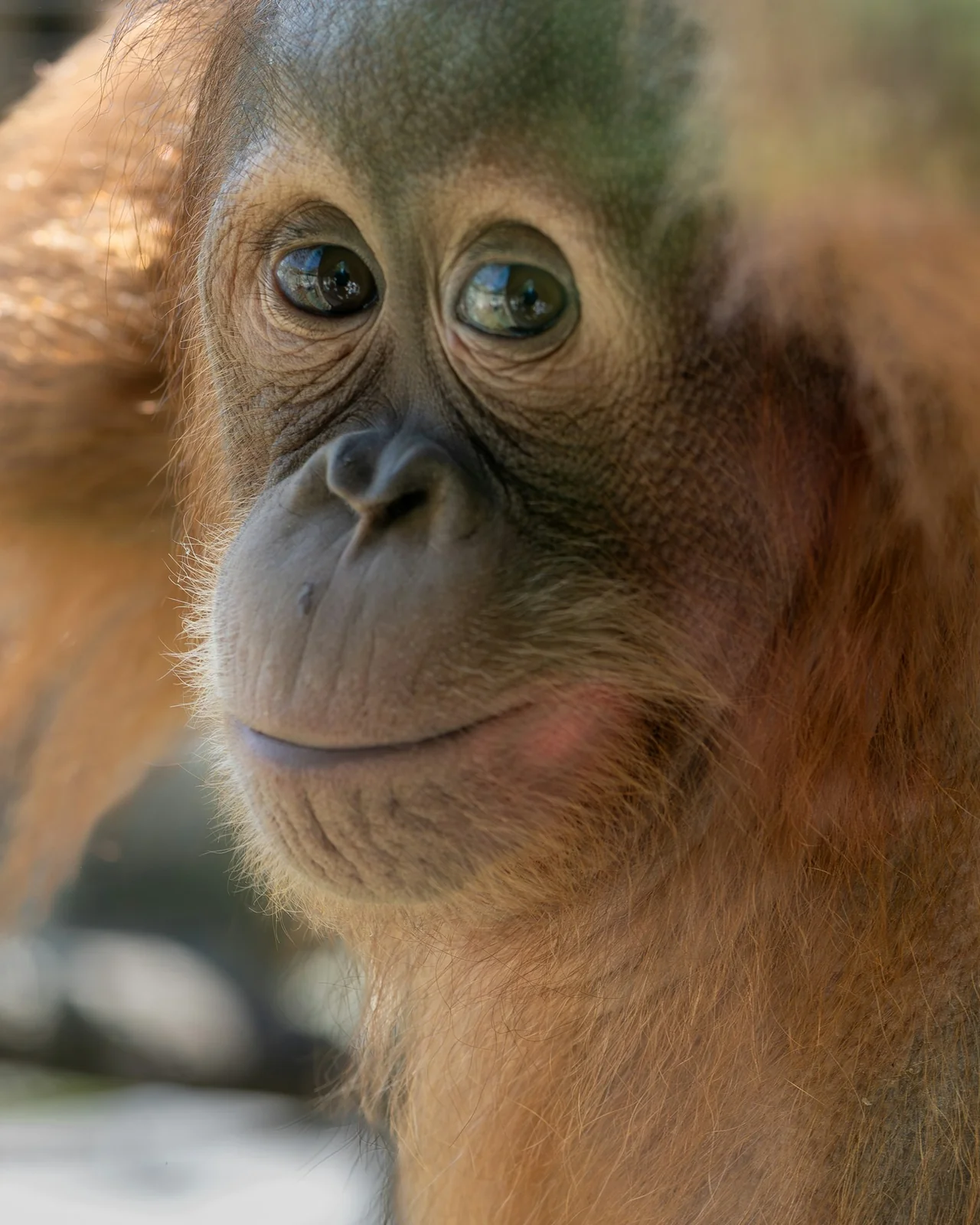
Sumatran orangutan (Pongo abelii) in the wild
The real animal · Pongo abelii Foto: Einar Storsul / Unsplash (Unsplash License)
Habitat
Lowland and montane tropical rainforest in northern Sumatra (Indonesia), above all the Leuser Ecosystem (Aceh and North Sumatra), always high in the canopy of tall trees that bear fruit year-round
Diet
Mostly fruit (more than 60% of the diet): figs, durian, mangosteen and other forest fruits, rounded out with leaves, bark, honey, eggs and insects it fishes out with sticks
Lifespan
around 30-40 years in the wild
Weight
strong dimorphism: flanged males reach around 90 kg and 1.7 m; females are around 45 kg · the arms, outstretched, far exceed the body's height
Adaptation
Very long arms and grasping hands and feet (four "hands") for life in the canopy, and an exceptional memory of the forest: it remembers where each fruit tree stands and when it bears
Record
The long call of an adult flanged male carries about 1.6 km, the farthest-reaching vocalization of any Asian great ape

Conservation status

Global (IUCN)
Critically Endangered
Where it lives
It is the great ape with the smallest range in the world: the entire wild population lives in northern Sumatra (Aceh and North Sumatra), above all in the Leuser Ecosystem, the only place where tigers, elephants, rhinos and orangutans still live together in the wild.
Population
An estimated 13,800 individuals remain, and falling. A cited model projects a decline of up to 81% between 1985 and 2060 if current trends continue.

Main threats

  1. The clearing of the forest for oil-palm and pulpwood plantations, which takes away the very fruit trees it lives on.
  2. The fragmentation of the forest by roads and mining, which leaves families isolated in patches of jungle that no longer touch.
  3. Poaching and the capture of infants for sale: to take a baby, the mother is killed.
The Sumatran Orangutan Conservation Programme (SOCP) has rescued and reintroduced hundreds of animals into protected forests, though on its own it does not reverse the decline; the loss of forest has to be stopped.

Did you know…?

01
The longest childhood after ours

The infant spends seven to nine years glued to its mother before it can manage on its own: the longest childhood in the animal kingdom after that of people. It learns everything by watching her: which fruits to eat, how to cross the canopy, how to fold a nest.

02
A new nest every night

Every evening it builds a fresh nest by bending branches in the canopy to sleep in, and some add a roof of leaves if rain threatens. Infants start practicing at six months, but don't get it right until about five years old.

03
Tools taught from one valley to the next

It uses sticks as tools: to get at honey or insects, or the seeds of the Neesia fruit, guarded by stinging hairs. The technique isn't instinct: it is learned, and each population does it its own way, like a custom passed from mothers to infants.

04
The voice that carries farthest

The long call of an adult flanged male can be heard about a kilometer and a half away across the forest: no other Asian great ape's voice carries so far.

05
Two ways to be a big male

There are flanged males (with wide pads on the sides of the face) and unflanged ones; some take years to develop the flanges, and until they have them they live a different way.

06
The gardener of the forest

By eating so much fruit and moving so much, it scatters the seeds of hundreds of fruit trees across the forest. Without it, a forest like Leuser grows back far worse: it is, without meaning to, its gardener.

Frequently asked questions

Why does Togar wear denim overalls and a striped shirt?
Because he's a Sumatran orangutan infant, and in Animal Kinhood the animals dress like people. His fur is reddish, like his species, and he has the grey face of the young; the denim overalls and the orange-and-white stripes are a kid's clothes.
Is the Sumatran orangutan endangered?
Yes, Critically Endangered. About 13,800 remain, and falling. Its forest is cleared for palm oil and paper, and infants are captured. They all live in northern Sumatra, above all in the Leuser Ecosystem.
How long does an infant stay with its mother?
Seven to nine years, the longest childhood in the animal kingdom after that of people. In that time it learns, just by watching her, to build nests, recognize hundreds of fruits and move through the canopy.
Where does Togar live?
In the forest of the Leuser Ecosystem, beside Bukit Lawang, on the edge of Gunung Leuser National Park, in the north of Sumatra (Indonesia).
§ 08 · Conservation three programs · verified
Sumatran orangutan

Help protect this species.

Every purchase helps, but a direct donation does more. Three NGOs with specific programs verified for this species.

No. 01 / 03

OIC.

Orangutan Information Centre

An Indonesian NGO based in Medan (North Sumatra) that restores forest, rescues and rehabilitates orangutans and works with communities against deforestation.

Donate to OIC
No. 02 / 03

SOCP.

Sumatran Orangutan Conservation Programme

A programme run by the PanEco Foundation with the Indonesian NGO YEL: it rescues captive orangutans and creates new wild populations in Leuser, Batang Toru and Ulu Masen.

Donate to SOCP
No. 03 / 03

SOS.

Sumatran Orangutan Society

A UK charity focused on the Sumatran orangutan: forest restoration, community patrols and education against deforestation and palm oil.

Donate to SOS
Animal Kinhood · 28 characters

Twenty-eight names. Twenty-eight stories. Twenty-eight personalities. One same project.

Full catalogue · Drop 01 — Q3 2026 Explore Animal Kinhood