Animal Kinhood Wild animals Critically Endangered
12 min read 9 chapters Live · Whenua Hou
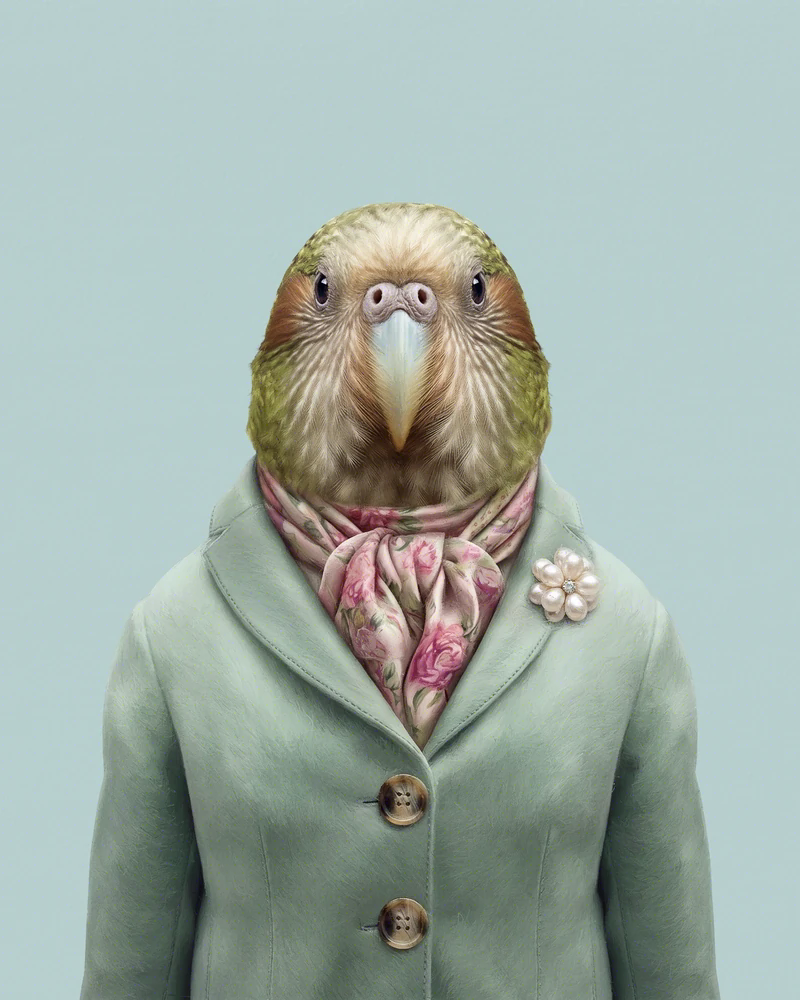
Front-facing portrait of Kiri, a middle-aged kakapo, wearing a sage-green tailored jacket, a pink floral scarf tied at her neck, and a flower-shaped pearl brooch on the left lapel, against a plain teal background. AK · 30 S 46°46′ E 167°38′ Kiri Whenua Hou, NZ PHOTO ©YP · 2026
Animal Kinhood · Wild animals No. 30 / 30 Episode · Kiri
Strigops habroptila

Kiri.

Kakapo

It doesn't have to be tonight. Just say the word.
Add it to your Kinhood.Already part of your Kinhood.
Biography · Block 01 of 03 Kakapo
Chapters · I–II–III

Two Hundred and Thirty-Four Names.

I
CH · 01 / 09

She Knows the Whole List by Heart

Kiri is a midwife on Whenua Hou, a fourteen-square-kilometre island off the coast of Rakiura, at the southern tip of New Zealand. She attends the births of the kakapo people, and the whole kakapo people — the whole world's worth, not just this stretch of coast — doesn't add up to three hundred.

When an outsider asks how many people she looks after, she answers with the exact number. Two hundred and thirty-four. If the visitor presses, surprised, Kiri adds that she knows the whole list by heart, names included, and that it's no great feat. It isn't, either: when a whole people fits in a notebook, knowing the names is simply how you keep count.

What does have consequences is the other thing, the part the visitor never quite grasps. Every person born on that island changes the census of an entire people. Not a valley's. Not a region's. A species'.

Kiri has always known it, and she would never put it in those words — it would sound like a speech. Instead, she puts on her jacket, picks up her bag, and goes out.

Her people are seen as slow, odd, a bit of a museum piece — people to be looked after rather than counted on. Contempt bothers Kiri a good deal less than pity does. When an outsider talks about her own in that tone, she answers with facts, in a flat voice that cuts sharper than bluntness ever could.

II
CH · 02 / 09

What Hine Taught Without Saying a Word

She was born on another island. At nine, she was put on a boat with twelve other people and set down on Whenua Hou; nobody explained why, because the explanation was demographic and she was nine years old. She remembers the smell of the engine, and that her mother never once let go of the box during the whole crossing.

Her mother was called Hine, and she was the midwife before her. At fourteen Kiri started going along with her, and for a long time her whole job was holding the lamp and keeping quiet.

It took her two years to notice that Hine handed her the instruments in the wrong order. Not by accident: always the wrong order, always on purpose, so the daughter would have to guess which one came next and get ahead of it. When Kiri worked it out, she said nothing. She kept holding the lamp.

She doesn't remember a single conversation where her mother explained anything about the trade. Not one. And everything she knows, she knows because of her.

At nineteen, Hine arrived late to a birth and Kiri handled the whole thing alone, her hands shaking only at the very end. When her mother walked through the door, she took in the scene, said nothing, and sat down in a chair in the corner. That silence was the certificate. There was never another one.

III
CH · 03 / 09

Marama's Brooch

Her grandmother was called Marama, and she wore a pearl brooch shaped like a flower pinned to her chest, even to sleep. She said it was so she wouldn't lose it, which explained nothing, and nobody thought that was strange.

When Marama died, the brooch went to Kiri. Nobody had promised it to her, there was no letter, no conversation beforehand, and yet it turned up on top of her things the morning of the funeral. She pinned it to her left side that same day to go out to work, and she hasn't left the house without it once since.

She wears it over a sage-green tailored jacket, good wool, already shiny at the elbows, which she first wore for an official transfer between islands. That day she discovered people listened to her differently when she was dressed like that, and she's worked in it ever since. Around her neck she ties a pink floral scarf, the only spot of color in her whole wardrobe. It belonged to her sister Awhina, who died young, in a bad year. Kiri doesn't tell that story, and nobody on the island asks her to.

She has one brother left, Tama, who lives in Pukenui, across the water. They see each other rarely and write even less. When the rimu fruits, he comes down to the coast, and she knows it without being told.

Voiceline · the character’s canonical quote Kiri · Kakapo
Hover to pause
It doesn't have to be tonight. Just say the word. AK · 30 · Kiri · Whenua Hou 2025 It doesn't have to be tonight. Just say the word. Voiceline · Strigops habroptila It doesn't have to be tonight. Just say the word. AK · 30 · Kiri · Whenua Hou 2025 It doesn't have to be tonight. Just say the word. AK · 30 · Kiri · Whenua Hou 2025 It doesn't have to be tonight. Just say the word. Voiceline · Strigops habroptila It doesn't have to be tonight. Just say the word. AK · 30 · Kiri · Whenua Hou 2025
§ 04 · Objects Open editions · everyday
10 pieces · Print on demand

Take Kiri home.

Biography · Block 02 of 03 Roots
Chapters · IV–V–VI

The Years Nobody Is Born.

IV
CH · 04 / 09

The Hardback Notebook

She keeps the people's birth register herself, in a hardback notebook with no elastic band to close it. One page per year, the year written by hand at the top.

Whole pages are blank. The year at the top, and nothing below it.

They're not oversights, not years she forgot to record. They're the years nobody was born. The kakapo people only breed when the rimu fruits, and the rimu fruits every two years, every three, sometimes every four. In the years between, the island's birth count is zero. Literal zero, not rounded down to it.

Kiri doesn't tear those pages out. She writes the year at the top, checks there's nothing to record, and turns to the next one.

A couple of years ago she was asked to check the whole register, and she found two names duplicated from thirty years back. Fixing it took an afternoon and cost her a week's sleep: for thirty years the people had believed themselves two persons larger than they were.

The notebook doesn't record the eggs that don't make it, either, and there are many. It's the legacy of having been so few for so long, and nobody is to blame for it. Kiri explains this to first-time mothers with deliberate coolness, so none of them carries it as a failure of her own.

V
CH · 05 / 09

The Rounds

She goes out at dusk, because her working day is the night, and she eats breakfast at four in the afternoon. Visitors from other islands always arrive at the wrong time, and she never tells them so.

The round is always the same. She goes down the path to the point, passes the houses where someone is of breeding age, doesn't go into any of them, doesn't knock on any door, turns around, and comes back. She finds her way without light and struggles to explain how. She carries a small lamp in her bag that she almost never switches on, and when someone flicks one on suddenly, she stands still for a moment before moving on.

She stands very close to people when she talks, closer than other islands would consider comfortable, and yet she rarely touches anyone. She knows who's been in a room before she walks in, and if someone is sick she usually knows before she touches them. She has never called that a sense of smell. She calls it having an eye for things, and it genuinely surprises her that others don't; she's come to suspect they're just hiding it.

In the years when nobody is born, she makes exactly the same round. Jacket on, brooch on, bag closed. She goes through it in full every week even if it's been two years since she last opened it: boil, dry, put away. It's missing two clasps — it was Hine's, and she won't replace it. If asked why she still goes out when there's no one to attend, she answers just in case, and changes the subject.

VI
CH · 06 / 09

The Busy Year

That's what she calls it: the busy year. In the years the rimu fruits, Kiri's whole body changes. She eats more, and at odd hours, sleeps worse in the daytime, and her rounds stretch kilometres past the last house. Sometimes she comes back at dawn without quite knowing where she's been.

Her explanation always comes in the same tone, the tone of someone stating an obvious fact of the trade: there's work coming, and you get moving ahead of it. She's getting ready because there's going to be work. That's what she says.

She hasn't bred in twenty years. The actual order of things is the exact opposite of the one she describes, and it has never once occurred to her.

She also knows whether the rimu is going to fruit weeks before the fruit shows, and puts it down to having seen a lot of trees. In those years she turns territorial about her instruments: if Ngaio rearranges the box, Kiri redoes the whole thing that same night. In the empty years she lets it be tidied without a word.

Biography · Block 03 of 03 Craft
Chapters · VII–VIII–IX

What Gets Passed to the Next One.

VII
CH · 07 / 09

Fourteen Births in Five Weeks

The rimu fruited like it hadn't since her childhood when she was thirty-eight. Fourteen births in five weeks, on an island where whole years go by without a single one.

She lost four kilos. She slept in snatches, in chairs, with her jacket on. She lost count of the days, but not of the order things arrived in, which was the one thing she couldn't afford to lose. She talks about those five weeks as the best stretch of her life, and she says it without emphasis, the same way she'd report the weather.

Her own children were born in a similar year, when she was twenty-six, with the island full of other people's births. The first two months she barely slept, and she doesn't tell it as a sacrifice, because that isn't how she experienced it. She raised them alone, like every woman of her people; on Whenua Hou nobody asks who anyone's father is, and nobody goes without for it. She saw her own father three times in her life, and the third time she didn't recognize him.

One of her children is still on the island. The other crossed over to Pukenui and calls rarely, which she mentions without complaint. The one time an outsider asked her if she didn't feel lonely, it took Kiri a while to understand the question.

VIII
CH · 08 / 09

Ngaio Grows Impatient

Three years ago she was assigned an assistant. Ngaio is in her twenties, quick, learns everything the first time, and gets bored. In the second empty year she said it to her face: what's the point of all these rounds if there's nobody there.

Kiri didn't defend herself. She started handing her the instruments in the wrong order.

She hasn't told her she's teaching her. Ngaio keeps count of the times her mentor has come back at dawn by the long way round, and has mentioned it twice; both times Kiri blamed it on insomnia.

When she's working she gives instructions in a soft imperative, always one at a time, never stringing two orders together. It's the one thing she does on purpose, because she's learned that in her trade one word too many frightens people. To calm someone down, she lowers her voice instead of raising it.

What she's afraid of isn't dying. She's afraid of reaching the next fruit year not fit for it, and above all afraid the girl will get tired and leave before she's seen one, because then the trade would end with her, and that really would be a loss for the people. Her own mother must have thought the same thing through the empty years Kiri spent holding the lamp. She never said it either.

IX
CH · 09 / 09

Counting to Three

When she was thirty-three, there was a birth that went wrong. She did everything right, in the correct order, and still the baby didn't breathe. The mother didn't reproach her for anything, which was the worst part. Kiri stood in the doorway until dawn.

Ever since, she doesn't sit down until the newborn has taken three breaths in a row. She counts one, two, three, very quietly, and only then does she sit. Nobody on the island knows she counts them.

Of the babies who never managed to breathe, she doesn't say the name. Not once. She uses the date, or she uses nothing at all.

On nights when someone on the island dies, she leaves the bedroom window open a couple of inches and closes it at dawn. The latch creaks. At funerals she stands at the back, by the door, and leaves first the moment it's over.

She rests by washing and putting away instruments she hasn't used. Boil, dry, put away, and start again. If anyone asked her what that is to her, she'd answer that it's keeping things in their place.

Forty-seven, in a people where you live to around sixty and some pass ninety, is the middle stretch. She has plenty of working years ahead of her still, and she counts them in fruit years.

§ 07 · Species file Strigops habroptila

About the kakapo.

Classification
  1. Animalia
  2. Chordata
  3. Strigopoidea
  4. Psittaciformes
  5. Strigopidae
Strigops habroptila
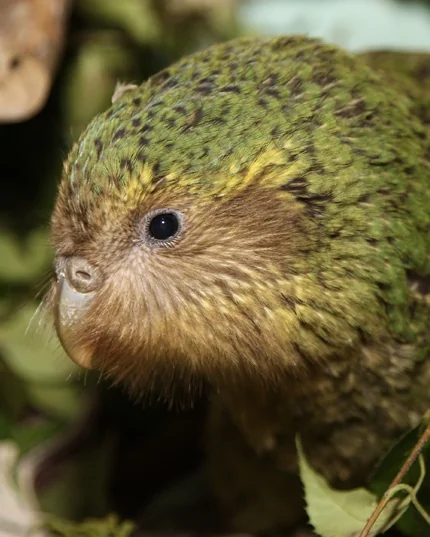
Kakapo (Strigops habroptila) in the wild
The real animal · Strigops habroptila Foto: Dianne Mason / Department of Conservation NZ (CC BY 2.0)
Habitat
Temperate rainforest in New Zealand. Today it survives only on predator-free sanctuary islands — Whenua Hou, Pukenui/Anchor and Hauturu — plus one fenced mainland enclosure.
Diet
Strictly herbivorous: leaves, roots, seeds, mosses and above all rimu fruit in mast years. It forages on foot along the forest floor and climbs trees for fruit.
Lifespan
Around 60 years on average, with individuals thought to pass 90. One of the longest-lived birds in the world.
Weight
Males 2 to 4 kg, females 1.3 to 2 kg. It is the heaviest parrot on the planet.
Adaptation
Complete loss of flight: no keel on the sternum and reduced wings that only help with balance and with slowing a climb down. The only parrot in the world with a lek mating system.
Record
The heaviest parrot ever documented, with males reaching 4 kg.

Conservation status

Global (IUCN)
Critically Endangered
Where it lives
The entire world population lives in New Zealand, spread across a handful of predator-free sanctuary islands plus one fenced mainland enclosure.
Population
Around 235 known individuals in early 2026, each one identified by name and fitted with a tracking transmitter.

Main threats

  1. Predation by introduced mammals (stoats, rats and feral cats), the historic cause of the species' collapse.
  2. Severely reduced genetic diversity after the population bottleneck, which raises the share of infertile eggs.
  3. Outbreaks of aspergillosis, a fungal respiratory infection that has killed birds in recent years.
  4. Reproductive dependence on rimu mast years, which only come every two to four years.
The population has grown from 124 individuals a decade ago to around 235 today, through the Kākāpō Recovery Programme.

Did you know…?

01
A parrot that cannot fly

It is the heaviest parrot in the world, up to four kilos, and the only one that has completely lost the ability to fly. It walks the forest floor at night and climbs trees for fruit, folding its wings like a parachute on the way down.

02
A boom that carries for kilometres

In the breeding season the male digs a bowl in the ground, inflates a thoracic air sac and booms at 20 to 100 hertz for up to eight hours a night. Every twenty booms or so he adds a high-pitched call that lets females pinpoint exactly where the sound is coming from.

03
The only parrot with a lek

No other parrot in the world mates in a lek. Males display in courtship arenas close to one another and females travel long distances to choose. There is no pair bond: the female incubates, feeds and protects the chicks alone.

04
It smells like a clarinet case

Its plumage gives off a sweet scent that observers describe as honey, flowers, or the inside of a wooden wind instrument case. On an archipelago with no carnivorous mammals that scent was harmless; once stoats, rats and cats arrived, it became a trail.

05
It only breeds when the rimu fruits

Breeding is tied to the mast fruiting of the rimu, which happens every two to four years and supplies the chicks with the calcium and vitamin D3 they need. Outside those years most females lay no eggs at all — one of the slowest reproductive rates of any bird.

06
A life almost as long as ours

With around sixty years of average life expectancy and individuals that may reach ninety, the kakapo's lifespan is closer to a human one than almost any other animal. A middle-aged kakapo has seen as many cycles as a middle-aged person.

Frequently asked questions

How many kakapo are left in the world?
Around 235 known individuals in early 2026. There are so few that each one has its own name and a tracking transmitter.
Why can't the kakapo fly?
It evolved in New Zealand with no native mammal predators, so it stopped needing flight. Its wings shrank and its sternum lacks the keel that anchors flight muscles.
What is the kakapo boom?
The deep sound the male makes by inflating a thoracic air sac for hours each night during the breeding season, to draw females from kilometres away.
Where does the kakapo live today?
Only on predator-free sanctuary islands in New Zealand — Whenua Hou, Pukenui/Anchor and Hauturu — and, for the past few years, in a small fenced mainland enclosure.
How long does a kakapo live?
Around sixty years on average, and some individuals may pass ninety. It is one of the longest-lived birds known.
Why doesn't it breed every year?
Because breeding depends on the mast fruiting of the rimu, which happens every two to four years. In the years between, most females lay no eggs.
§ 08 · Conservation three programs · verified
Kakapo

Help protect this species.

Every purchase helps, but a direct donation does more. Three NGOs with specific programs verified for this species.

No. 01 / 03

Kākāpō Recovery.

Kākāpō Recovery Programme · Department of Conservation

The official recovery programme, run by New Zealand's Department of Conservation together with Te Rūnanga o Ngāi Tahu. It monitors every living kakapo individually and manages island transfers, supplementary feeding and health screening.

Donate to Kākāpō Recovery
No. 02 / 03

Te Rūnanga o Ngāi Tahu.

Te Rūnanga o Ngāi Tahu

The iwi that co-manages the recovery programme. It brings cultural guardianship (kaitiakitanga), volunteers for the transfers and a voice in decisions about a species it has an ancestral bond with.

Donate to Te Rūnanga o Ngāi Tahu
No. 03 / 03

ZIP.

Zero Invasive Predators Charitable Trust

A New Zealand organisation specialising in removing invasive predators — stoats, rats and cats — from islands and peninsulas. The predator-free sanctuaries the kakapo depends on rest directly on this work.

Donate to ZIP
Animal Kinhood · 30 characters

Thirty names. Thirty stories. Thirty personalities. One same project.

Full catalogue · Drop 01 — Q3 2026 Explore Animal Kinhood