Animal Kinhood Wild animals Least Concern
12 min read 9 chapters Live · Seyðisfjörður
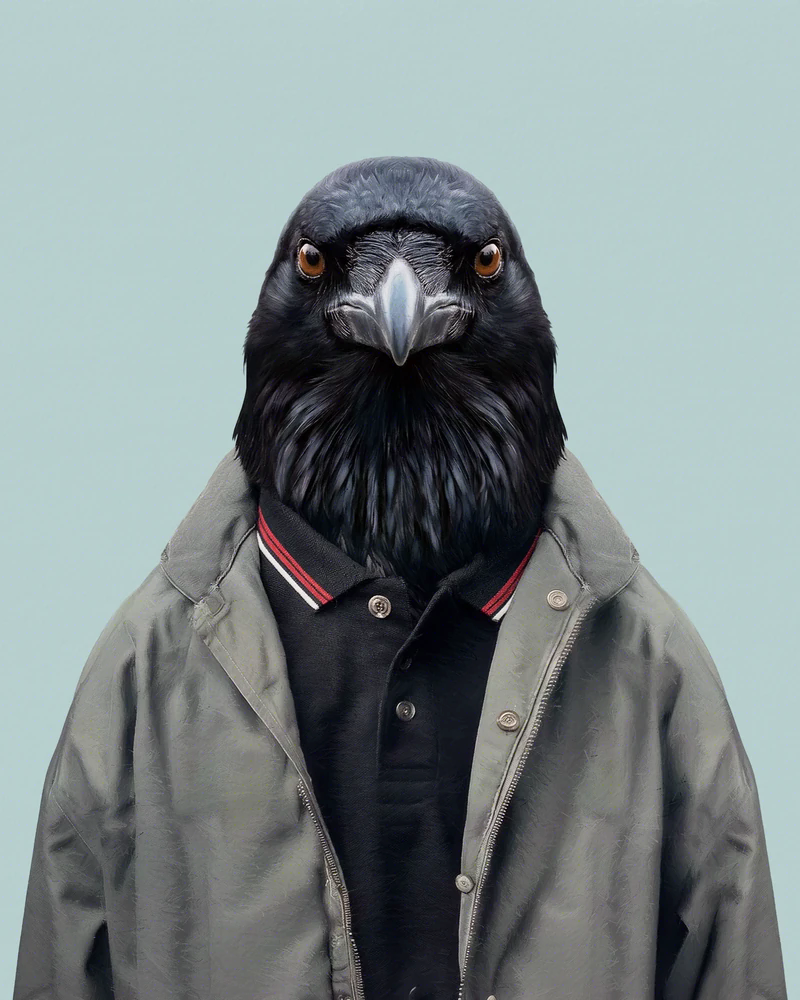
Realistic frontal portrait of a raven with black plumage with a blue sheen, an amber eye and a thick grey beak, dressed in a greyish-green work jacket over a black polo shirt with a red-and-white trimmed collar, against a plain celadon-green background; gazing straight ahead. This is Hrafn, a character from the Animal Kinhood series by Yago Partal. AK · 29 N 65°16′ W 14°01′ Hrafn Seyðisfjörður, IS PHOTO ©YP · 2026
Animal Kinhood · Wild animals No. 29 / 29 Episode · Hrafn
Corvus corax

Hrafn.

Common raven

If the pass opens, I go up. If it doesn't, I go up tomorrow.
Add it to your Kinhood.Already part of your Kinhood.
Biography · Block 01 of 03 Common raven
Chapters · I–II–III

The One Who Crosses the Pass.

I
CH · 01 / 09

Þetta reddast

Hrafn got the route nobody wanted and he's held onto it for six years. He leaves the Seyðisfjörður office while it's still dark, does the village on foot — the street painted in colors that runs down to the blue church, the corrugated-iron houses, the mailboxes that open upward — and then takes the van and heads into the valley. The farms along the Fjarðará, the houses of Vestdalur, and right at the top the Fjarðarheiði pass, six hundred meters of nothing, the only road connecting the fjord to the rest of the island. In winter the pass closes. Sometimes for a day, sometimes for three weeks. When it opens, he goes up. He says it like it's nothing, shrugging inside his grey work jacket: þetta reddast, it'll sort itself out. In his mouth it isn't optimism, it's arithmetic. If not today, tomorrow; if not tomorrow, Thursday. He learns the forecast by heart at six in the morning and checks his tires twice before setting off, every day, even in June. He doesn't talk about that. About the pass in general, he doesn't talk much.

II
CH · 02 / 09

The Hook in the Right-Hand Pocket

The mailboxes in the valley freeze shut from the inside. Not the lock — the opening, the slot, the metal sealing itself after a night of rain and wind. The first time it happened to him he spent ten minutes wrestling with a letter and ran late for everything after. The next day he went down to his father's garage, grabbed a rod, put it to the blowtorch and bent it until it looked right. Out came an ugly, crooked iron hook with a loop at the end, and it worked on the first try. It's lived in the right-hand pocket of his coat ever since, and it's opened half the valley. He doesn't lend it out. When a mailbox gives way on the first try and that short click of metal peeling apart sounds out, Hrafn gets a moment of good humor he doesn't mention to anyone, because there's no way to explain it without it sounding ridiculous. At the pool, once or twice, he's come close. He's kept quiet. His thing is the small stuff that works: the hook, the van with two hundred thousand kilometers on it, the route done in the exact order he always does it.

III
CH · 03 / 09

Coffee Behind the Third Post

There's a thermos of coffee behind the third post past the bridge. A pair of dry gloves in the gap in the wall at the farm below. A wrench under a particular rock at kilometer six, a rock with nothing special about it that he'd pick out of a thousand. It isn't foresight out of a manual — it's just how he is. He leaves things along the route and knows exactly where they are months later, and if someone sees him leave one, he comes back another day and moves it, without quite knowing why he does it. It's the same with the houses. Number thirty-one has had the blue door and the crooked mailbox since before he was born. He knows the surname that lives behind every door in the village and every farm in the valley, knows who's moved three weeks before word gets round at the shop, and remembers perfectly the one who shut the door in his face when he was eighteen. The office stopped giving him route lists a long time ago. His sister Elín points at any house from the bus and he gives the surname before he even looks. They laugh both times: her because she finds it funny, him because he doesn't see what's strange about it.

Voiceline · the character’s canonical quote Hrafn · Common raven
Hover to pause
If the pass opens, I go up. If it doesn't, I go up tomorrow. AK · 29 · Hrafn · Seyðisfjörður 2025 If the pass opens, I go up. If it doesn't, I go up tomorrow. Voiceline · Corvus corax If the pass opens, I go up. If it doesn't, I go up tomorrow. AK · 29 · Hrafn · Seyðisfjörður 2025 If the pass opens, I go up. If it doesn't, I go up tomorrow. AK · 29 · Hrafn · Seyðisfjörður 2025 If the pass opens, I go up. If it doesn't, I go up tomorrow. Voiceline · Corvus corax If the pass opens, I go up. If it doesn't, I go up tomorrow. AK · 29 · Hrafn · Seyðisfjörður 2025
§ 04 · Objects Open editions · everyday
10 pieces · Print on demand

Take Hrafn home.

Biography · Block 02 of 03 Roots
Chapters · IV–V–VI

What the Landslide Left Behind.

IV
CH · 04 / 09

The Snowplough at Night

His father, Bjarni, opened that pass twenty winters running with the snowplough. One bad night he took Hrafn up with him, at eight years old, sitting in the seat beside him and gripping the door handle. The headlights lit up nothing, just snow blowing sideways through the beam, and every so often a roadside marker would appear and vanish again. It was the first time he saw the whole route from up above, and also the first time he understood that a road is a place and not a line. His father didn't explain a thing in the two hours it took them to reach the top. He drove watching the edge and chewing gum, and every so often cracked the window an inch to listen to the wind before rolling it back up. Today Bjarni's had a ruined back for years and welds other people's odd jobs in the garage with the radio on, and still checks the forecast at six out of habit. When Hrafn gets back from his route, the two of them stand in the garage doorway and talk about road conditions, whether they've salted it, whether the wind was coming from the north. They never talk about anything else. Both of them understand perfectly that they're talking about everything else.

V
CH · 05 / 09

The Song of the Crevice

His grandmother, amma Guðrún, lives two streets down and used to sing him, as a boy, the old song about the one who slept in the crack of the cliff, the one the houses of the east used to sing when bad weather set in. He learned it whole before he could read and still hums it badly in the van without noticing. Amma Guðrún is one of those who remember the rooftops full: when so many of their own would gather at the docks and the slaughterhouse that there wasn't room for one more, and you could hear them from the road. Now you can count them. The ravens of the east are still a large people on a world scale — they live from the desert to the ice, and on the island they see out the whole winter when almost everyone else leaves — but here their numbers are falling, and they're still huntable year-round, by law, because someone decided long ago they were to blame for the lambs. In Hrafn's house that isn't told as a tragedy. It's told the way you'd tell what the weather used to be like. But it explains fairly well why nobody in that kitchen quite trusts a door that opens.

VI
CH · 06 / 09

Nineteen

He was nineteen when the hillside came down on the village after days of rain and the whole place had to be evacuated. His house held. The one two streets down didn't. For weeks he delivered the mail to people sleeping in other people's houses, and without meaning to, he built up in his head a complete map of who was in whose bed, a map that still hasn't quite left him. Things turned up out of the mud. They appeared in the street, in the ditch, among the rubble as it was cleared out: a loose earring, a key, a little plastic soldier, a ring with no name inside it. Whatever someone claimed got given back: there was a table in the school gym with everything laid out on it and a list, and people came by to look. After a month the table was cleared away and what was left stayed left. Whatever nobody claimed, he took home and put in an old baking tray in the corrugated-iron shed out back. Back then he still said it out loud, «until the owner turns up». He said it for a year or two. Then he stopped saying it, and the tray kept filling up all the same, no longer with things from the mud, but with whatever the road leaves him every week.

Biography · Block 03 of 03 Craft
Chapters · VII–VIII–IX

The Shed.

VII
CH · 07 / 09

The Tray

There's quite a lot there now. They're arranged by stretch: the village on one side, the valley in the middle, the pass at the far end, and within each stretch by kilometer. Nobody's arranged them that way. Nobody knows they're arranged that way. The tray is a big baking tray, and it's gotten too small: there's now a biscuit tin on the bench too, and a glass jar of screws that aren't screws. Ask him about any one of them and Hrafn will tell you which bend it came from, what month, and who was living in the nearest house at the time, and often he'll also tell you who he thinks lost it. And he doesn't give it back. Six years have gone by, and the idea of knocking on a door with an earring in his hand and explaining why he has it feels more distant and more ridiculous every year. He doesn't throw anything away either. He earns his living delivering things that aren't his, goes up the pass with the mail when the forecast is frightening so nobody goes without what's theirs, and keeps a shed full of other people's objects he has no intention of moving. Both things are true at once. He's never once put them side by side.

VIII
CH · 08 / 09

Twenty Minutes in the Kitchen

Salka works shifts at the fjord fish farm's hatchery station and comes home smelling of cold water and feed. They met at the village pool, which is where everyone here meets everyone, sitting on the warm edge. She asked him why he was always watching the door and he didn't know what to say, and they stayed two hours. They've been together four years. They live in the house up the street, the one with the shed, cheap rent because the hillside looms over it; when it rains hard for several days running, neither of them says anything, but both of them look out the kitchen window at the same spot on the mountain. He leaves before dawn; she starts in the afternoon. They overlap at noon, twenty minutes, eating standing up with the weather report on the radio, her still in her boots and him without taking off his coat. Salka has opened the shed. She's seen the tray. Once she moved an earring two spots to the left to see if he'd notice, and that same evening he asked her, from the doorway, if she'd touched anything. They didn't talk about it then and they haven't talked about it since. It's the one quiet pact they have, and it works.

IX
CH · 09 / 09

The Position on the Other Side

In winter Hrafn is whole. He gets up before dawn, fixes leaks, changes tires, goes up the pass with the van loaded and comes back in a good mood; in summer, with the sun up at three in the morning and the village full of outsiders, he sleeps badly and argues over nothing. He blames it on the noise. A few months ago he was offered the permanent posting at the big office in Egilsstaðir, on the other side of the pass: better pay, a counter, heating, no snow and no route. He said he'd think about it. He still hasn't answered, and the office doesn't ask as often anymore. His brother Ari moved down to Reykjavik at twenty and calls at Christmas; of the eleven in his year, three are left in the fjord. He knows what this is called. What he can't say is why he can't leave, and the closest he's come to explaining it was one afternoon in the garage, with his father, talking about something else entirely: that over there everything would be fine, but he wouldn't know where anything was.

§ 07 · Species file Corvus corax

About the common raven.

Classification
  1. Animalia
  2. Chordata
  3. AvesBirds
  4. Passeriformes
  5. Corvidae
Corvus corax
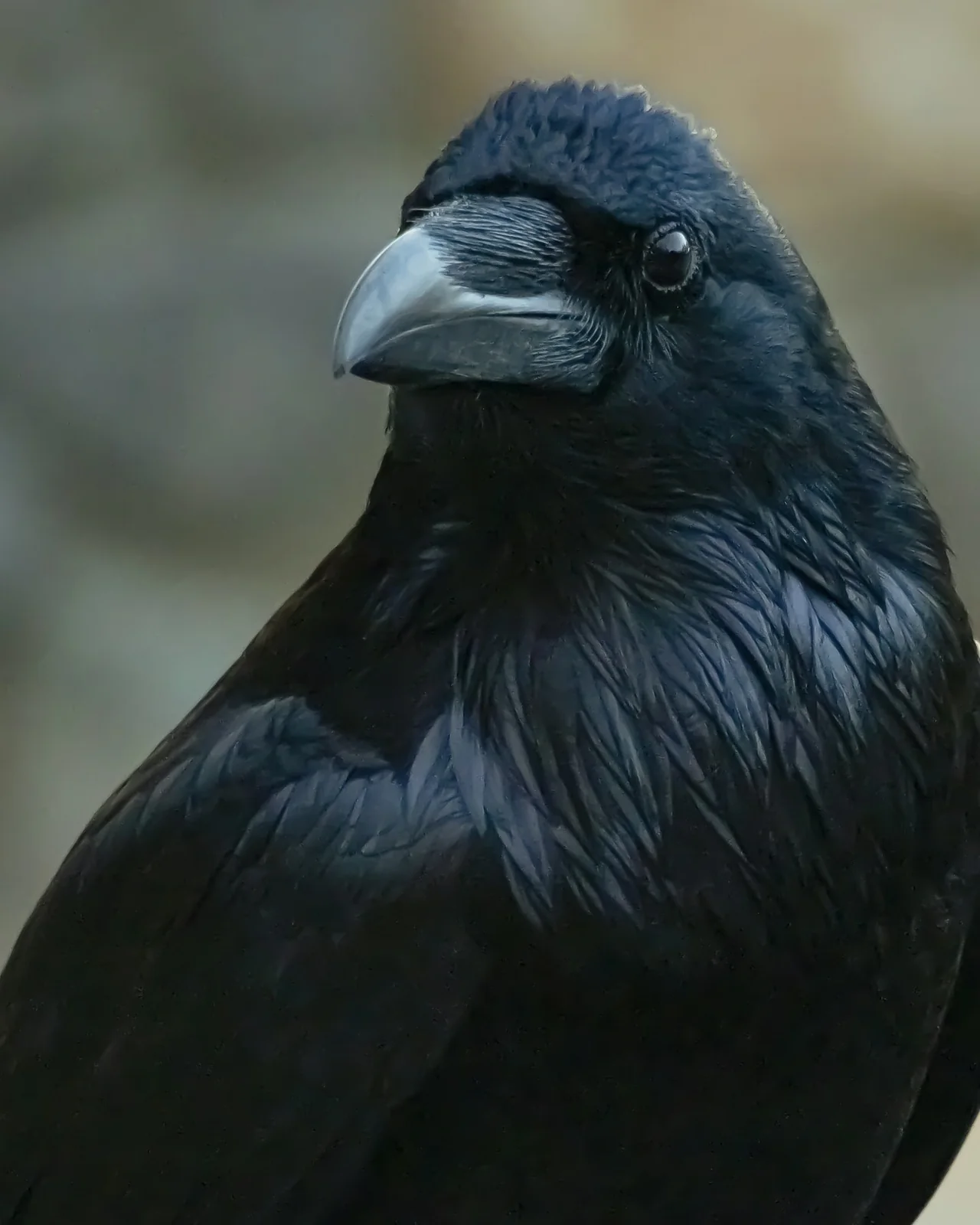
Common raven (Corvus corax) in the wild
The real animal · Corvus corax Foto: Roger Worden / Unsplash
Habitat
An extreme generalist: boreal forest, coast, steppe, mountain, Arctic tundra and desert across almost the whole northern hemisphere. In Iceland it is a year-round resident, even in midwinter, on sea cliffs, in fjords and around the edges of towns.
Diet
Opportunistic omnivore: carrion, insects, berries, grain, small vertebrates, eggs and refuse. It stores leftovers in caches scattered across its range and remembers where each one is.
Lifespan
Ten to fifteen years in the wild, with more than 23 documented; over 40 in captivity.
Weight
0.69 to 2.25 kg · 54-71 cm long, with a wingspan of 116-153 cm.
Adaptation
A very large brain for a bird, with future planning, tool-making and social exchange; an enormous vocal repertoire and the ability to mimic sounds it hears.
Record
It's the heaviest passerine bird in the world, and has been recorded flying and foraging at 6,350 m on Everest.

Conservation status

Global (IUCN)
Least Concern
Where it lives
Least Concern worldwide, but Vulnerable (VU) on Iceland's red list; in Iceland it is still legal to hunt it all year round.
Population
Globally abundant and increasing in some regions. In Iceland the breeding population is below 10,000 individuals, with a fall of around 20% between 1993 and 2017 and a particularly sharp retreat in the north-east.

Main threats

  1. direct persecution by livestock farming (shooting and poison)
  2. secondary poisoning from carrion containing lead shot or rodenticides
  3. collision and electrocution on power lines and at wind farms
  4. loss of the slaughterhouse and fishery waste many pairs depended on
Across much of western Europe it was all but exterminated by direct persecution between the 18th and 20th centuries and has recolonized its historical range since gaining legal protection. In Iceland the winter index, after falling by roughly half between 1960 and 1990, has risen again in recent years.

Did you know…?

01
Thought and Memory

In Norse mythology Odin's two ravens are called Thought and Memory. Ethology bears the myth out: the common raven solves new problems, makes tools and plans hours ahead.

02
It remembers who cheated it

In food-exchange experiments ravens remember for weeks which individual honoured the deal and which did not, and behave accordingly next time.

03
Caches with a trick to them

It hides food in hundreds of different places, and if it notices another raven watching it will fake a cache and move the food elsewhere the moment it's alone.

04
It works with wolves

When it finds a carcass its beak cannot open, it calls with specific sounds to draw in wolves or other carnivores to break the skin, then feeds on what is left.

05
It sledges down snow

It flies upside down, barrel-rolls and drops in a dive for no apparent reason, and in snowy country it has been filmed sliding down slopes on its belly over and over.

06
A gang when young, a pair for life

Unpaired youngsters gather in noisy flocks — what Iceland calls a hrafnaþing, a "raven parliament"; adults pair up and defend a territory together for years.

Frequently asked questions

Is a common raven the same as a crow?
No. The raven is far bigger — it's the heaviest passerine in the world — with a much heavier bill, a wedge-shaped tail and a far deeper voice.
Where does it live?
Across almost the whole northern hemisphere, from desert to tundra. In Iceland it is a year-round resident, even in the depths of the Arctic winter.
What does it eat?
Almost anything: carrion, insects, berries, grain, small animals and refuse. It stores what it does not need in caches it remembers by heart.
Is it endangered?
Not globally: it is listed as Least Concern. In Iceland it is listed as Vulnerable, with fewer than 10,000 breeding individuals and a declining population.
§ 08 · Conservation three programs · verified
Common raven

Help protect this species.

Every purchase helps, but a direct donation does more. Three NGOs with specific programs verified for this species.

No. 01 / 03

Fuglavernd.

Fuglavernd - BirdLife Iceland

Iceland's bird conservation society, the BirdLife International partner, which surveys the country's bird populations with the help of citizen counts and works to protect their habitats.

Donate to Fuglavernd
No. 02 / 03

Náttúrufræðistofnun Íslands.

Náttúrufræðistofnun Íslands (Icelandic Institute of Natural History)

Public research institute responsible for Iceland's red list of birds and for the ringing programmes; it is the authority on the raven's status on the island.

Donate to Náttúrufræðistofnun Íslands
No. 03 / 03

BirdLife International.

BirdLife International

Global network of bird conservation organizations that compiles population and threat data at European and worldwide scale.

Donate to BirdLife International
Animal Kinhood · 29 characters

Twenty-nine names. Twenty-nine stories. Twenty-nine personalities. One same project.

Full catalogue · Drop 01 — Q3 2026 Explore Animal Kinhood