Animal Kinhood Wild animals Endangered
12 min read 9 chapters Live · Ushuaia
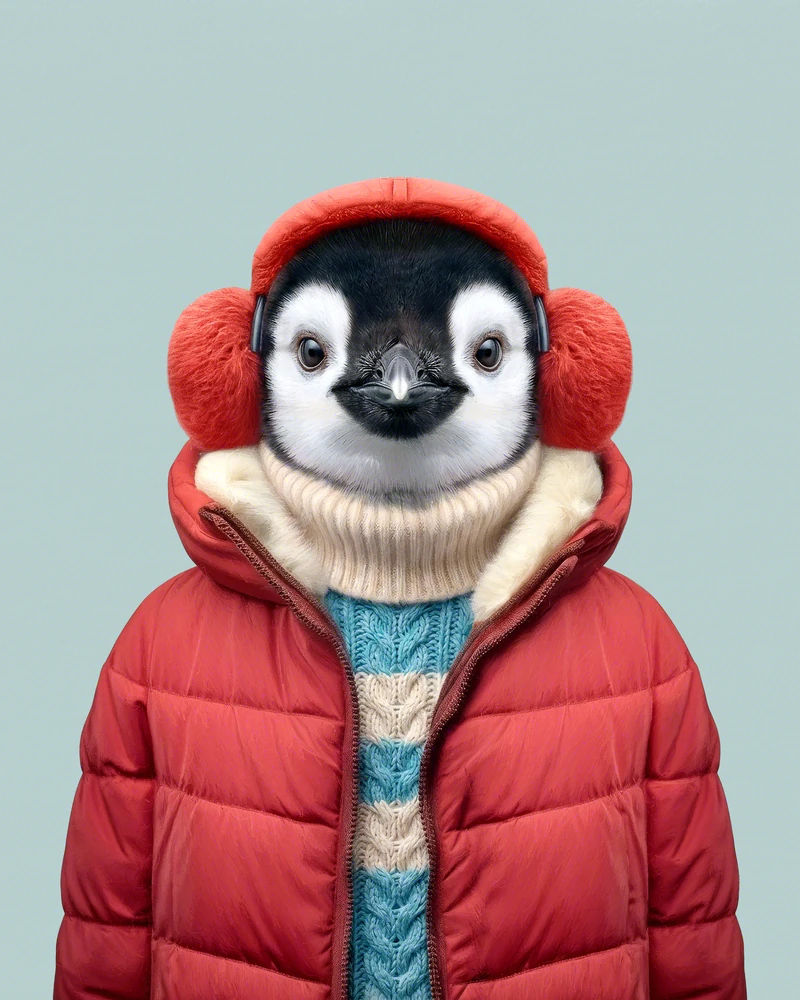
Realistic frontal portrait of an emperor penguin chick with a black-and-white facial mask and large dark eyes, dressed in a red down coat, red fur earmuffs and a red hat, a cream knit turtleneck and a light blue cable-knit sweater underneath, against a plain blue-grey background. This is Birdie, a character from the Animal Kinhood series by Yago Partal. AK · 01 S 54°48′ W 68°18′ Birdie Ushuaia, AR PHOTO ©YP · 2026
Animal Kinhood · Wild animals No. 01 / 22 Episode · Birdie
Aptenodytes forsteri

Birdie.

Emperor penguin

People huddled together feel less cold. I make sure to count them all, so no one goes missing.
Add it to your Kinhood.Already part of your Kinhood.
Biography · Block 01 of 03 Emperor penguin
Chapters · I–II–III

The platform and those who wait.

I
CH · 01 / 09

Those who wait for the train

There's still a while before the train leaves, and Birdie is already on the platform, hand shading his eyes, watching the bend in the tracks where it has to appear. He can't see it yet. Doesn't matter: he watches anyway, as if staring hard enough at the distance could bring the arrival closer. Behind him, End of the World Station smells of cold coal and wet wool.

He's an emperor penguin chick, the black-and-white facial mask still soft, his dark eyes too big for the rest of him. He's bundled up for the worst of winters: a red down coat down to the knees, red fur earmuffs, a red hat pulled down to his eyebrows. Underneath, a cream knit turtleneck and a light blue cable-knit sweater his grandmother made him.

While he waits, he counts. He does it quietly, with his finger, so no one notices. One, two, three... the woman with the bag, the man in the hat, the couple arguing over a map. Someone slips past him and he starts over. He can't settle until everyone's there and he knows exactly how many. It's the first thing he did today, and it'll be the last.

II
CH · 02 / 09

That's how you keep warm

The passengers arrive scattered, each one alone in their own cold, staring at their shoes. That gets to Birdie. He goes up to the long bench on the platform and starts bunching people together without asking, a pat on the shoulder and a line he repeats all day: that's how you keep warm. He nudges one person over a hand's width, sits another in the gap, and suddenly the bench is a tight row of people who aren't shivering the same way anymore.

He brings out the thermos of mate cocido that Olga makes him, the kind that wakes you right up, and passes it hand to hand. To the woman who arrived without gloves he lends his own blanket —after all, I keep moving, I won't get cold— and stays there in his coat sleeves, perfectly happy. Olga's mate cocido is made with yerba used three times over and a mountain of sugar, and comes out dark and sweet, the kind that brings a frozen person back to life. If he spots someone off on their own, alone at the far end of the platform, he won't rest: he goes over, brings them back, puts them in the row.

He couldn't really explain why he does it. He'd say it's just colder that way, plain common sense. In his head there's nothing strange about it: people apart get cold, and he doesn't like people apart. He brings them together, and that's that.

III
CH · 03 / 09

The bell is not a toy

It all started the way you let a kid lend a hand. The old conductor, once his hands started giving him trouble with the ice, began passing things over: let's see what you make of this. First the departure bell. Then helping with the blankets in the carriage. Then calling out the stops loud enough to carry from one end to the other. For Birdie it was never a kid's game: it was the most serious thing in the world.

Now Birdie rings the bell as if the whole world were riding on it, very serious, very proud. The train's leaving!, he shouts, whoever's left on the platform stays on the platform! —and he'd never really leave anyone behind, not ever, but the line sounds good and he loves saying it.

Before every departure he does his round. Is everyone here? Let's see, let me count. And he counts, again, twice and three times if he has to. His grandmother teases him, says he counts people the way you count sheep to fall asleep. He defends himself: he doesn't count to fall asleep, he counts so no one's missing. He keeps the bell tucked in a pocket of his coat as if it were his own. In a way, it is.

Voiceline · the character’s canonical quote Birdie · Emperor penguin
Hover to pause
People huddled together feel less cold. I make sure to count them all, so no one goes missing. AK · 01 · Birdie · Ushuaia 2025 People huddled together feel less cold. I make sure to count them all, so no one goes missing. Voiceline · Aptenodytes forsteri People huddled together feel less cold. I make sure to count them all, so no one goes missing. AK · 01 · Birdie · Ushuaia 2025 People huddled together feel less cold. I make sure to count them all, so no one goes missing. AK · 01 · Birdie · Ushuaia 2025 People huddled together feel less cold. I make sure to count them all, so no one goes missing. Voiceline · Aptenodytes forsteri People huddled together feel less cold. I make sure to count them all, so no one goes missing. AK · 01 · Birdie · Ushuaia 2025
§ 04 · Objects Open editions · everyday
10 pieces · Print on demand

Take Birdie home.

Biography · Block 02 of 03 Roots
Chapters · IV–V–VI

What's kept in a tin.

IV
CH · 04 / 09

The first trip with Olga

It started with his grandmother. Olga —Olga Kusanovic, la nona to everyone— runs a stall selling knitwear and thermoses at the station, and that's where Birdie grew up in stretches, among people coming and going, while his mother cooked in the harbor canteen. It was Olga who first put him on the train, in the last carriage, when he was tiny, three or four years old, with a thermos almost as big as he was.

Birdie didn't look at the scenery. They crossed the Cañadón del Toro and the Pipo River, the brown peat bog, old tree trunks stuck in the mud like fingers, the lenga forest stripped bare by the wind, the whole end of the world going by outside the window, and he spent the whole ride watching the passengers instead. They struck him as too spread out, each one alone in their own cold, and he set about bunching them together on the long bench with that stubbornness of his. The old conductor laughed and handed him the bell to keep him quiet for a while.

He didn't stay quiet. But from that day on, the station was his place. Olga says he learned to recognize the regulars by their voice before their face, from hearing them talk over the counter so often. That Birdie never forgets a voice.

V
CH · 05 / 09

The winter his father was late

There was a winter when his father took longer than expected to come back from the sea. Nothing serious, just bad weather, but for a chick the days stretch long and the food in the pantry gets counted differently. Birdie didn't say anything. Quietly, he started keeping things in a dented cookie tin: leftover croissants, sugar cubes, a crust of bread, a stray glove. In case someone shows up cold and hungry.

That tin has never gone empty again. He hands things out from it every day —to whoever's missed their snack, to whoever shows up shivering— with a generosity no one finds surprising anymore. But secretly, he makes sure it never runs out: he refills it before it's empty, always before. And he keeps it half-hidden, at the back of the drawer, because being caught with the tin embarrasses him in a way he couldn't quite name.

It's the one thing Birdie keeps to himself. The one who gathers everyone up and lends out everything has that tin at the back he won't share, and won't let run low. Underneath the croissants there's a small fear he still hasn't looked at head-on.

VI
CH · 06 / 09

The one who comes back from the sea

His father, Danilo —Dani at home— works on the boats that sail out of the channel, fishing or hauling supplies for the southern expeditions. He leaves for weeks and comes back. The household is built around that: his mother, Marina, in charge in the meantime, and Birdie setting his father's plate at the table even on the nights he's away, the portion covered, just in case. It's always the same plate, a deep white china one with a chip on the rim, and he sets it at the head of the table even if the chair stays empty the whole dinner.

The people they come from breed far south, down where the fast ice holds through the whole winter. Olga says the colonies used to be packed, and that now the ice comes late and breaks up early, and that there was one year when a whole stretch of the ice colony didn't raise a single chick. That year, families came down to the port and never went back up. For his people, Ushuaia is that: the edge of the inhabited world, the last port before the ice.

Birdie doesn't fully understand those stories. They settle in him another way: in wanting whoever leaves to come back soon, in the plate laid out, in the full tin. In checking the dock on his way home, to see if there's a boat light.

Biography · Block 03 of 03 Craft
Chapters · VII–VIII–IX

Counting so no one goes missing.

VII
CH · 07 / 09

I know you by your voice

The night his father's boat came in very late, in thick fog, Birdie recognized him before he could see him. There were twenty voices on the dock, people unloading and shouting to each other, and out of all of them he pulled his father's voice the way you pull a thread from a ball of yarn. He took off running into the white nothing before anyone else had even noticed the boat had arrived.

It happens to him all the time. He knows people by their voice: if you've spoken once near him, he's got you filed away for good, even if he never sees you. That's why he calls out the stops so loudly, chest wide open, so they carry, he says, as if a voice could go out and find someone far away and bring them back.

He doesn't think of it as a gift or anything like that. It's just a trick he has, and that's it. At the station, the old conductor learned to trust it: if Birdie says something's coming down the line, it's coming, even if you still can't hear it. No one puts it together. Not even him. He simply hears better than he knows.

VIII
CH · 08 / 09

The last train

What he doesn't like is the last train. As long as there's people, noise, the thermos passing hand to hand, Birdie is in his element. But when the last train empties out and the platform falls quiet, with that big stillness places get once everyone has left, something strange settles in his chest.

He doesn't leave. He could, and no one would think worse of him, but he doesn't leave. He sweeps the platform slowly, and when he's done he sweeps it again, even slower. He leaves the tin uncovered on the long bench, in case someone turns up late and cold, even though he knows no one will. And he waits for the conductor to switch off the station light before he goes, always the last to leave.

He doesn't talk about it, and he couldn't say why he does it. If you asked him, he'd say he just likes leaving everything tidy. But it's something else, something to do with the door he keeps glancing at, the plate he sets out regardless, the tin he never lets run low. The same thing, deep down.

IX
CH · 09 / 09

The bend in the tracks

And he goes back, like every day, to watching the bend in the tracks. Even when there's no train due for a while, even with the platform empty, his eyes drift to the far point where the rails curve and vanish among the lenga trees. He isn't waiting for any particular train. He's waiting for something to come, for someone to appear, for whoever's missing to be just about to round the bend.

Olga catches him like that sometimes, hand shading his eyes, very still. She doesn't ask him anything. She just stands beside him, rests a hand on the back of his neck —still downy with chick feathers— and looks along with him, both their heads turned toward the same far point. They stay like that a moment, without a word, until it passes for Birdie and he goes back to his own business: counting, gathering, filling the tin.

He's a small child in the southernmost city in the world, the one the conductor lets ring the bell, who has decided, all on his own, that no one is going to be cold on his watch. That's no small thing, for someone so young, to keep watch so that everyone comes back.

> **Canonical quote:** When the last train empties out, Birdie doesn't leave: he sweeps slowly and leaves the tin uncovered, in case someone arrives late and cold.

§ 07 · Species file Aptenodytes forsteri

About the emperor penguin.

Classification
  1. Animalia
  2. Chordata
  3. AvesBirds
  4. Sphenisciformes
  5. Spheniscidae
Aptenodytes forsteri
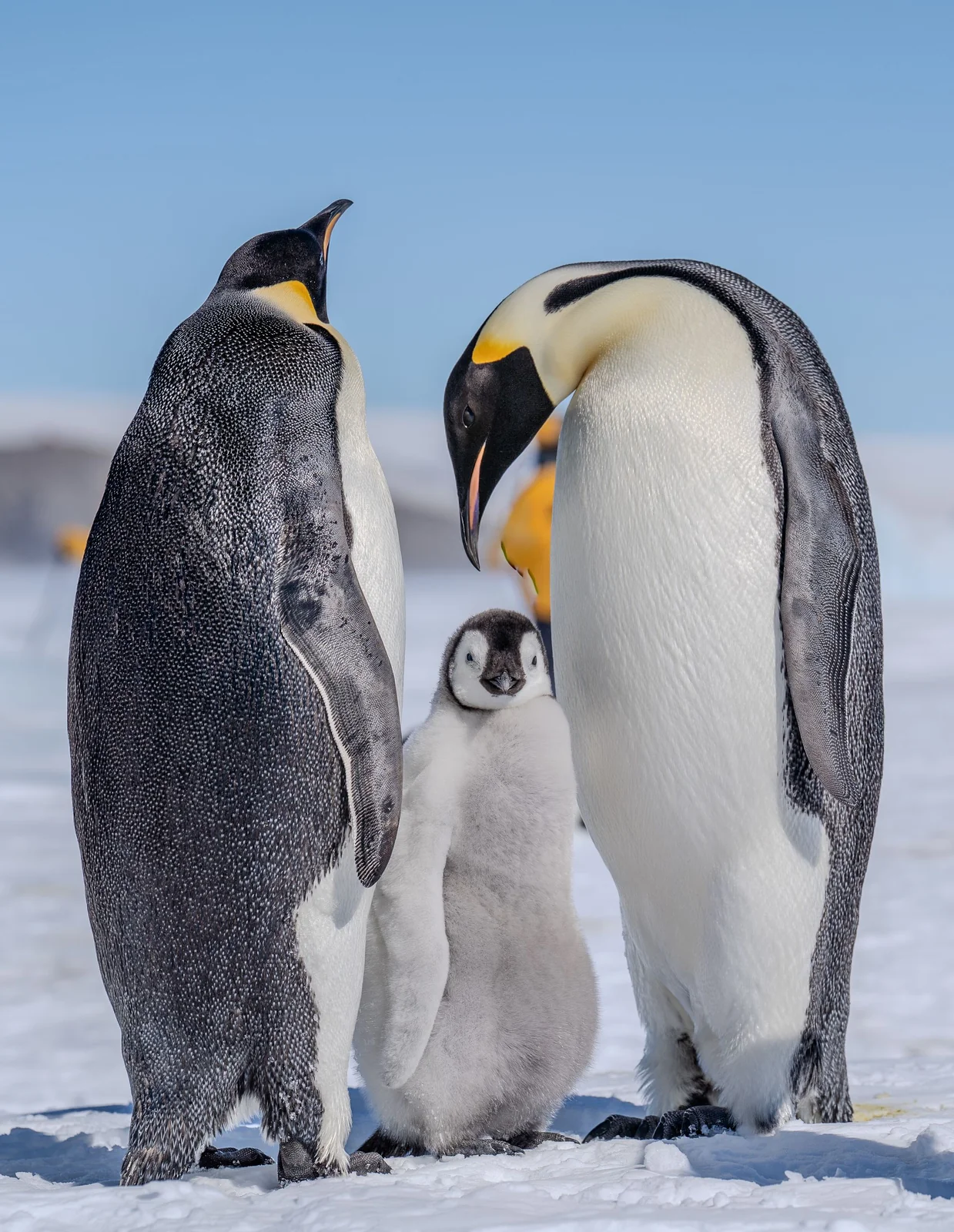
Emperor penguin (Aptenodytes forsteri) in the wild
The real animal · Aptenodytes forsteri Foto: Jan Tang / Pexels
Habitat
Fast ice and coastlines of continental Antarctica (colonies in the Weddell Sea, the Ross Sea, and Adélie Land)
Diet
Antarctic krill, notothenioid fish, and squid, caught by diving
Lifespan
about 15-20 years in the wild
Weight
22-45 kg · 1.1-1.3 m tall
Adaptation
One of the densest plumages of any bird, subcutaneous fat, and a countercurrent heat exchange system in the feet and flippers keep the body near 38°C even when the air is far below freezing
Record
The longest reproductive fast of any bird: the male goes without food for months on end while incubating the egg on his feet

Conservation status

Global (IUCN)
Endangered
Where it lives
West Antarctic colonies (Bellingshausen Sea) suffered a near-total breeding collapse in a recent season; other areas, such as parts of the Ross Sea, have so far remained more stable.
Population
Around 238,000 breeding pairs (roughly 595,000 adults) spread across more than sixty colonies, according to satellite surveys. The trend is downward: some West Antarctic colonies have lost more than 20% of their numbers in just over a decade.

Main threats

  1. Loss and early breakup of fast sea ice caused by the warming of the Southern Ocean, the essential substrate where the species breeds and molts.
  2. Changes in the availability of krill and prey fish linked to ocean warming.
  3. Sudden, localized breeding collapses when the ice breaks up before the chicks are ready to swim.
Protection of priority marine habitat and scientific colony monitoring (Oceanites' Antarctic Site Inventory), alongside the Global Penguin Society's conservation work and status tracking by BirdLife/IUCN.

Did you know…?

01
Recognized among thousands

At seven weeks old, the chick leaves its father's warmth and joins the crèche: hundreds of chicks huddled in a circle. Amid the crowd, its parents recognize it by its call alone, as unique as a voiceprint.

02
Huddling in waves

In the thermal huddle, the penguins take tiny, coordinated steps that keep reorganizing the group, so everyone rotates toward the warm center and no one gets stuck on the cold edge.

03
Colonies visible from space

Their colonies are spotted by satellite from the guano stains they leave on the white ice; more than sixty have been discovered this way across Antarctica.

04
Can't fly, but roams the sea

It can't take to the air, but it's the deepest-diving bird alive: it descends over five hundred meters and holds its breath for several minutes chasing prey.

05
Diver without wings

Its scientific name, Aptenodytes, means “diver without wings.” In French it isn't a “pingouin” (that's the auk of the north) but a “manchot”; in German, “Kaiserpinguin.”

06
Tied to fast ice

It breeds on fast ice, which it needs to stay stable through the whole winter. As that ice arrives later and breaks up earlier each season, the species has gone from near threatened to endangered.

Frequently asked questions

Why is Birdie so bundled up in his portrait?
Because he's an emperor penguin chick, the bird that breeds in the coldest place on the planet. In Animal Kinhood he lives in Ushuaia, the southernmost city, and wears a red down jacket, earmuffs, and a hat against the cold of the south.
Is the emperor penguin endangered?
Yes. The IUCN lists it as Endangered: it depends on stable fast ice to breed, and that ice is arriving later and breaking up sooner. Several colonies have suffered breeding collapses in recent years.
Where does Birdie live?
In Ushuaia, at the mouth of the Beagle Channel: the southernmost city in the world and the gateway to Antarctica. He spends his days at the End of the World Station, with his grandmother.
§ 08 · Conservation three programs · verified
Emperor penguin

Help protect this species.

Every purchase helps, but a direct donation does more. Three NGOs with specific programs verified for this species.

No. 01 / 03

Oceanites.

Oceanites, Inc.

A nonprofit dedicated to independent scientific monitoring of Antarctic penguin colonies; its field censuses feed directly into the species' status assessments.

Donate to Oceanites
No. 02 / 03

GPS.

Global Penguin Society

An international organization dedicated exclusively to the conservation of penguin species and their marine ecosystems.

Donate to GPS
No. 03 / 03

BirdLife.

BirdLife International

A global bird conservation alliance and the official Red List assessor for the IUCN, which keeps the emperor penguin's status sheet up to date.

Donate to BirdLife
Animal Kinhood · 22 characters

Twenty-two names. Twenty-two stories. Twenty-two personalities. One same project.

Full catalogue · Drop 01 — Q3 2026 Explore Animal Kinhood