Animal Kinhood Wild animals Endangered
12 min read 9 chapters Live · Liwa
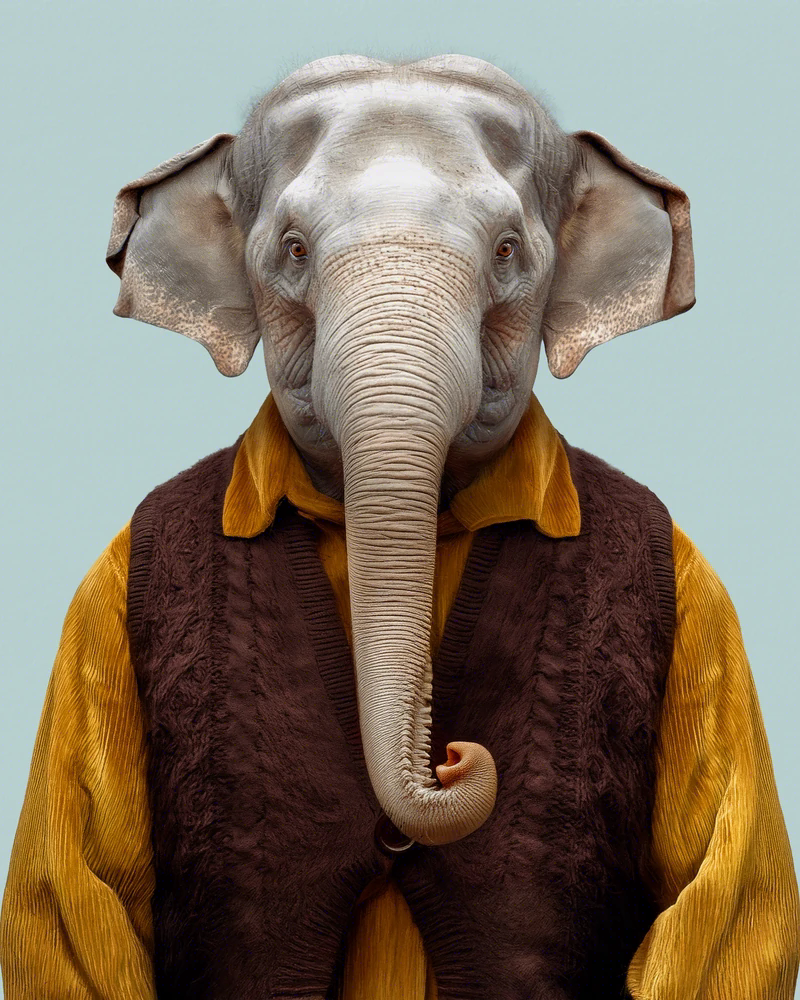
Frontal, realistic portrait of an Asian elephant with medium-sized ears and no visible tusks, wearing a mustard corduroy shirt and a textured brown gentleman's waistcoat, on a plain celadon-green background; looking straight ahead. This is Bagus, a character from Yago Partal's Animal Kinhood series. AK · 01 S 5°02′ E 104°05′ Bagus Liwa, ID PHOTO ©YP · 2026
Animal Kinhood · Wild animals No. 01 / 26 Episode · Bagus
Elephas maximus

Bagus.

Asian elephant

There's no such thing as a weed. Just an herb you haven't found the use for yet.
Add it to your Kinhood.Already part of your Kinhood.
Biography · Block 01 of 03 Asian elephant
Chapters · I–II–III

The apothecary of the high market.

I
CH · 01 / 09

Let's see what you've got to tell me

Bagus runs his stall in the high market of Liwa, the mountain town, where the air is cool and smells of coffee and rain on the way. He doesn't hang a sign: people climb up already knowing which door to knock on. A neighbor comes in with a jar and a face that hasn't slept, and he doesn't ask what's wrong. He takes what she's brought, brings it to his nose, rubs a leaf between his fingers to let the scent out. "Let's see what you've got to tell me," he says — but not to her, to the plant. He closes his eyes for a second, breathes. "This isn't for the stomach. This is for sleep." And he's right. The village clinic had already given her a pill, and fair enough; Bagus makes the local remedy to go alongside it, a brew of roots ground in the stone mortar, and explains how to take it. The old folks who climb up with an ache that's really just an excuse to talk a while in the cool morning air, he often doesn't charge. He grinds them something, gives them conversation, sends them home with a bundle. He's a big shopkeeper, tuskless, wearing his corduroy shirt even though no one's expecting him to dress for it. He says the one who really knows is his grandmother.

II
CH · 02 / 09

What the dew gives up

Before he opens up, he climbs the mountain. It's the first thing he does, while the village still sleeps and the dew is letting the leaves' scent loose — that's when a plant tells you what it's got. He picks slowly, up the slope, tasting and smelling, always with a blade of grass in his mouth. He carries no list: he has the whole mountain in his nose, and he knows which hillside he's on with his eyes half shut, just from the smell of the grass. He can't help cataloguing as he goes — a bitter bark, a flower on its way out, the good water running under a dry leaf. He comes down loaded up right as the sun starts to bite, because by midday his strength is gone and the first hour is his real hour. With his fingertips he separates out the smallest seeds, strips leaves without tearing them, ties a tight bundle weighing the herbs by eye. People think he has a gift. He says he grew up behind the old one, walking the mountain, and that no book taught him what he knows about plants. He calls it having a good nose, and leaves it at that.

III
CH · 03 / 09

One less path

Bagus's mountain keeps getting smaller. Where there used to be a herd's crossing there's now a row of palms planted in a line; where there was a pond, a ditch. His kind, the elephants of this part of Sumatra, always walked under the same stretch of shade from one mountain to the next, and now that shade is broken into patches that no longer touch. His grandmother tells it the way you'd name a river that dried up: not all at once, but sip by sip, a clearing every season. This year they cut off the path he used to take up to the best grass slopes, and now he has to go a long way round to reach what he needs; some plants he can no longer get to. Bagus doesn't complain out loud. He carries it inside, in the silent tally of which hillside he walked last year and can no longer walk. If someone at the market gets dramatic about the forest running out, he cuts them off with a tired "sabar" and changes the subject. He figures grieving doesn't put a single plant back where it was, and he's a fix-things-or-keep-quiet sort of elephant. Mostly the keeping-quiet sort. That season, though, he fills more little jars and talks less.

Voiceline · the character’s canonical quote Bagus · Asian elephant
Hover to pause
There's no such thing as a weed. Just an herb you haven't found the use for yet. AK · 01 · Bagus · Liwa 2025 There's no such thing as a weed. Just an herb you haven't found the use for yet. Voiceline · Elephas maximus There's no such thing as a weed. Just an herb you haven't found the use for yet. AK · 01 · Bagus · Liwa 2025 There's no such thing as a weed. Just an herb you haven't found the use for yet. AK · 01 · Bagus · Liwa 2025 There's no such thing as a weed. Just an herb you haven't found the use for yet. Voiceline · Elephas maximus There's no such thing as a weed. Just an herb you haven't found the use for yet. AK · 01 · Bagus · Liwa 2025
§ 04 · Objects Open editions · everyday
10 pieces · Print on demand

Take Bagus home.

Biography · Block 02 of 03 Roots
Chapters · IV–V–VI

What he learned behind the old matriarch.

IV
CH · 04 / 09

The bitter bark

As a calf he stuck close to grandmother Sekar, the matriarch who leads the herd through the mountain. The old one didn't teach him geography: she taught him to read the forest by smell, where the good water was, which bark you could eat and which you couldn't. "Smell before you look," she kept telling him, and he, a calf with his trunk stuck into everything, absorbed it into his body without quite understanding it. One day, his stomach upset, Sekar brought him a bitter bark and told him to chew it. It worked. That was the first time he understood a plant wasn't just food, that it could be medicine, and from then on he tasted, smelled and kept everything the mountain put in front of him. Nenek Sekar knows where to find water in the worst August and which trail to cross by when the others dry up; one drought summer she led the herd along paths only she remembered, to a pond that held out, and it saved them. Bagus says the two of them make the map together: she knows where the water is, he knows what plant grows next to it. His mother, Ningrum, is the old one's second-in-command, and keeps track of the calves and the village's grief.

V
CH · 05 / 09

The bull that passed by

He barely knew his father. Gading was a big tusked bull who passed through the herd and went on his way, the way males do — they don't stay. Bagus saw him up close only a handful of times, the last one already grown, when Gading passed through once more heading for another mountain and they greeted each other from a distance, little more than that. He died old, deep in the mountains, far from everything. It wasn't a big grief: it was a door closing without a sound. What he got from him was the size, not the tusks. Bagus is a makhna, a tuskless bull, a natural thing among his kind, and he doesn't dwell on it; he thinks about it without resentment, almost with curiosity, the way you'd look at a hand that resembles another. What happened to him is what happens to every male of his people: as a young one he started not being able to sit still in the herd, drifting off, coming back, drifting off again, with a restlessness he couldn't name that pushed him up the mountain, alone. Back home they put it down to him being big now. That restlessness still comes over him every so often — he gets short-tempered, closes the stall and disappears up the mountain for a few days. He comes back calmer. He calls it "needing air."

VI
CH · 06 / 09

Grandmother's mortar

He came down to Liwa as a young elephant and apprenticed with the old herbalist of the high market, who no longer climbed the mountain to gather and let him stay on because the young one could tell apart by smell things the old man had stopped being able to tell apart. He ground roots for him, carried the workload, and above all, smelled. The first time Bagus cured someone the clinic couldn't find anything wrong with, he smelled the neighbor, smelled what she'd brought in her basket, rubbed a leaf and found what she needed; the old man didn't believe it until the woman came back cured. From that afternoon on, smelling out the ailment has been his signature. Over the years he set up his own stall and learned to make jamu the way it's made around here — the remedies of roots, bark, flowers and spices ground by hand. He grinds with a worn stone mortar that belonged to grandmother Sekar, the same stone she used to grind the mountain's herbs. He'd rather use that old stone than any new grinder, and he won't sell it or lend it out. "This is what I grind with," he says when someone points at it, "not what you pay with." It's the one thing of the old one's that stayed with him, and he looks after it the way you look after a thread.

Biography · Block 03 of 03 Craft
Chapters · VII–VIII–IX

What he keeps just in case.

VII
CH · 07 / 09

A bundle for each one

Behind the counter hangs a row of dried bundles Bagus doesn't explain. It's one for every neighbor he couldn't cure. An old woman from the neighborhood he'd been treating for years faded and there was no remedy left; Bagus tied the last plant he'd prepared for her with a cord and hung it there, without thinking much about it. He didn't throw it out. When the cord loosens, he ties it again. That's how the bundles started, and that's how they stay: he doesn't sell them, doesn't return them, doesn't let them fall. He knows how to tell when it's his job to cure and when it's only his job to be there, and he doesn't confuse the two. To someone past fixing, he doesn't lie or sell false hope: he prepares something warm that tastes like what they ate as a child, gives it to them lukewarm, stays a while and says nothing. At the neighborhood wakes he stands at the back and hands out herb water from the bucket he brings up, quiet, listening for who's missing this year and who's coming weaker. The next morning he climbs the mountain and gets to work. The one patient who slips away before he finds what they need is the only thing that truly weighs on him; he sets it aside by tying the bundle and climbing up for something else.

VIII
CH · 08 / 09

Seeds just in case

On the back shelf, in little jars with small handwriting, Bagus keeps seeds. They're from the trees that are almost gone from up there now, the ones leaving the mountain at the same pace the mountain is shrinking. He started keeping them one dry summer, watching plants he'd thought were permanent wither, and he hasn't stopped since. "Just in case," he says, "you never know." He doesn't tell it as some grand gesture; he tells it like putting things somewhere safe. For a while now he's been leaving a copy of his jars at the botanical garden in Liwa, the first one there ever was in all of Sumatra, so the seeds don't depend on his shelf holding out or his door staying open. Now and then he climbs up to the high clearing where the herd lets its elders go, stays a while, and the herbs that grow there he picks but doesn't sell: he sets them aside in the apothecary. His deepest fear isn't his own death. It's being left, some season, with no mountain left to gather from, being the last one who knows where each plant grew on a bare hillside. That's where the jars come from. That's why he talks little and keeps so much.

IX
CH · 09 / 09

That calf's got a good nose

Melati, his sister Wulan's calf, has started following him up the mountain the way he used to follow his grandmother. She tries everything, tucks a guava leaf into her mouth and watches him to see if it's any good, smells what he smells. "That calf's got a good nose," Bagus says, and it's about as close to pride as he'll let himself get. In a shrinking village, a new calf was cause for celebration for the whole herd, and having the knowledge of plants pass on to another young nose is his best piece of news, even if he never says so. Wulan knows him best of anyone: she keeps count of his extra trips up the mountain, watches him smell out whoever walks through the door before they've said a word, watches him sink when a mountain path gets cut off. She doesn't ask why. She lets him go up and come back. If someone calls him the last one who knows the plants of these hillsides, Bagus laughs, changes the subject, and usually says it's his grandmother who really knows. But at dawn, with a blade of grass in his mouth and the whole mountain in his nose, climbing up to gather before the sun starts to bite, he knows one thing without needing to say it: as long as he keeps climbing — and now Melati too — the knowledge isn't lost, not entirely. And tomorrow, again, to see what the dew has to tell him.

> **Canonical quote:** Behind Bagus's counter hangs a bundle for every neighbor he couldn't cure, and on the back shelf he keeps, in jars labeled "just in case," the seeds of the trees that no longer grow on the mountain.

§ 07 · Species file Elephas maximus

About the asian elephant.

Classification
  1. Animalia
  2. Chordata
  3. MammaliaMammals
  4. Proboscidea
  5. Elephantidae
Elephas maximus
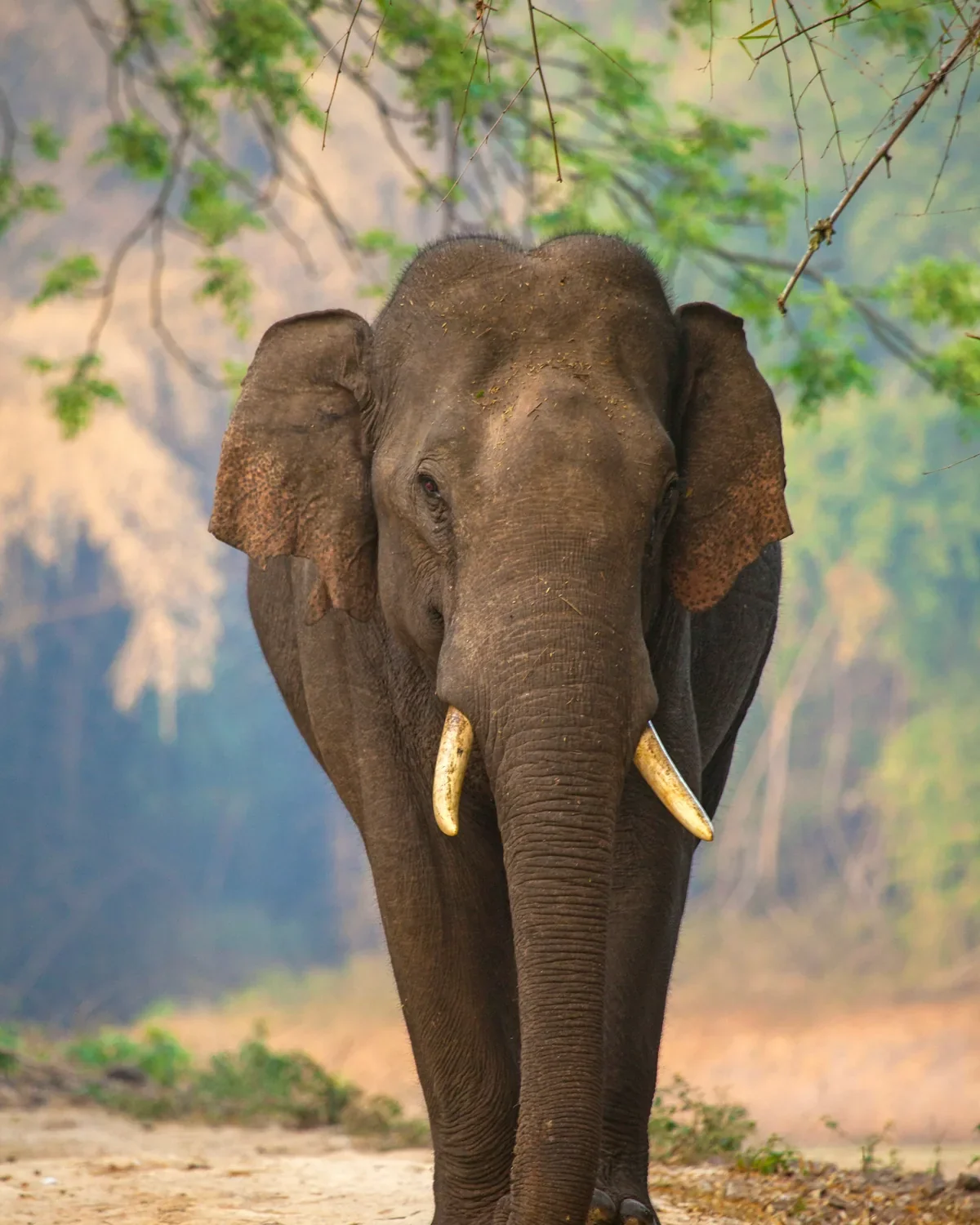
Asian elephant (Elephas maximus) in the wild
The real animal · Elephas maximus Foto: Rohit Varma / Unsplash
Habitat
Tropical forests and grasslands of South and Southeast Asia (India, Sri Lanka, Nepal, Myanmar, Thailand, Malaysia, Sumatra and Borneo, and southern China); the Sumatran branch lives in the lowland forests and the slopes of the Bukit Barisan mountains.
Diet
Herbivorous browser: grasses, bark, roots, fruit and branches of hundreds of plant species; it eats around 150 kg a day and spends sixteen to eighteen hours feeding.
Lifespan
Sixty to seventy years in the wild.
Weight
3,400 to 5,200 kg for adults; shoulder height of 2.6 to 3.2 m.
Adaptation
A boneless trunk moved by some 40,000 muscle bundles and ending in a single prehensile “finger” (the African elephant has two), able to pick up something as small as a coin; smaller, rounder ears than the African elephant.
Record
Its gestation, eighteen to twenty-two months, is the longest of any land mammal; the calf weighs about 100 kg at birth.

Conservation status

Global (IUCN)
Endangered
Where it lives
India holds more than half the total; Sri Lanka has high densities; a few hundred remain in Yunnan, China; the Sumatra and Borneo populations are isolated and in sharp decline from deforestation for oil palm.
Population
From 30,000 to 50,000 individuals in the wild, declining since it was listed as endangered.

Main threats

  1. loss and fragmentation of habitat (agriculture, oil-palm plantations in Sumatra and Borneo, roads and infrastructure)
  2. conflict between herds and people as the forest shrinks
  3. killing of tusked males for their ivory
  4. capture of wild individuals for tourism, logging and ceremonies
No recovery at the species level: it remains endangered, with a major drop over recent generations; there are local successes in easing conflict, not a global reversal.

Did you know…?

01
A single finger on the trunk

The Asian elephant's trunk ends in a single prehensile “finger” — the African has two — with which it can pick up something as small as a coin.

02
Tuskless bulls

Females almost never have tusks, and some males don't either: those tuskless bulls are called makhna.

03
A trunk without a single bone

The trunk has no bone at all: it is moved by some 40,000 muscle bundles, which makes it both powerful and extremely delicate.

04
They speak in infrasound

They communicate with low calls below what we can hear, travelling for kilometres; the biologist Katy Payne was the one who documented them, listening closely to Asian elephants.

05
A living sacred animal

Across much of Asia the elephant is a living religious symbol, from the god Ganesha to the white elephant of royal courts.

06
Mud as sunscreen

They cover themselves in mud and dust as sunscreen and insect repellent, despite a skin more than two centimetres thick.

Frequently asked questions

How does it differ from the African elephant?
The Asian elephant is somewhat smaller, with smaller, rounder ears, a more convex back and a single prehensile “finger” on the trunk (the African has two).
Why do so many have no tusks?
It's natural to the species: females almost never have them and some males don't either (makhna); hunting big-tusked bulls for ivory has made it more common.
How do they communicate?
With low infrasound calls below what we can hear, travelling for kilometres; the biologist Katy Payne documented them by listening to Asian elephants.
Are they still used for work and ceremonies?
Yes: there are elephants in captivity or semi-captivity in Thailand, Myanmar, India and Sri Lanka, for work and ceremonies, with an open debate about their welfare.
§ 08 · Conservation three programs · verified
Asian elephant

Help protect this species.

Every purchase helps, but a direct donation does more. Three NGOs with specific programs verified for this species.

No. 01 / 03

Centre for Conservation and Research.

Centre for Conservation and Research (Sri Lanka)

Sri Lankan organisation devoted to research and conservation of the Asian elephant and to easing the conflict between herds and people.

Donate to Centre for Conservation and Research
No. 02 / 03

Wildlife SOS.

Wildlife SOS

Indian NGO that rescues and rehabilitates elephants and other wild animals that have been exploited or endangered.

Donate to Wildlife SOS
No. 03 / 03

Elephant Family.

Elephant Family (British Asian Trust)

Organisation dedicated to protecting the Asian elephant and its habitat, and the corridors the herds move along.

Donate to Elephant Family
Animal Kinhood · 26 characters

Twenty-six names. Twenty-six stories. Twenty-six personalities. One same project.

Full catalogue · Drop 01 — Q3 2026 Explore Animal Kinhood