Animal Kinhood Wild animals Least Concern
12 min read 9 chapters Live · Numazu
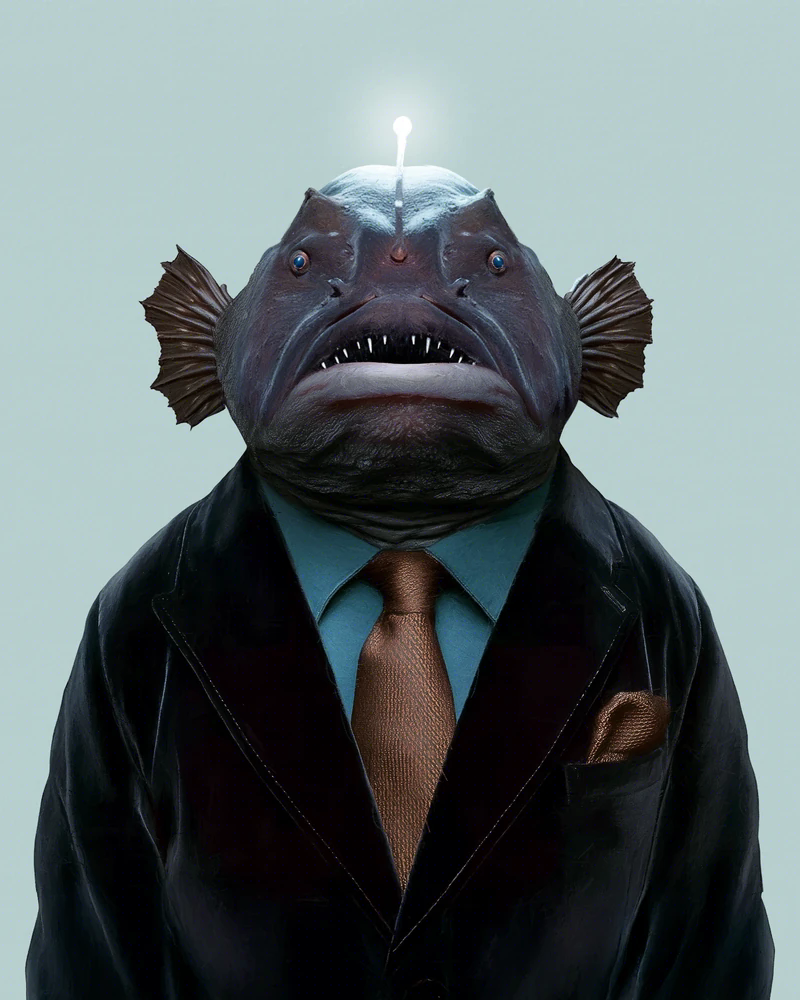
Front-facing portrait of Naoko, an adult female anglerfish with skin so dark it is almost black, a wide mouth with fine teeth showing and small bluish eyes set on either side of her head. Above her head she carries the filament with the lit esca, a point of white light. She wears a black narrow-lapel blazer, a petrol-blue shirt, a copper satin tie and a matching pocket square. Plain grey-green background. AK · 37 N 35°06′ E 138°52′ Naoko Numazu, JP PHOTO ©YP · 2026
Animal Kinhood · Wild animals No. 37 / 36 Episode · Naoko
Melanocetus johnsonii

Naoko.

Black seadevil

The light a place already has is never any good. I always bring my own.
Add it to your Kinhood.Already part of your Kinhood.
Biography · Block 01 of 03 Black seadevil
Chapters · I–II–III

Going aboard with the lamp.

I
CH · 01 / 09

Give me the exact time

Naoko Mochizuki reaches the outer wharf of Numazu harbour at ten past six, briefcase in her left hand and the company car reversed into its space, the way she always parks it. The freighter she has come to survey came in before dawn listing to starboard and has had the pumps running ever since. The owner is waiting at the foot of the gangway and starts telling her what happened before she has set foot on board.

—Give me the exact time —she says.

The owner gives her a round number. She asks him to repeat it with the minutes, writes it down, says the figure under her breath and only then opens the briefcase.

Inside there is a three-metre tape measure, a set of hard pencils, two clear plastic bags, a handful of cable ties and a small desk lamp with a dented shade. The lamp is the first thing she takes out.

She is a marine claims surveyor for the Suruga Shipowners' Mutual and she has been at the same branch office for twenty years. The Numazu deep-sea fishing fleet is half her book; the rest is coastal freighters, tugs and dredgers. She goes aboard when something has gone wrong: a flooded hold, a longline fouled in the propeller, a trawler that touched bottom in the harbour mouth. She goes below, measures, photographs from a hand's width away and writes a report. The report decides whether anyone gets paid.

You can tell the other surveyors at the branch because they take their photographs from the compartment door. Hers are taken right up against the plating, with the lamp set on top of whatever she is measuring, and they stand out at a glance in any file.

II
CH · 02 / 09

A sentence that tells no lies

On her laptop desktop there is a folder called "templates". Inside are a couple of dozen documents with the formats she uses every week: survey reports, letters of appointment, measurement annexes, model demands. And there is one she opens far less often and knows by heart.

It is a four-line formula. It moves a loss from the covered column to the not-covered column without saying a single thing that is false. The piece that does all the work is a subordinate clause: sea conditions not exceptional for the time of year. If the weather that shifted the cargo falls within what that month normally does in that bay, the damage stops being an accident and becomes foreseeable, and foreseeable goes in another box. Every figure in the report is still true. The owner still does not get paid.

She wrote it for the first time at thirty-seven. The file belonged to a small shipowner from Heda, one of those surnames you hear on the west coast of Izu from childhood; her father had repaired that man's father's boiler. Naoko measured, photographed, requested the weather records for the previous three days and reached the conclusion she reached. Nobody asked her for anything. Nobody phoned her. That same afternoon she went back to the branch, copied the paragraph into a blank document, filed it with the rest of the formats and did not mention it to anyone.

She has used it more times since. She does not keep count.

III
CH · 03 / 09

Two clicks

This year there is a file that is turning awkward. A tug with engine damage, a line that parted and a reading of the conditions that can be written up two ways. Both are true. One costs the mutual more.

She has spent three weeks turning over the order of the annexes.

On Thursday she gets to the branch before anyone else, coffee beside the mouse and the blind still down. The lamp sits switched off on the desk, inventory sticker facing up. She opens the templates folder and scrolls down to the document. Two clicks.

Voiceline · the character’s canonical quote Naoko · Black seadevil
Hover to pause
The light a place already has is never any good. I always bring my own. AK · 37 · Naoko · Numazu 2025 The light a place already has is never any good. I always bring my own. Voiceline · Melanocetus johnsonii The light a place already has is never any good. I always bring my own. AK · 37 · Naoko · Numazu 2025 The light a place already has is never any good. I always bring my own. AK · 37 · Naoko · Numazu 2025 The light a place already has is never any good. I always bring my own. Voiceline · Melanocetus johnsonii The light a place already has is never any good. I always bring my own. AK · 37 · Naoko · Numazu 2025
§ 04 · Objects Open editions · everyday
10 pieces · Print on demand

Take Naoko home.

Biography · Block 02 of 03 Roots
Chapters · IV–V–VI

Behind the shopping street.

IV
CH · 04 / 09

Sundays at the repair yard

Her father, Susumu, was a boilermaker at the harbour repair yard until he was sixty-two. On the Sundays he was on call he took her along. She was six the first time.

What she remembers from that day is the lamp. A portable one with a rubber grip that her father hooked onto the scaffolding to see inside a tank and that he put back in the workshop cupboard when he was done. It belonged to the workshop. Nobody took it home and nobody argued about that.

Two things she got from him she still does. One is to rest the back of her hand against a bulkhead before going down into a hold and wait two seconds: if there is water on the other side, your skin knows before your eyes do. The other is never to trust the light a place already has.

Her mother, Kazuko, spent thirty years on the till of a stationery shop on the shopping street and still lives with Susumu in the house behind it. When Naoko turns up unannounced, there is a plate for her. It is sixteen years since she last asked her about her life: she stopped the year Naoko turned thirty and answered "fine" three times running. Naoko noticed four years later, at New Year, eating. She said nothing.

V
CH · 05 / 09

The jacket off the other hanger

At twelve they went to buy the school uniform. She tried on the jacket from the girls' section, took it off, left it folded on the counter and stood looking at the other hanger. She gave no explanations. Her mother took the sleeves up at home and said nothing about the shoulders, which were two sizes too wide.

Three years later she walked into a men's tailor on the shopping street on her own, with her New Year money. The tailor took her measurements without asking who the suit was for. He took the same ones he still takes: not one of them has changed in twenty years, and he writes them down the same way every time in the same oilcloth-covered notebook. Naoko goes for fittings mid-morning on a weekday, when there is nobody in the shop, and leaves with the jacket over her arm in its cover.

Narrow lapel, plain shirt, satin tie. She folds the pocket square herself and always the same way. She is the only one at the branch who dresses like that. On inspections she changes her shoes in the car and goes aboard in the suit.

VI
CH · 06 / 09

The year of copying out

She went to Tokyo at eighteen to study naval architecture. Four years. She brought nobody home at New Year and nobody from Numazu came up to see her, and both things struck her as normal.

She came back at twenty-three and joined the mutual as an assistant. Her first year she did not board a single ship: twelve months copying out other surveyors' reports, correcting their units and assembling photo annexes. The order she uses today she learned there, watching which ones came back and why.

Her first survey on her own came at twenty-six. A sand dredger with a flooded hold, at night, on the outer wharf, with the quay floodlight blown for weeks. Before leaving she took the desk lamp that was on the office shelf, put it in her briefcase and went.

She has not given it back. She has not asked for one of her own either. The inventory sticker is still on the base, with the branch number and the year, and she sees it every time she switches it on.

Biography · Block 03 of 03 Craft
Chapters · VII–VIII–IX

The bay right in front of her.

VII
CH · 07 / 09

The time that did not move

A skipper asked her at thirty-three, in front of two witnesses, to change one time in a report. Half an hour. Just enough for the damage to fall on the other side of the watch handover.

Naoko asked him to repeat the exact time. He repeated it. She wrote it down as she had been given it the first time, closed the notebook and signed the report that same afternoon.

The skipper never spoke to her again. She went on surveying his ships for another eight years, without incident, until he sold the company and retired to Mishima. The same year she signed that report, the mutual widened her signing authority.

They offered her the department from the Tokyo office when she turned forty-one. She asked for a week to think about it. She answered by email on a Tuesday morning, three lines, and carried on going aboard. She did not mention it at her parents' house. At the branch they found out from the new org chart.

VIII
CH · 08 / 09

The New Year box

Her sister Yuka lives in Mishima, two stops down the line, with two kids and a house full of people at all hours. Every New Year she sends her a box with a week's worth of food. Naoko finishes it in one afternoon and thanks her by message the next day. They do not talk on the phone.

She eats once a day, late, and eats enormously. At working lunches she clears the table while everyone else is still on the first course, and if anyone notices she says she has not had time for breakfast. It is true that she has not had time.

They see each other at their parents' house at New Year and at obon. Naoko arrives once they have started, sits wherever there is room and leaves before the fruit comes out.

She gets to her flat at nine or ten and leaves the switch where it is. She drops her keys, takes off her shoes, helps herself to something from the fridge and waits. When it is completely dark outside, she turns on the living-room lamp. The neighbour across the landing sees it from her window and asked her once whether her power was out. She said no.

IX
CH · 09 / 09

She has never gone down to look

Suruga Bay is the deepest in the country. A few kilometres from the harbour mouth, right in front of the branch office, the bottom drops to two thousand five hundred metres. Her people come from down there, where no light reaches.

She has never gone down to look at it. What she knows about her own people she has read: that there is no census, that nobody has ever counted them, that in all recorded history one of them has been seen alive exactly twice, and that the second came up to the surface off Tenerife on a January morning, in front of a camera, and died that same afternoon. She does not talk about it.

In Numazu they know her in two places: the tailor's and the stationery shop where her mother worked. At the branch everyone consults her, nobody sits beside her, and if you ask them why they would not know what to say. To her it seems the ordinary state of things.

On Thursday, mid-morning, she goes aboard the tug with the file still open. She rests the back of her hand on the bulkhead, waits two seconds and switches on the lamp.

> **Cita canónica:** Give me the exact time, she says before she writes anything down, and then she signs the report with a lamp that still has the office inventory sticker on its base.

§ 07 · Species file Melanocetus johnsonii

About the black seadevil.

Classification
  1. Animalia
  2. Chordata
  3. Actinopterygii
  4. Lophiiformes
  5. Melanocetidae
Melanocetus johnsonii
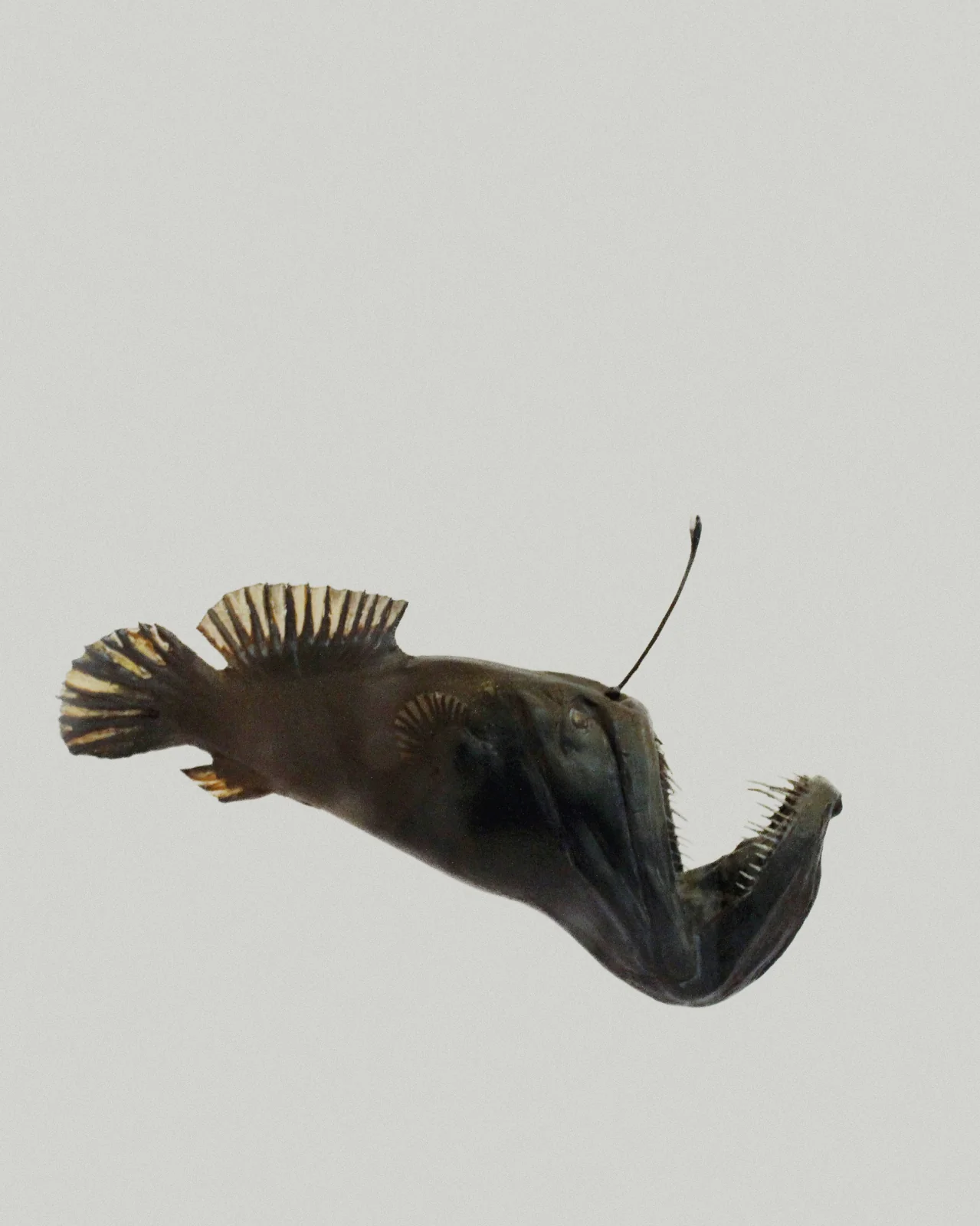
Black seadevil (Melanocetus johnsonii) in the wild
The real animal · Melanocetus johnsonii Foto: Emőke Dénes / Wikimedia Commons (CC BY-SA 4.0)
Habitat
Meso and bathypelagic zone of tropical and temperate seas worldwide, usually between 200 and 1,500 metres deep, with occasional records a good deal deeper. Permanent darkness, cold and high pressure.
Diet
Opportunistic ambush predator. It stays almost motionless waving the luminous esca to draw in prey — fish, crustaceans and small cephalopods — and swallows them whole in a single snap of the jaw. An oversized mouth and an extremely distensible stomach let it take prey larger than its own body, which in a place where a meal can take weeks to come round again is the only strategy that works.
Lifespan
Unknown in the wild: there are no tagging or long-term tracking studies of the living species. In captivity no adult has survived more than a few hours.
Weight
Females reach around 18 cm in total length and weigh on the order of a few hundred grams. Males are dwarfs of barely 2 or 3 centimetres and have neither illicium nor esca: it is the most extreme sexual dimorphism in the family Melanocetidae.
Adaptation
The light of the esca is not produced by the fish: it is generated by symbiotic bacteria of the genus Enterovibrio housed in the terminal bulb of the illicium. The relationship is facultative — the bacteria can live free in sea water — and is acquired horizontally from the environment in each generation, not inherited from the mother.
Record
First video of the living species in its habitat: MBARI's ROV Doc Ricketts, Monterey submarine canyon, 17 November 2014, at around 580 metres. Only record of a live adult at the surface in broad daylight: off Tenerife, on 26 January 2025.

Conservation status

Global (IUCN)
Least Concern
Where it lives
There is no regional assessment for Japan or for Suruga Bay. The bay is the deepest in the country, with seabeds around 2,500 metres very close to shore, and it holds exactly the darkness and cold that define the species' habitat; there is, however, no published and confirmed record of Melanocetus johnsonii caught there, although other ceratioid deep-sea anglerfishes are documented as bycatch in the area.
Population
No reliable figures or census. There is no population estimate study for Melanocetus johnsonii: the least concern category rests on the absence of a directed fishery and on the breadth of its geographic distribution, not on any actual count of individuals.

Main threats

  1. Bycatch in deep-water trawl fisheries, although it is not the target of any commercial fishery.
  2. Deep-sea mining, which could disturb benthic habitats and the adjacent bathypelagic water column where it lives.
  3. Deoxygenation and warming of intermediate ocean layers linked to climate change, which could shift or shrink the oxygen minimum zones the species appears to tolerate well.
  4. The near-total absence of sustained scientific monitoring, which would prevent a real decline from being detected even if it were happening.
There is no recovery programme because there is no measured decline and no known population. What would change the picture is not a rescue action but monitoring: sustained robotic exploration of the deep sea and protection of the seabed from trawling and seabed mining.

Did you know…?

01
A light that is not its own

The black seadevil does not manufacture its own light. A lure hangs over its head housing bioluminescent bacteria captured from sea water, not inherited from its mother. The fish provides the shelter; the bacteria provide the glow that draws prey in the total darkness of the abyss.

02
Rented bacteria, not family ones

A 2020 study in eLife found that deep-sea anglerfishes from entirely different families share nearly identical strains of a bacterium of the genus Enterovibrio, with a heavily reduced genome adapted almost exclusively to life inside the esca. Each generation picks up its bacteria from a shared pool in the ocean rather than inheriting them.

03
A stomach bigger than itself

The female can swallow prey larger than her own body thanks to an oversized mouth, sharp teeth curved inwards that work like the bars of a trap, and a stomach able to stretch to several times its usual volume. Where a meal can take weeks to come round again, eating whatever crosses your path is the only thing that works.

04
It holds on where almost nothing breathes

Its physiology allows it to regulate its aerobic metabolism and tolerate long periods of very low oxygen, common in certain layers of the deep ocean. That keeps it active in an environment that would be lethal for most shallow-water fish.

05
Eighteen centimetres and two and a half

The sexual dimorphism of the family Melanocetidae is among the most extreme known in vertebrates: females reach some 18 centimetres and carry the luminous esca, while males are barely two or three centimetres long, have neither illicium nor esca and have an atrophied digestive tract.

06
Seen alive twice in all of history

Every image that exists of this species alive comes from two episodes: MBARI's ROV footage in Monterey Canyon in 2014, at 580 metres, and the specimen filmed at the surface off Tenerife in January 2025, which died shortly afterwards. More than ten years passed between them without a single confirmed sighting.

Frequently asked questions

Why is it called the black seadevil?
Because of its family. Melanocetidae comes from the Greek melas, black, and ketos, sea monster, and in English the whole family is called black seadevils. The name describes the colour and the look, not the behaviour.
How does it produce the light on its rod?
It does not. The light is generated by bioluminescent bacteria of the genus Enterovibrio living inside the bulb at the tip of the rod. The fish provides the lodging and the bacteria provide the light, and they are not inherited from the mother: each generation picks them up from sea water.
Is it true that the males are tiny?
Yes. It is one of the most extreme cases of sexual dimorphism known in vertebrates: females reach around 18 centimetres and carry the luminous esca, and males are two or three centimetres long, have neither rod nor esca and have an atrophied digestive tract. In the genus Melanocetus the union is temporary, not the permanent fusion seen in other deep-sea anglerfishes.
How deep does it live?
Usually between 200 and 1,500 metres, in the meso and bathypelagic band of temperate and tropical seas worldwide, with occasional records a good deal deeper. It is permanent darkness: no sunlight reaches down there.
How many are left?
Nobody knows. There is no published population estimate for this species. It is listed as least concern, but that category rests on there being no directed fishery and on the breadth of its distribution, not on a count. In practice its demonstrated rarity is better documented than its supposed abundance.
Has it ever been seen alive?
Twice in all recorded history. MBARI's ROV Doc Ricketts filmed one in Monterey Canyon on 17 November 2014, at around 580 metres. And on 26 January 2025 another appeared off Tenerife, at the surface and in broad daylight, filmed for close to an hour; it died shortly afterwards.
§ 08 · Conservation three programs · verified
Black seadevil

Help protect this species.

Every purchase helps, but a direct donation does more. Three NGOs with specific programs verified for this species.

No. 01 / 03

JAMSTEC.

Japan Agency for Marine-Earth Science and Technology

Japan's national agency for ocean and deep-sea research, based in Yokosuka. It operates autonomous vehicles and deep-diving submersibles that explore seabeds such as those off Shizuoka, and produces the scientific basis on which any future management of the Japanese deep sea rests, Suruga Bay included.

Donate to JAMSTEC
No. 02 / 03

DSCC.

Deep Sea Conservation Coalition

International coalition of more than 130 organisations working exclusively on the protection of deep-sea ecosystems. It pushes for a moratorium on seabed mining, presses for protection of seamounts from bottom trawling and takes part in the United Nations review of deep-sea fisheries: exactly the habitat the black seadevil depends on.

Donate to DSCC
No. 03 / 03

MBARI.

Monterey Bay Aquarium Research Institute

Non-profit oceanographic institute founded in California in 1987, responsible for the first video ever recorded of this species alive in its habitat, in Monterey Canyon in 2014. It develops the robotic exploration technology that makes it possible to document bathypelagic creatures like the black seadevil.

Donate to MBARI
Animal Kinhood · 36 characters

Thirty-six names. Thirty-six stories. Thirty-six personalities. One same project.

Full catalogue · Drop 01 — Q3 2026 Explore Animal Kinhood