Animal Kinhood Wild animals Least Concern
12 min read 9 chapters Live · Longyearbyen
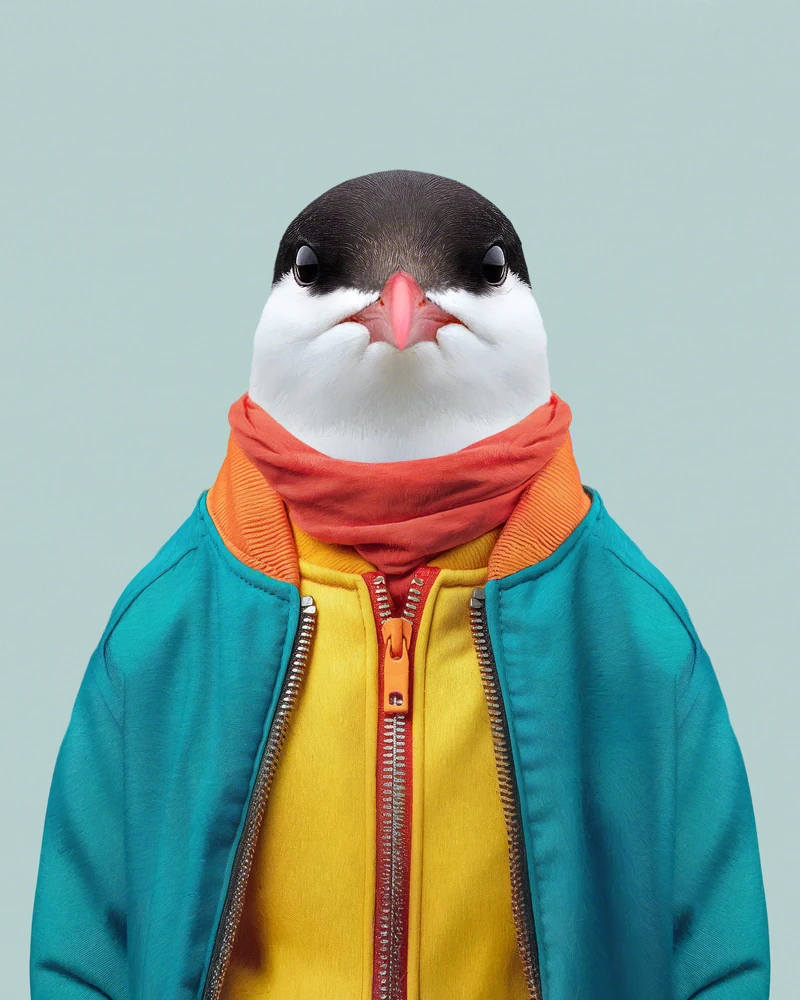
Front-facing portrait of Hakon, an adult male arctic tern with a black cap, white cheeks and a coral-red bill, his dark eyes set on either side of his head. He wears a coral neck gaiter over an orange turtleneck, a yellow zip-up sweatshirt and a teal bomber jacket. Plain gray-green background. AK · 36 N 78°13′ E 15°39′ Hakon Longyearbyen, NO PHOTO ©YP · 2026
Animal Kinhood · Wild animals No. 36 / 36 Episode · Hakon
Sterna paradisaea

Hakon.

Arctic tern

In August the wood moves more.
Add it to your Kinhood.Already part of your Kinhood.
Biography · Block 01 of 03 Arctic tern
Chapters · I–II–III

The Three Rows on the Hillside.

I
CH · 01 / 09

Two Knocks and He Listens

The houses in Longyearbyen do not rest on the ground. They stand on piles driven into terrain that freezes and thaws and that, when it takes to moving, carries the house along with it. The pipes run above ground, boxed into wooden casings, because burying them isn't an option either. Hakon Bendiksen walks into one of those houses, stands in the entryway and raps his knuckles twice on the wall. Then he waits a second, listening, before he touches anything.

He does it in houses he isn't there to fix, too. In his mother's he does it in the same spot, beside the back door frame, and nobody remarks on it anymore.

He's a carpenter. He shores up, he shims and he relevels, and in town that means that when a corner starts to drop they call him before they call anyone else. He works the three rows of houses on the hillside and two sheds down at the dock, and every so often he gets landed with a pipe casing whose lid the ice has burst open.

A job of his is always the same job. Open up underneath, clear it out, get the jack in next to the pile, lift a little and slowly, shim, lower the jack, measure. If the number doesn't add up, pull the shim, cut another one and do it again. The part that takes the longest is dragging himself around under there on plastic sheeting with a flashlight in his mouth, and that part he doesn't mention.

II
CH · 02 / 09

A Millimeter and a Half

He keeps a notebook with two columns per house: the spring measurement and the fall one. Twenty-odd houses, twice a year, since he was eighteen. He takes the spring one before the ground starts to let go; the fall one once he's done what he set out to do. When somebody asks him how much a house has moved, he says the number before he says whether it's bad.

A millimeter and a half is his unit for anything small. A millimeter and a half of lean, a millimeter and a half of play in a door frame, a millimeter and a half of whatever it is he barely cares about and cares about a little. "It's nothing," he says, "but it's a millimeter and a half every year."

If a house comes out at two millimeters all at once in the fall, he puts it at the top of the list and keeps it back for the end of winter, when the ground is hard and everything can be worked without shifting underneath. He decides that himself and doesn't ask anyone.

The other thing he does before measuring is point with his finger. He comes out into the street, looks at the front of the house from the other side and points at the corner that's giving. Then he gets out the spirit level and the number proves him right. That's what they call him for, to save themselves a survey, and he brushes it off by saying he's walked that row enough times.

He wants his shims in wood. He keeps a bucket with three thicknesses and the plastic ones off to one side, which he doesn't like, and if they ask him why he can't answer. The jack he borrows from the man at the workshop, and he returns it with diesel in it.

III
CH · 03 / 09

The House in the Bottom Row

There was one that kept going. He shimmed it twice, the second time opening up underneath and working on his back, and in the next fall's measurement the number had grown again. A pile had gone off axis and that was no longer a matter of shims. They had to empty it out.

That house's measurements are in the notebook like all the others, with the two columns down to the end and a line drawn underneath. He doesn't open that page again. When he's looking for another one, he thumbs past it without looking at it, and that's all he does with it.

The vinyl came loose off the van's passenger seat a long time ago and he has it patched with electrical tape that catches his pant leg on the way out. He never cleans the back window; he backs up on the mirrors.

Voiceline · the character’s canonical quote Hakon · Arctic tern
Hover to pause
In August the wood moves more. AK · 36 · Hakon · Longyearbyen 2025 In August the wood moves more. Voiceline · Sterna paradisaea In August the wood moves more. AK · 36 · Hakon · Longyearbyen 2025 In August the wood moves more. AK · 36 · Hakon · Longyearbyen 2025 In August the wood moves more. Voiceline · Sterna paradisaea In August the wood moves more. AK · 36 · Hakon · Longyearbyen 2025
§ 04 · Objects Open editions · everyday
10 pieces · Print on demand

Take Hakon home.

Biography · Block 02 of 03 Roots
Chapters · IV–V–VI

The Month When the Wood Moves.

IV
CH · 04 / 09

The Last Boat

His people reach the coast in May and leave in August. That isn't a turn of phrase: between September and April there is nobody of his own on the coast, and his people's houses are shut.

They arrive with nothing to spare. They swallow the journey whole and land here with nothing in reserve, so the season depends on the small fish having come up already by the time they show up. In the years it hasn't come up, there are no young ones. That's how it's said, plainly, the same way it's said that the cargo came in late this year.

He made the whole trip for the first time at six, stuck close to his own. He doesn't remember the sea from that. He remembers the stop in the middle, weeks of sitting still in water that belonged to no one, and his father telling him that there you eat and you keep quiet.

At nine, on the last boat of August, he turned to look back from the water. The village was already empty, the colored houses shut and nobody on the gravel. Nobody else turned around.

V
CH · 05 / 09

Three Weeks

At seventeen he went to the mainland to get his trade. He came back with a certificate, a toolbox bought on installments and no wish to share a room with anyone.

The following summer they gave him three weeks of work on a house in the top row that was going down at one corner. The village boat left in August and he watched it go from the roof, harness on and one hand on the chimney. That winter was the first he spent here.

That makes six. He has a three-week answer for every one of them and he has never added them up. When they ask him if he isn't leaving, he answers with the job he has that week, and the answer is just as true in January as it is in August.

From his father he got the spirit level and the knuckle on the wall. At twelve his father let him hold the other end of the batten and he went twenty minutes without breathing so as not to move the bubble. When the mine wound down and his father went from going down every day to working only the loading season, at home they talked about changing the back door. They still talk about houses.

VI
CH · 06 / 09

The Van at Four

In August he sleeps three hours. He eats twice as much without noticing, takes on jobs he has no room for and accepts work in the small hours that he charges at the daytime rate. Three weeks like that, every year, and in September, with the first day the light no longer comes all the way back, it drops off him all at once and he sleeps eleven hours straight.

He says that with light at three in the morning nobody can sleep. In June and in July he sleeps the way he always does.

The man at the workshop, the one who lends him the jack, finds his van running out on the gravel at four in the morning. The first time, he said something about it. Now he leans out, asks him if he wants coffee and goes back inside.

In winter it goes out of him. The same clothes, the same town, and at the sports hall somebody tells him he looks rough. He answers that it's the light.

On Thursdays he plays indoor soccer, the only hall in town that smells of anything else. He plays out on the wing and doesn't run. He doesn't stay for the third half.

Biography · Block 03 of 03 Craft
Chapters · VII–VIII–IX

A Batten in the Gravel.

VII
CH · 07 / 09

The Key and the Freezer

His mother works in the canteen at the base during the light season and leaves with the rest. The day before she goes she leaves him the key to her house and the fridge full.

The first two winters she used to ask him if he was coming. Not anymore. This past August she left the key on the table and the only thing she said on her way out was that the freezer was making a noise. He looks at it every year before she goes; it's the gasket, and he tells her so every time.

His sister Marte leaves in August with her two young ones and she's the one who calls. He answers short and asks after the young ones. Aksel, the little one, made the whole trip on his own last year and came back telling all of it to anyone who would listen. Hakon asked him about the stop in the middle, and about nothing else.

There were two Mays in a row with someone who came in with her own people. The third she didn't come back to this stretch of coast and he didn't ask anyone about her. That year he took every job he was offered, and when it comes up he says it was a year with a lot of work.

VIII
CH · 08 / 09

The Tools in the Snow

Behind the workshop there's a strip of gravel where he parks the van. It belongs to no one. It isn't painted, it isn't assigned and it hasn't occurred to anyone to argue about it. At one end there's a wooden batten driven into the ground, with no mark and no number, that he puts back every spring when the snow pulls away.

A new kid left his toolbox open there, with the snow getting in. Hakon took the tools out and set them down in the snow, one by one, without raising his voice and without hurrying. When the kid came back and asked what had happened, Hakon said nothing and let him think the box had fallen over on its own.

He hasn't apologized. When he tells it, he tells the part about the snow inside the box, and whoever hears it agrees with him. The kid hasn't parked there again and they don't speak.

IX
CH · 09 / 09

Next Year's List

He rents a room in the middle row. There's a chair, a table, the bucket of shims by the door and nothing on the walls. He's been there six years and the landlord has offered twice to paint it.

When a house in town is closed for good, whoever empties it leaves the key hanging on the outside of the door frame. Hakon has hung two. Both times he walked back down, which for him is unusual.

Next season's list he has written down before this one is over: four houses he's going to have to open up underneath, two door frames, a pipe casing in the top row. It's in the last pages of the notebook, with the fall measurements still not filled in.

In the inside pocket of his jacket he keeps the first shim he ever cut, at fourteen, out of a formwork board that was lying on the warehouse floor. It came out with the tip too thick and it was never good for anything. He's changed jackets three times.

When he finishes at a house he comes down off the scaffolding, puts his hand on the front wall and says the same thing he always says: that this will hold one more winter, and that the one after that it won't.

§ 07 · Species file Sterna paradisaea

About the arctic tern.

Classification
  1. Animalia
  2. Chordata
  3. AvesBirds
  4. Charadriiformes
  5. Laridae
Sterna paradisaea
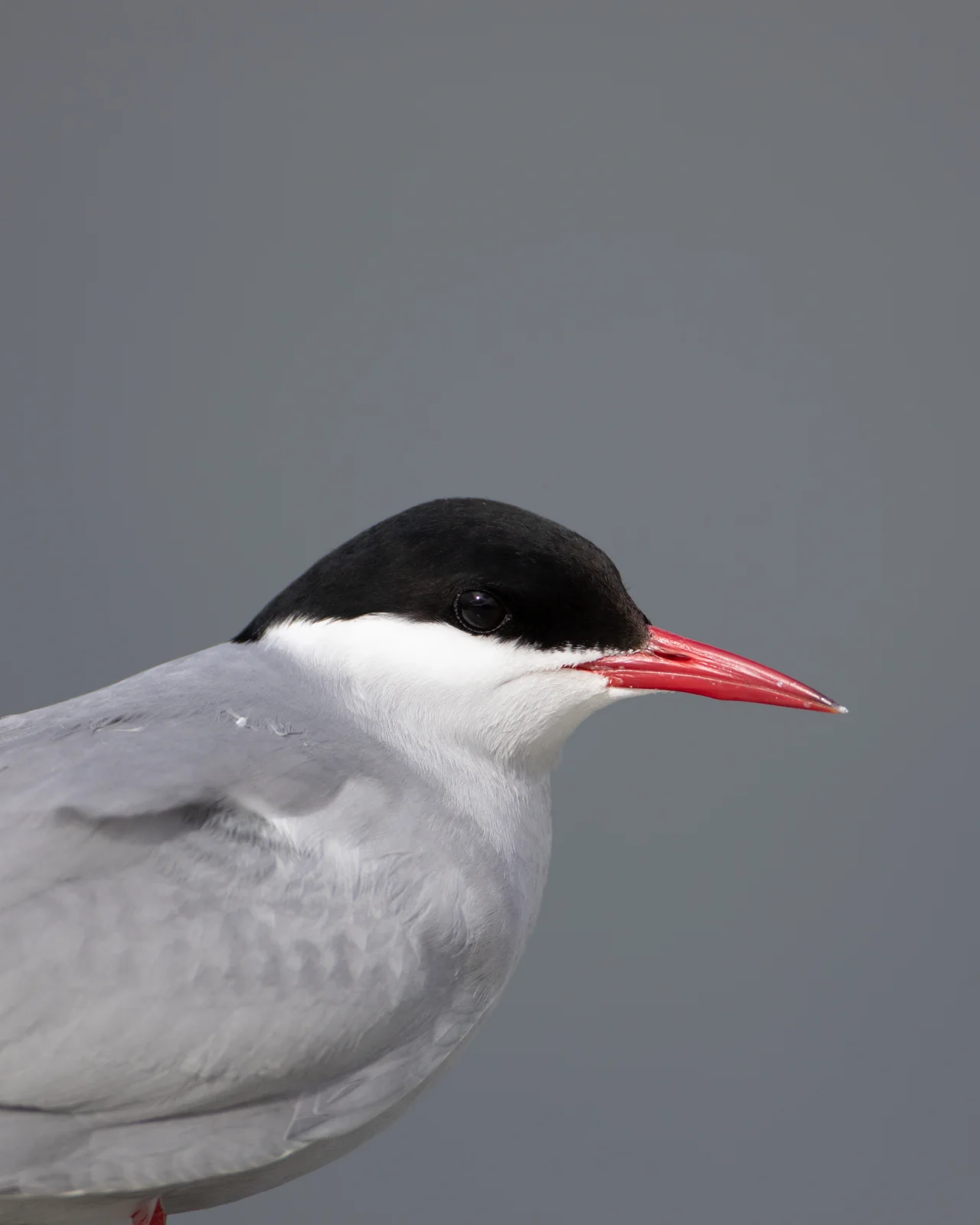
Arctic tern (Sterna paradisaea) in the wild
The real animal · Sterna paradisaea Foto: Peter Pearsall / USFWS (dominio público)
Habitat
Breeds on Arctic and subarctic coasts, islets and coastal tundra — Greenland, Iceland, Svalbard, northern Scandinavia and Russia, the British Isles, the Canadian Arctic and Alaska — on shingle beaches and predator-free islets. Winters in the Southern Ocean, tied to the sea ice and to the most productive waters of the southern hemisphere.
Diet
Small pelagic fish — herring, capelin, sand eel, juvenile cod — plus marine crustaceans and invertebrates, caught by hovering low over the water and then plunge-diving.
Lifespan
Fifteen to thirty years in the wild. The verified ringing record is thirty-one years.
Weight
86 to 127 g, 33-36 cm long, with a wingspan of 76-85 cm and no marked size difference between the sexes.
Adaptation
It breeds in the boreal summer and winters in the austral one, so it strings two summers together and skips both polar nights: it is the vertebrate known to accumulate more daylight per year than any other.
Record
One bird fitted with a geolocator on the Farne Islands covered 96,000 km in ten months, the longest individual migration ever recorded for any electronically tracked animal.

Conservation status

Global (IUCN)
Least Concern
Where it lives
Common along the whole coast of Svalbard, with greater abundance in western and northern Spitsbergen. On mainland Finnmark there is a documented decline seen at one remove through the collapse of the Arctic jaeger colony at Slettnes, which BirdLife International links to the parallel fall of the arctic tern and the black-legged kittiwake through a shortage of forage fish. Iceland remains one of the most important breeding areas in the world, with hundreds of thousands of pairs and breeding failures tied to a scarcity of sand eel.
Population
Secondary sources repeat an order of magnitude of around two million individuals, with the trend described as decreasing. It was not possible to confirm against the original IUCN assessment whether the figure refers to total or mature individuals, or its exact range, because iucnredlist.org blocked automated access.

Main threats

  1. Local collapses of sand eel and capelin in the North Atlantic, with a measured effect on breeding success in Iceland.
  2. Predation by large gulls and by introduced predators — foxes, rats, American mink — on breeding islets that previously had none.
  3. Falling adult survival: on the Icelandic colony of Flatey, five decades of ringing give an annual figure of 0.851 ± 0.034 since 2000 (Polar Biology, 2020).
  4. Loss and disturbance of breeding beaches through coastal development and trampling on accessible colonies.
The global category rests on the total size of the population and the breadth of its range, not on an absence of problems. What is being watched closely is the availability of small fish in the North Atlantic and the clearing of introduced predators from breeding islets.

Did you know…?

01
The route is not a line

The first geolocator study of the species (Egevang et al., PNAS, 2010) found that they do not head south in a straight line: they trace a giant S across the Atlantic, riding the prevailing winds, and some go by the African coast while others take the Brazilian one.

02
The still stop in the middle

Before carrying on south they halt for several weeks in the central North Atlantic to fatten up. It is not a technical layover: it is the stretch of the journey that decides the rest of it.

03
Forty days back

The return leg from Antarctica to southern Greenland averaged 24,270 km in 40 days in the 2010 study, with individual birds between 20,070 and 27,790 km.

04
It lives by dodging the night

It breeds in the Arctic summer and spends the rest of the year in the Antarctic one, so it strings two summers together and skips both polar nights. No other known vertebrate accumulates more daylight per year.

05
A hundred grams that draw blood

It weighs between 86 and 127 grams and dive-bombs any intruder that comes near its hollow, however much bigger. It is so effective that other birds nest close to its colonies on purpose, to borrow the defense.

06
The bill changes color

In the breeding season the bill is blood red from base to tip, with no black point: that is what separates it from the common tern. Out of season, bill and legs darken.

Frequently asked questions

How far does an arctic tern fly in a year?
It depends on the population and the route. The 2010 geolocator study describes annual distances of more than 80,000 km for some individuals, with a typical figure of around 70,900 km a year for birds from Greenland and Iceland. The individual record, from another population, is 96,000 km in ten months.
Why doesn't it fly in a straight line?
Because not doing so is cheaper. The S-shaped route across the Atlantic rides the prevailing winds, and the straight-line distance between breeding and wintering grounds — on the order of 19,000 to 20,000 km — falls well short of what it actually covers.
How do you tell it from the common tern?
By the bill: the arctic tern's is blood red all the way, and the common tern's has a clearly black tip. The arctic tern also has shorter legs, a grayer and more uniform belly, and a tail that extends past the wing tip when perched.
Where does it breed in Europe?
In Iceland, one of the most important breeding areas in the world, and along the coasts of Svalbard, northern Scandinavia, Russia and the British Isles. In Svalbard it is common all along the coast, with greater abundance in the west and north of Spitsbergen.
Is it threatened?
Globally it is listed as of least concern, but with a decreasing trend. The category rests on the size and breadth of the population rather than on an absence of problems: there are regional declines tied to a shortage of small fish, and a documented fall in adult survival in Iceland since 2000.
How long does it live?
Fifteen to thirty years in the wild, and the verified ringing record is thirty-one years. That is a great deal for a bird of a hundred grams.
§ 08 · Conservation three programs · verified
Arctic tern

Help protect this species.

Every purchase helps, but a direct donation does more. Three NGOs with specific programs verified for this species.

No. 01 / 03

Fuglavernd.

Fuglavernd · BirdLife Iceland

Icelandic bird protection organization and a BirdLife International partner. It works on the coastal habitats and wetlands where the kría — the Icelandic name for the arctic tern — breeds alongside other seabirds.

Donate to Fuglavernd
No. 02 / 03

BirdLife Norge.

BirdLife Norge (formerly Norsk Ornitologisk Forening)

Norwegian bird conservation organization and a BirdLife International partner, running monitoring programs for coastal species across Norway, including the Arctic coast where the tern breeds.

Donate to BirdLife Norge
No. 03 / 03

BirdLife International.

BirdLife International

Global network of national bird conservation organizations. It maintains the species assessment and has publicly documented the decline of seabird colonies in Finnmark tied to the arctic tern and the black-legged kittiwake.

Donate to BirdLife International
Animal Kinhood · 36 characters

Thirty-six names. Thirty-six stories. Thirty-six personalities. One same project.

Full catalogue · Drop 01 — Q3 2026 Explore Animal Kinhood