Animal Kinhood Wild animals Least Concern
12 min read 9 chapters Live · Duluth
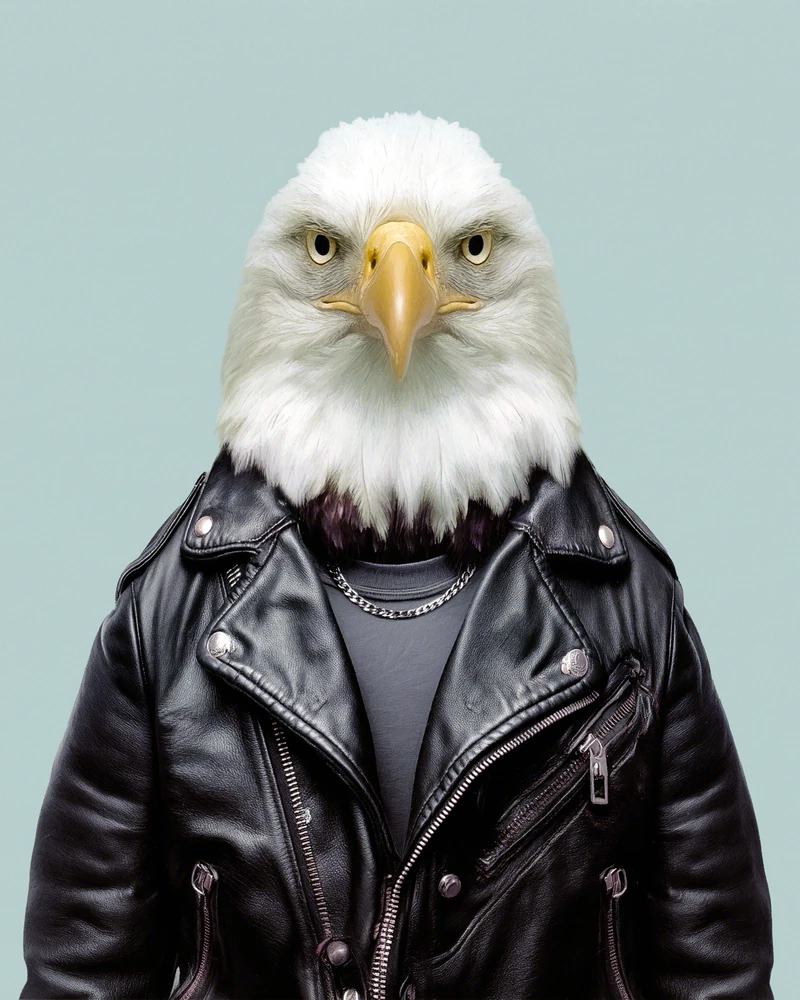
Realistic front-facing portrait of an adult bald eagle, with a head and neck of white feathers, a bright yellow hooked beak and yellow eyes with a fixed stare, wearing a black leather biker jacket over a gray T-shirt and a silver chain around its neck, against a plain gray-green background. This is John, a character from Yago Partal's Animal Kinhood series. AK · 02 N 46°47′ W 92°06′ John Duluth, MN PHOTO ©YP · 2026
Animal Kinhood · Wild animals No. 02 / 25 Episode · John
Haliaeetus leucocephalus

John.

Bald eagle

I don't shout, I tune. I give half the city a voice and keep my own on the workbench, in a guitar I've spent years not finishing. Someday I'll play it for Carol.
Add it to your Kinhood.Already part of your Kinhood.
Biography · Block 01 of 03 Bald eagle
Chapters · I–II–III

The one whose voice won't come out.

I
CH · 01 / 09

It's not dead, it's just out of tune

John's workshop is in Lincoln Park, in a place with windows facing Duluth harbor, where the cold off Lake Superior slips under the door for a good part of the year. There's no display window, no flashy sign; people find it by ear, because somebody told somebody that inside they leave guitars talking again.

A kid comes in with a secondhand electric, warped, a worn-down fret and dead strings. He's written it off before he even sets it on the bench. John turns it over slowly, with those big taloned hands that frighten and tune in equal measure, holds the neck up to the light and snorts through his nose.

"It's not dead, man," he says, without raising his voice. "It's just out of tune with life, that's all. Give me a week."

It's the longest thing he'll say all morning. He has the white head, the black leather jacket and the chain of a man you don't argue with; and a way of handling wood, like someone taking a pulse, that gives the lie to the whole look.

II
CH · 02 / 09

The voice that stayed inside him

As a boy, one day he had to read aloud in class. He opened his mouth expecting something to match his size, and out came what really comes out: a thin, high, halting voice that doesn't suit him in the slightest. The class laughed. It wasn't a tragedy, it was a small, precise embarrassment, and that morning John closed his mouth in public and never quite opened it all the way again.

That same winter he found a broken guitar in the garage. He spent weeks straightening it out, and when it finally made a sound he understood something without putting words to it: he could make other things sing, even if his own voice wouldn't. He learned it at thirteen and it has never left him. He still keeps that first guitar hanging from a nail in the workshop, with the strings he put on it back then, and he wouldn't sell it for anything in the world.

That's why he builds. Every guitar that leaves his bench is a sentence he couldn't say, said by someone else, louder and clearer. He wouldn't put it that way even drunk; he'd say he's a handy guy with a good ear. But that's what it is: the one who can't sing, tunes.

III
CH · 03 / 09

First he climbs up and looks

There's a loft in the workshop, four boards and a chair, that John climbs up to before making any decision. He stays there a good while, still, looking down at the bench from above as if the problem would solve itself just from seeing the whole of it. When Carol comes looking for him, she looks up first. She knows he'll be there.

As a teenager he'd climb the ridge that overlooks the city, the one that looks down on the lake from up high, and sit watching the ships come and go from the harbor for a full hour before coming down to anything. He learned young that decisions come easier from above, and he hasn't changed his method.

He also has an uncanny eye. He holds a maple board up to the light and sees the guitar inside it: where to cut, where the knot is that would ruin it. He can spot a fret a tenth of a millimeter too high from the far end of the workshop. He doesn't think of it as a gift. He'd say, if anything, "I've got a good eye," and go back to his work. It's a hunter's eye, set to hunt in the grain.

Voiceline · the character’s canonical quote John · Bald eagle
Hover to pause
I don't shout, I tune. I give half the city a voice and keep my own on the workbench, in a guitar I've spent years not finishing. Someday I'll play it for Carol. AK · 02 · John · Duluth 2025 I don't shout, I tune. I give half the city a voice and keep my own on the workbench, in a guitar I've spent years not finishing. Someday I'll play it for Carol. Voiceline · Haliaeetus leucocephalus I don't shout, I tune. I give half the city a voice and keep my own on the workbench, in a guitar I've spent years not finishing. Someday I'll play it for Carol. AK · 02 · John · Duluth 2025 I don't shout, I tune. I give half the city a voice and keep my own on the workbench, in a guitar I've spent years not finishing. Someday I'll play it for Carol. AK · 02 · John · Duluth 2025 I don't shout, I tune. I give half the city a voice and keep my own on the workbench, in a guitar I've spent years not finishing. Someday I'll play it for Carol. Voiceline · Haliaeetus leucocephalus I don't shout, I tune. I give half the city a voice and keep my own on the workbench, in a guitar I've spent years not finishing. Someday I'll play it for Carol. AK · 02 · John · Duluth 2025
§ 04 · Objects Open editions · everyday
10 pieces · Print on demand

Take John home.

Biography · Block 02 of 03 Roots
Chapters · IV–V–VI

From the first new batch.

IV
CH · 04 / 09

The springs without voices

His father, Gene, loaded ore on the docks until his knees gave out, and he still tells it, offhand, the thing about the empty years. There was a time, when he was young, when almost no one was born. The eggs came to nothing, the broods were lost to whatever was poisoning the shells, and there were whole springs when not one new voice was heard on the entire lake. So few families were left that they all fit on a single dock.

When the cold clamps down and the lake freezes over, his people still gather in the open water of the estuary, shoulder to shoulder in the few spots that haven't iced up. Gene used to take him as a boy to those winter gatherings and point out, one by one, who had come back that year. That's how John learned to count, by looking: those who are here and those who are missing.

And then, little by little, the people came back. Chicks started hatching again, and in a single generation they went from being counted by families to being counted by the thousands. John is one of that first new batch. "You were one of the first ones again," Gene told him once, without ceremony, and it wasn't until much later that John understood the weight of what he was being handed.

That's why he throws nothing away. He fixes what others discard, keeps old screws and strings, finds an owner for whatever's left over. He doesn't call it a principle. It's just that he knows, in some quiet place, that being here was never guaranteed.

V
CH · 05 / 09

Always returning to the same place

He met Carol young and there was no need to look any further. Among his people, pairs are for life and return each season to the same place, and the two of them have spent twenty-four years coming back to the same house in Lincoln Park. She starts her night shift at the hospital as he's leaving the workshop; they cross paths in the kitchen for ten minutes, in the gray light off the lake, and he leaves the coffee made at dawn before he goes.

Carol is the only person in front of whom his thin voice stopped embarrassing him, though it took him years to sing softly just once, with his back turned, thinking no one was there. She heard him and said nothing, not then and not later. She put her hand on the back of his neck, and that was all. That's her way of saying the big things: without saying them. Through the long winters, when she strings night shifts together, they see little of each other and talk even less; so he leaves her notes in the coffee tin, a word or two, and she answers underneath with another. They've spent years writing each other their life on jar lids.

They raised Cole and Marla together, in turns, with no divvying up of whose job was what. Those were the best, noisiest years of the house, and John, who says little, remembers every one of them.

VI
CH · 06 / 09

The nest when the kids fly off

The kids flew off. Cole went to the Twin Cities to play the dive bars, partly on the strength of the guitars that came off his father's bench; Marla went further still. The house turned big all at once, and the nest, empty.

John didn't pack it in. He did the opposite: he kept adding things to the workshop, a new shelf, a press, one more shaving to the pile; and to his own guitar, the one he never finishes, another part. It's an old instinct, this urge to keep enlarging the nest even when there's no one left to put inside it, and he obeys it without naming it.

Carol notices and says nothing. She pours him the good beer on the nights he comes home from the workshop quieter than usual, which are the nights he's been thinking about the kids without calling them, because he doesn't want to crowd them. On Sundays he does call Cole, briefly: whether the venue sounds good, to take care of that hand, since it's the one that feeds him. And he hangs up before he goes soft.

Biography · Block 03 of 03 Craft
Chapters · VII–VIII–IX

Giving voice.

VII
CH · 07 / 09

The guitar in the clamps

On the bench, held in clamps for years now, there's a guitar John is building for himself. His own. The one that would finally sound the way he'd want to sound. He gives it the best of every leftover piece of wood, works it over, adjusts it and sets it back in the clamps. It's always missing the same thing. He never finishes it.

He carved the neck years ago; the body he's hollowed out and filled back in more than once, chasing a tone he couldn't describe. He swaps the pickups now and then, tries a new wood on the bridge, leaves it. It's the only one he doesn't hand over, and the only one he won't play at volume in front of anyone. When he tests a guitar that's about to leave, if there's someone in the workshop, he won't turn the amp up past two notches; he opens them up for real only once he's closed the door and he's alone. No one knows how his guitars sound until someone else carries one away.

Carol told him once, "play it for me when it's ready," and he answered "when it's ready" and kept sanding. They both know that "when it's ready" never comes, and neither of them brings it up. Keeping the guitar of his own voice unfinished is his way of not having to give it away entirely, and at the same time of not letting go of it.

VIII
CH · 08 / 09

His voice in other hands

One night he went to a downtown dive bar to watch a kid play, one he'd built the guitar for. He stood at the back, with a beer he never got around to drinking. The kid opened the first song and out of the speakers came, whole and huge, the voice John has never been able to give: his own, made with his hands, sounding through another mouth across the whole room.

He said nothing. He stood very still, watching from the back the way he watches from the loft, and inside he was closer to singing than he's ever been in his life.

Half the city's music scene plays instruments that came off his bench, and he has no idea of the size of that. For the ones just starting out who can't afford a decent instrument, he does cheap repairs, lets them pay later, leaves them something that sounds. He doesn't call it generosity; to him it's just how things are, almost a tally he keeps without writing it down: every kid with a guitar that sings is one more voice that didn't go unheard.

IX
CH · 09 / 09

Up Highway 61

In summer he takes out the motorcycle. Up Highway 61, the road that hugs the north shore of the lake, Carol behind him and the engine low, and John glides for miles riding the clean wind like someone who won't waste a single drop more than he has to. It's one of the few stretches where the fierce face and the calm inside finally line up. "Out here I really am the one on the poster," he says, and it's the only time he lets himself.

He comes back quiet and content, washes the workshop off his hands, opens the tin box that was his mother's — buttons, mending scraps, old strings kept just in case — and takes out whatever he needs for the next day's work.

He's not a man of grand phrases. If anyone pities his small life, he snorts and shakes his head: he has Carol, he has the bench, he has the motorcycle and a people that came back when it might not have. Everything else, he shares. The guitar on the bench, no; that one stays in the clamps, waiting for a shut-tight night, an amp opened all the way, and a man at last willing to hear himself.

§ 07 · Species file Haliaeetus leucocephalus

About the bald eagle.

Classification
  1. Animalia
  2. Chordata
  3. AvesBirds
  4. Accipitriformes
  5. Accipitridae
Haliaeetus leucocephalus
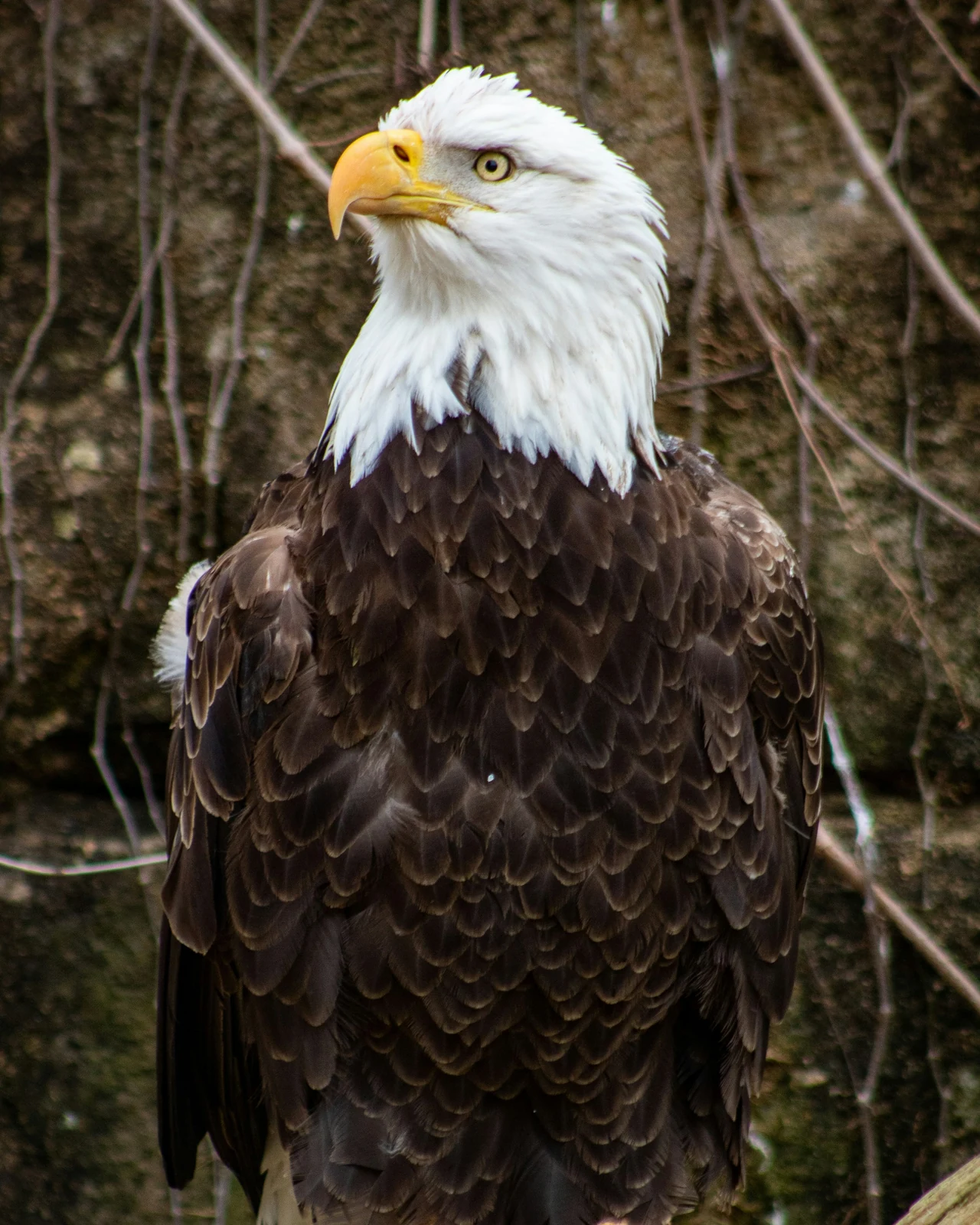
Bald eagle (Haliaeetus leucocephalus) in the wild
The real animal · Haliaeetus leucocephalus Foto: Joshua J. Cotten / Unsplash
Habitat
Coasts, estuaries, large lakes, rivers and reservoirs across North America, from Alaska and Canada down to northern Mexico, always near open water rich in fish and with tall trees to nest in
Diet
Mostly fish snatched from the water's surface, supplemented by prey stolen from other birds (including the osprey), waterfowl, small mammals and carrion in winter
Lifespan
around 20-30 years in the wild, with banded records of more than 30
Weight
3-6.3 kg (females up to 25% larger than males) · wingspan of 1.8 to 2.3 m
Adaptation
A grip far stronger than a human hand's, with rough scales on the soles that keep a slippery fish from escaping, and eyesight four to five times sharper than a human's
Record
It builds the largest nest on record for any bird in the world: a pair in Florida raised one 2.9 m wide, 6 m deep and weighing over 2 tonnes, enlarged year after year

Conservation status

Global (IUCN)
Least Concern
Where it lives
Fully recovered in the continental U.S. after coming to the brink of extirpation in the 1960s (417 pairs in 1963); Alaska and Canada always kept robust populations and never appeared on federal endangered-species lists.
Population
About 316,700 individuals in the U.S. according to the 2020 estimate by the U.S. Fish & Wildlife Service, including some 71,467 breeding pairs in the 48 continental states; adding Alaska and Canada, the total North American population is considerably higher, and rising.

Main threats

  1. Chronic lead poisoning from ammunition and fishing tackle: recent studies find exposure in nearly half of the specimens analyzed, and a fragment the size of a grain of rice can be lethal.
  2. Highly pathogenic avian influenza (H5N1), responsible for deaths and nesting failures documented since 2022.
  3. Collisions and electrocution on power lines and wind farms, and the loss of riverside and coastal habitat to development.
The DDT ban (U.S. 1972, Canada 1973) allowed the rebound; the bald eagle was removed from the Endangered Species Act in 2007 after far exceeding its targets, though it remains protected by the Bald and Golden Eagle Protection Act and the Migratory Bird Treaty Act.

Did you know…?

01
Its cry isn't its own

The sharp, powerful cry you hear in movies whenever a bald eagle appears isn't its own: it's the scream of the red-tailed hawk. Its real voice is thinner and more broken, almost like a hoarse gull, and Hollywood swapped it out because it sounded too unimposing.

02
White head at five years old

Juveniles are entirely brown with irregular white patches, and are often mistaken for golden eagles. The head and tail don't turn white until four or five years old, when the bird matures and begins to breed.

03
The builder of the world's largest nest

The pair builds the largest nest on record for any bird on the planet. The biggest one, in Florida, measured 2.9 meters wide by 6 deep and weighed more than 2 tonnes, reused and enlarged by the same pair.

04
Talons that won't let go and eyes that see everything

Its talons exert a pressure far greater than a human hand's, with rough scales that keep a slippery fish from escaping. Its eyesight, four to five times sharper than ours, spots prey over the water from great height.

05
A national symbol with controversy

It has been the emblem of the United States since 1782, though Benjamin Franklin objected to its habit of stealing food from other birds. Curiously, it wasn't declared the national bird by law until December 2024, more than two centuries later.

06
It almost vanished, and came back

In 1963 only 417 pairs remained in the continental United States, decimated by the pesticide DDT, which thinned the shells of their eggs. After DDT was banned, it recovered to more than 71,000 pairs and came off the endangered-species list in 2007.

Frequently asked questions

Why is it called 'bald eagle' if it has feathers on its head?
The name comes from Old English, where 'bald' meant 'white' or 'white-patched,' not 'hairless.' It refers to the contrast of its white head against the dark body, not to actual baldness.
Is the cry you hear in the movies really its own?
No. That sharp scream belongs to the red-tailed hawk; the bald eagle's real voice is thinner and more broken, so Hollywood studios replace it for sounding too unimposing.
Is it in danger of extinction?
Not anymore. After almost disappearing from the continental U.S. because of DDT (417 pairs in 1963), it recovered to more than 71,000 pairs and came off the endangered-species list in 2007; the IUCN classifies it as least concern, and increasing.
Where does John live?
In Lincoln Park, a neighborhood of Duluth, Minnesota, on the shore of Lake Superior. He is an electric-guitar luthier and climbs the ridge above the city to look at the harbor from on high.
§ 08 · Conservation three programs · verified
Bald eagle

Help protect this species.

Every purchase helps, but a direct donation does more. Three NGOs with specific programs verified for this species.

No. 01 / 03

AEF.

American Eagle Foundation

A Tennessee-based organization dedicated to the rehabilitation, breeding and release of injured bald and golden eagles; its program has returned more than 180 chicks to the wild to reinforce the species' recovery.

Donate to AEF
No. 02 / 03

NEC.

National Eagle Center

An education and conservation center in Wabasha, Minnesota, on the banks of the Mississippi River, devoted entirely to observing and defending the wild bald eagle; it houses non-releasable ambassador eagles.

Donate to NEC
No. 03 / 03

TPF.

The Peregrine Fund

A global organization specializing in birds of prey, based in Boise, Idaho, that researches and fights threats shared by the bald eagle, such as lead poisoning and habitat loss.

Donate to TPF
Animal Kinhood · 25 characters

Twenty-five names. Twenty-five stories. Twenty-five personalities. One same project.

Full catalogue · Drop 01 — Q3 2026 Explore Animal Kinhood